Planet Formation in Walter Russell’s Cosmology
How did Walter Russell think planets formed? Explore his account of planets discharged by the Sun and compare it with the solar nebula model.
In this article
The life of a planet in Russell’s account
Walter Russell imagines a planet forming in the Sun and being discharged outward. He compares its changing size, orientation and motion to youth, maturity and decline. The analogy ties a planet’s formation to the cycle he assigns to all matter. [3][4][5][6]
The Universal One by Walter Russell
In The Universal One, Walter Russell treats planets as products formed by a parent sun. His early-life diagram places a young planet near the parent’s equatorial plane and marks paths for Mercury and Jupiter. It shows how position and orientation are supposed to change together. [7][3][4][5]
A second plate shows stages from youth to age. Russell gives concentration the work of early growth and assigns decline to radiation. His chapter on revolution keeps the planet within a system of motion shared with its parent. [5][6][8][9][10]
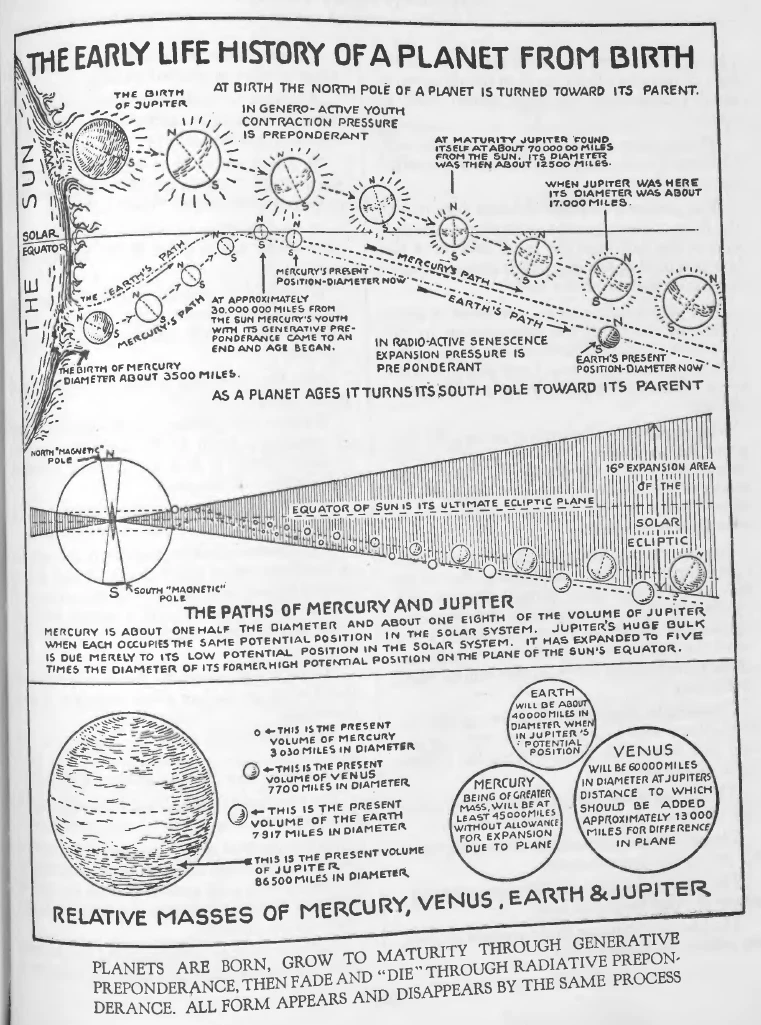
Russell draws paths from a parent sun to a planet. The plate shows how its position and orientation are supposed to change early in its life.
Walter Russell, The Early Life History of a Planet from Birth. Brieger Press, New York, copyright 1926, Library of Congress LCCN 27004508. Library of Congress, public domain. · Image source ↗ · Public Domain
See references (8)
- The Universal One, printed p. 187, Reader page 186
- The Universal One, printed p. 272, Reader page 271
- The Universal One, printed p. 273, Reader page 272
- The Universal One, printed p. 275, Reader page 274
- The Universal One, printed p. 186, Reader page 185
- The Universal One, printed p. 278, Reader page 277
- The Universal One, printed p. 280, Reader page 279
- The Universal One, printed p. 281, Reader page 280
Formation from a disk
NASA describes the Sun forming near the centre of a disk of gas and dust while planets assemble from material farther out. Meteorites and samples returned by missions help researchers examine the early material. Russell’s explanation begins with planets formed by their parent sun. [3][5][10][2]
In the library
The Universal One
Reading note
The separately titled account draws on exact passages in the consulted Library edition.
Sources
See references (10)
- The Early Life History of a Planet from Birth ↗Walter Russell, The Early Life History of a Planet from Birth. Brieger Press, New York, copyright 1926, Library of Congress LCCN 27004508. Library of Congress, public domain.
- NASA Science, Planetary Systems ↗NASA Science, Planetary Systems, formation and evidence.
- The Universal One, printed p. 187, Reader page 186Walter Russell, The Universal One, edited by Louise Russell, University of Science and Philosophy, Limited Edition De Luxe. Lumitheca Library edition IMJ-0605-E001.Read this page in The Universal One ↗
- The Universal One, printed p. 272, Reader page 271Walter Russell, The Universal One, edited by Louise Russell, University of Science and Philosophy, Limited Edition De Luxe. Lumitheca Library edition IMJ-0605-E001.Read this page in The Universal One ↗
- The Universal One, printed p. 273, Reader page 272Walter Russell, The Universal One, edited by Louise Russell, University of Science and Philosophy, Limited Edition De Luxe. Lumitheca Library edition IMJ-0605-E001.Read this page in The Universal One ↗
- The Universal One, printed p. 275, Reader page 274Walter Russell, The Universal One, edited by Louise Russell, University of Science and Philosophy, Limited Edition De Luxe. Lumitheca Library edition IMJ-0605-E001.Read this page in The Universal One ↗
- The Universal One, printed p. 186, Reader page 185Walter Russell, The Universal One, edited by Louise Russell, University of Science and Philosophy, Limited Edition De Luxe. Lumitheca Library edition IMJ-0605-E001.Read this page in The Universal One ↗
- The Universal One, printed p. 278, Reader page 277Walter Russell, The Universal One, edited by Louise Russell, University of Science and Philosophy, Limited Edition De Luxe. Lumitheca Library edition IMJ-0605-E001.Read this page in The Universal One ↗
- The Universal One, printed p. 280, Reader page 279Walter Russell, The Universal One, edited by Louise Russell, University of Science and Philosophy, Limited Edition De Luxe. Lumitheca Library edition IMJ-0605-E001.Read this page in The Universal One ↗
- The Universal One, printed p. 281, Reader page 280Walter Russell, The Universal One, edited by Louise Russell, University of Science and Philosophy, Limited Edition De Luxe. Lumitheca Library edition IMJ-0605-E001.Read this page in The Universal One ↗