Pitrs
The Pitṛs are the ancestors addressed as Fathers in Vedic hymns. Read about their offerings, Agni’s role and the company of Yama.
In this article
Who are the Pitṛs?
The Pitṛs, or Fathers, are ancestors honoured in Vedic hymns and Indian epic. Worshippers invite them to receive offerings and ask for their favour. The Fathers can include both remembered relatives and ancestors whose names the living no longer know. [3][4][1][5]
The Fathers in Rigveda 10.15
In Ralph T. H. Griffith’s translation of Rigveda 10.15, the worshipper calls on ancestors from long ago and from the recent past. The hymn invites them to the offerings, places Yama in their company and asks Agni to carry the offerings to them. [1]
The last verses include known and unknown Fathers, those cremated and those who were not. The invitation reaches beyond the dead an individual worshipper could name. [1]
Indian Myth and Legend by Donald A. Mackenzie
In Indian Myth and Legend, Donald A. Mackenzie describes Agni conveying the dead along the path to the Fathers after cremation. The deceased recovers a radiant form and joins the ancestors with Yama. An epic account fills Yama’s hall with forebears, sages, music and abundance. [3][6][4]
Mandapala, in a separate story, fails to gain the reward he expects from austerities. The celestial speakers tell him he has no children. Mackenzie connects his predicament with a son’s duty to perform funeral rites and present offerings. [5][7][8]
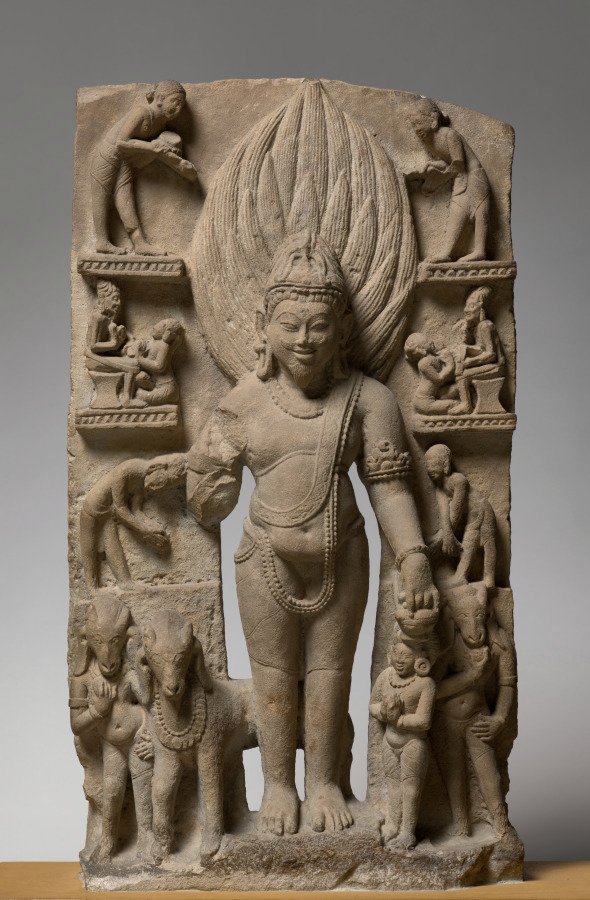
An image of Agni from about 1000, with flames and figures carrying out rites. Rigveda 10.15 asks Agni to bear offerings to the Fathers.
The Cleveland Museum of Art, Edward L. Whittemore Fund, 1955.51. CC0; resized and converted to JPEG. · Image source ↗ · CC0
The dead go to the Fathers, and the Fathers are called near
Mackenzie follows the deceased to the Fathers. The hymn asks the Fathers to come near the living. The Mandapala episode gives descent and funeral duty a personal urgency, while the hymn addresses a community of ancestors wider than any one household. [3][1][5][7]
Read further in the library
Indian Myth and Legend
Reading note
The separately titled account draws on exact passages in the consulted Library edition.
Sources
See references (8)
- Rigveda 10.15, translated by Ralph T. H. Griffith ↗Griffith’s translation of the hymn to the Fathers. See especially verses 2, 4, 8–9 and 12–14.Return to text ↑
- Agni, God of Fire, c. 1000 ↗The Cleveland Museum of Art, Edward L. Whittemore Fund, 1955.51. CC0; resized and converted to JPEG.
- Indian Myth and Legend, Reader page 101Donald A. Mackenzie, Indian Myth and Legend, Gresham Publishing Company Limited, London, undated consulted impression. Library edition IMJ-0649-E001. Persistent PageIDs and current Reader positions verified against the supplied PDF and cached Reader manifest. Embedded translations are Mackenzie’s presentation unless a separately consulted primary text is named.Read this page in Indian Myth and Legend ↗Return to text ↑
- Indian Myth and Legend, Reader page 121Donald A. Mackenzie, Indian Myth and Legend, Gresham Publishing Company Limited, London, undated consulted impression. Library edition IMJ-0649-E001. Persistent PageIDs and current Reader positions verified against the supplied PDF and cached Reader manifest. Embedded translations are Mackenzie’s presentation unless a separately consulted primary text is named.Read this page in Indian Myth and Legend ↗Return to text ↑
- Indian Myth and Legend, Reader page 124Donald A. Mackenzie, Indian Myth and Legend, Gresham Publishing Company Limited, London, undated consulted impression. Library edition IMJ-0649-E001. Persistent PageIDs and current Reader positions verified against the supplied PDF and cached Reader manifest. Embedded translations are Mackenzie’s presentation unless a separately consulted primary text is named.Read this page in Indian Myth and Legend ↗Return to text ↑
- Indian Myth and Legend, Reader page 105Donald A. Mackenzie, Indian Myth and Legend, Gresham Publishing Company Limited, London, undated consulted impression. Library edition IMJ-0649-E001. Persistent PageIDs and current Reader positions verified against the supplied PDF and cached Reader manifest. Embedded translations are Mackenzie’s presentation unless a separately consulted primary text is named.Read this page in Indian Myth and Legend ↗Return to text ↑
- Indian Myth and Legend, Reader page 125Donald A. Mackenzie, Indian Myth and Legend, Gresham Publishing Company Limited, London, undated consulted impression. Library edition IMJ-0649-E001. Persistent PageIDs and current Reader positions verified against the supplied PDF and cached Reader manifest. Embedded translations are Mackenzie’s presentation unless a separately consulted primary text is named.Read this page in Indian Myth and Legend ↗Return to text ↑
- Indian Myth and Legend, Reader page 173Donald A. Mackenzie, Indian Myth and Legend, Gresham Publishing Company Limited, London, undated consulted impression. Library edition IMJ-0649-E001. Persistent PageIDs and current Reader positions verified against the supplied PDF and cached Reader manifest. Embedded translations are Mackenzie’s presentation unless a separately consulted primary text is named.Read this page in Indian Myth and Legend ↗Return to text ↑