The Pineal Gland and the Third Eye
Why is the pineal gland associated with the third eye? Compare Descartes’s philosophy, Manly P. Hall’s esoteric account and the gland’s biological function.
In this article
How the gland became associated with the third eye
The pineal gland is a small gland in the brain that makes melatonin. The third eye is an image of inward or spiritual sight. Some modern esoteric writers connect them by making the gland the physical counterpart of an inward faculty. [4][5][6][3]
Passions of the Soul by René Descartes
In The Passions of the Soul, René Descartes singles out a small gland in the middle of the brain. He holds that the soul exercises its functions most directly there and uses the gland to explain the interaction of sensation, thought and bodily motion. [2]
Man the Grand Symbol of the Mysteries by Manly P. Hall
In Man the Grand Symbol of the Mysteries, Manly P. Hall starts with the gland’s place in the brain and surveys older comparisons with light-sensitive structures in animals. He brings those comparisons into contact with religious images of an eye. [4][5][7][8][9]
When Hall turns to Theosophy, he cites Helena P. Blavatsky’s account of a luminous aura around the pineal gland. This is the structure Hall’s account says a clairvoyant would perceive. [6][10][11]
See references (8)
- Man the Grand Symbol of the Mysteries, Reader page 320
- Man the Grand Symbol of the Mysteries, Reader page 321
- Man the Grand Symbol of the Mysteries, printed p. 336, Reader page 328
- Man the Grand Symbol of the Mysteries, printed p. 331, Reader page 323
- Man the Grand Symbol of the Mysteries, printed p. 333, Reader page 325
- Man the Grand Symbol of the Mysteries, printed p. 334, Reader page 326
- Man the Grand Symbol of the Mysteries, printed p. 337, Reader page 329
- Man the Grand Symbol of the Mysteries, printed p. 338, Reader page 330
Three ways to understand the gland
Descartes makes the gland a meeting point for soul and body. Hall draws on a Theosophical theory of clairvoyance. In modern physiology, the pineal gland releases melatonin in a daily rhythm regulated by light and darkness. [6][10][11][2][3]
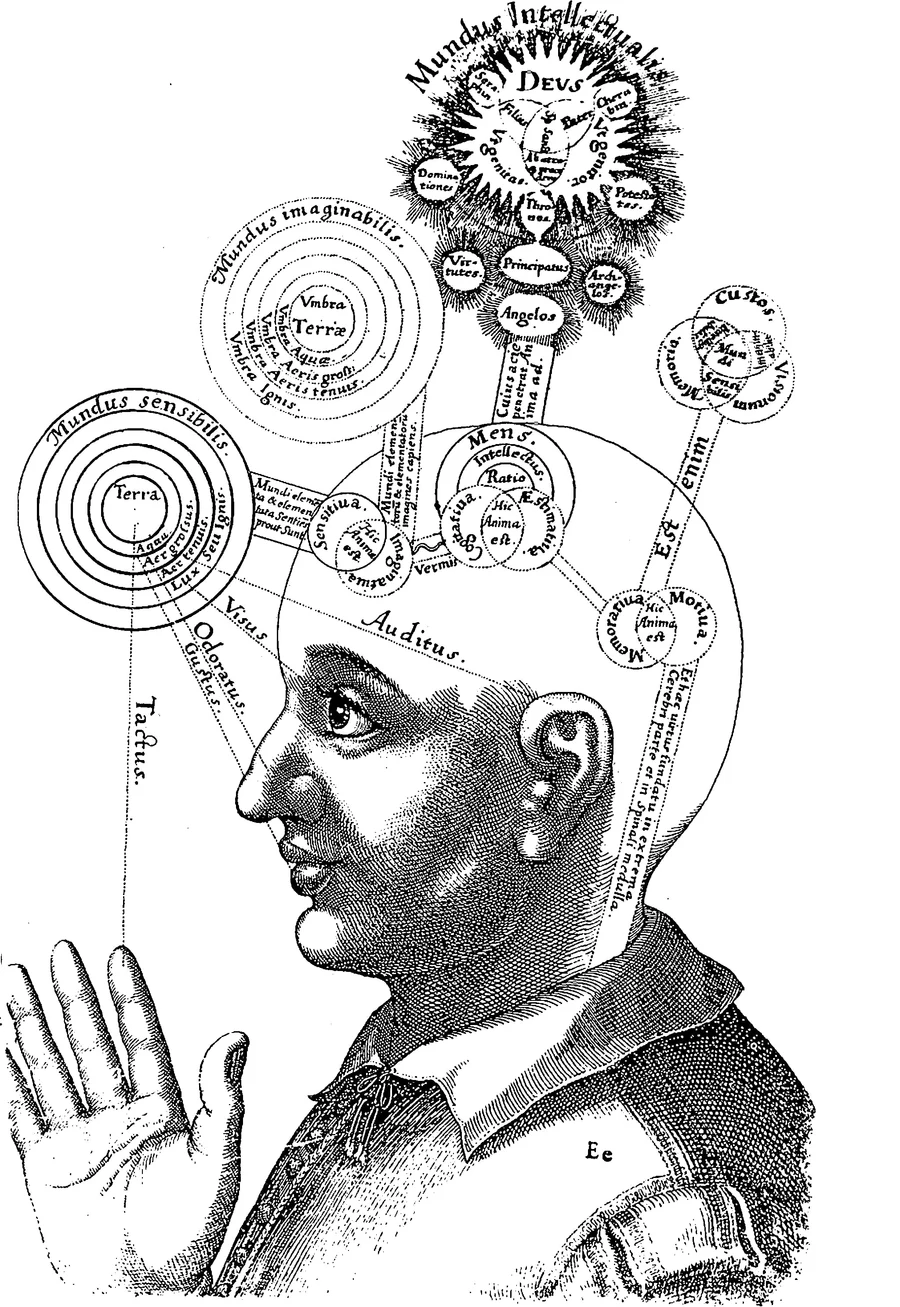
Robert Fludd’s engraving gives mental faculties a place in his map of the head. This earlier diagram offers context for Descartes’s search for a point of contact between soul and body.
Robert Fludd, Utriusque cosmi historia, volume II, 1619. Wikimedia Commons, via Source Library. Public Domain Mark. · Image source ↗ · Public Domain
See references (5)
In the library
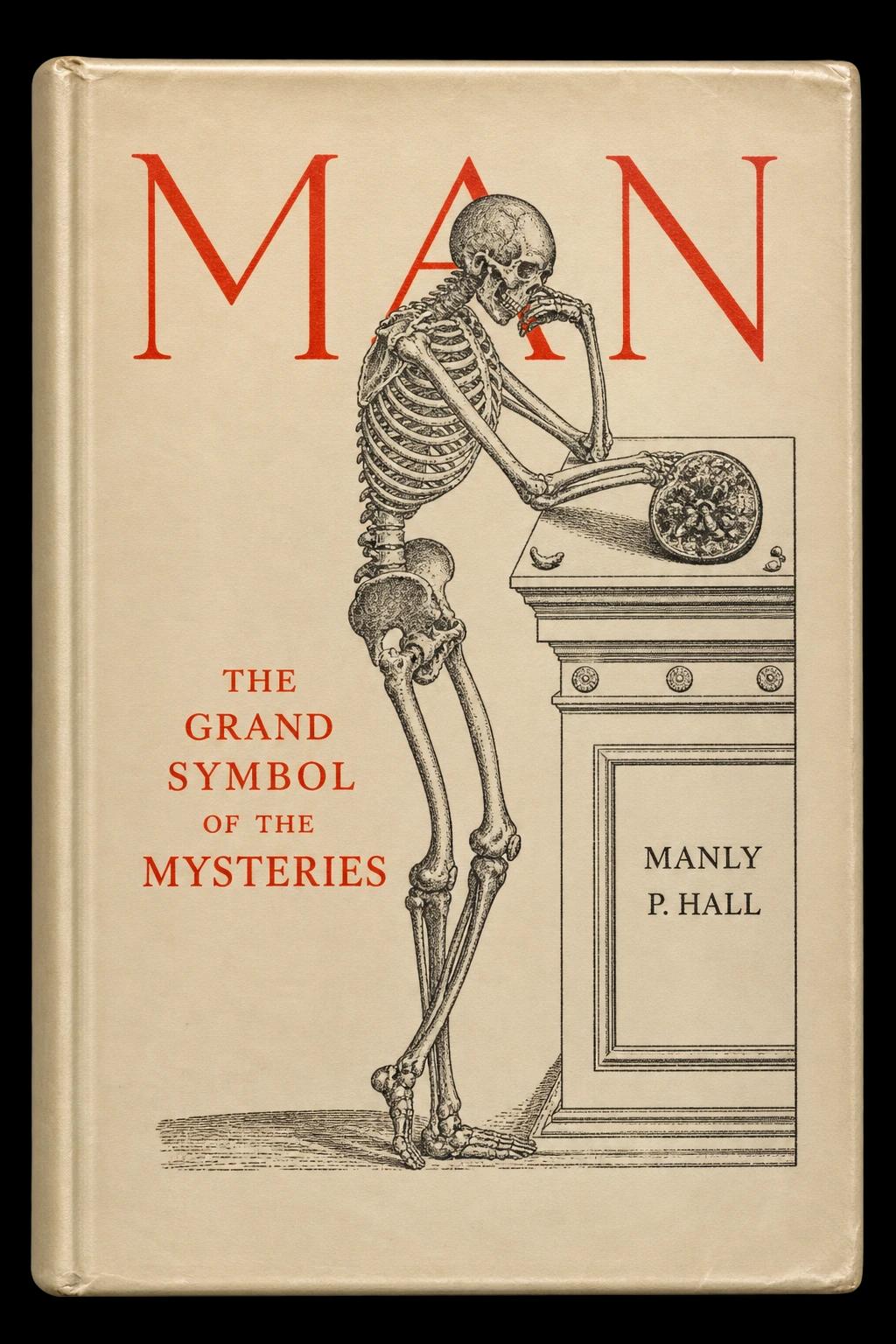
Man the Grand Symbol of the Mysteries
Reading note
The separately titled account draws on exact passages in the consulted Library edition.
Sources
See references (11)
- Fludd’s diagram of the faculties and senses ↗Robert Fludd, Utriusque cosmi historia, volume II, 1619. Wikimedia Commons, via Source Library. Public Domain Mark.
- Passions of the Soul, article 31 ↗René Descartes, Passions of the Soul, article 31. Historical English translation reproduced by Claremont Graduate University.
- Physiology of the Pineal Gland and Melatonin, abstract ↗Josephine Arendt and Anna Aulinas, Physiology of the Pineal Gland and Melatonin. Endotext, NCBI Bookshelf.
- Man the Grand Symbol of the Mysteries, Reader page 320Manly P. Hall, Man the Grand Symbol of the Mysteries, Fourth Edition, The Philosophers Press, Los Angeles, 1937. Lumitheca Library edition IMJ-0603-E001.Read this page in Man the Grand Symbol of the Mysteries ↗
- Man the Grand Symbol of the Mysteries, Reader page 321Manly P. Hall, Man the Grand Symbol of the Mysteries, Fourth Edition, The Philosophers Press, Los Angeles, 1937. Lumitheca Library edition IMJ-0603-E001.Read this page in Man the Grand Symbol of the Mysteries ↗
- Man the Grand Symbol of the Mysteries, printed p. 336, Reader page 328Manly P. Hall, Man the Grand Symbol of the Mysteries, Fourth Edition, The Philosophers Press, Los Angeles, 1937. Lumitheca Library edition IMJ-0603-E001.Read this page in Man the Grand Symbol of the Mysteries ↗
- Man the Grand Symbol of the Mysteries, printed p. 331, Reader page 323Manly P. Hall, Man the Grand Symbol of the Mysteries, Fourth Edition, The Philosophers Press, Los Angeles, 1937. Lumitheca Library edition IMJ-0603-E001.Read this page in Man the Grand Symbol of the Mysteries ↗
- Man the Grand Symbol of the Mysteries, printed p. 333, Reader page 325Manly P. Hall, Man the Grand Symbol of the Mysteries, Fourth Edition, The Philosophers Press, Los Angeles, 1937. Lumitheca Library edition IMJ-0603-E001.Read this page in Man the Grand Symbol of the Mysteries ↗
- Man the Grand Symbol of the Mysteries, printed p. 334, Reader page 326Manly P. Hall, Man the Grand Symbol of the Mysteries, Fourth Edition, The Philosophers Press, Los Angeles, 1937. Lumitheca Library edition IMJ-0603-E001.Read this page in Man the Grand Symbol of the Mysteries ↗
- Man the Grand Symbol of the Mysteries, printed p. 337, Reader page 329Manly P. Hall, Man the Grand Symbol of the Mysteries, Fourth Edition, The Philosophers Press, Los Angeles, 1937. Lumitheca Library edition IMJ-0603-E001.Read this page in Man the Grand Symbol of the Mysteries ↗
- Man the Grand Symbol of the Mysteries, printed p. 338, Reader page 330Manly P. Hall, Man the Grand Symbol of the Mysteries, Fourth Edition, The Philosophers Press, Los Angeles, 1937. Lumitheca Library edition IMJ-0603-E001.Read this page in Man the Grand Symbol of the Mysteries ↗