Paper offerings for the dead
Paper offerings honour and provide for the dead in some Chinese traditions. Read about spirit money and paper objects, then J. S. M. Ward’s interpretation.
In this article
Understanding paper offerings for the dead
Paper offerings are items made of paper and offered to the dead. In some Chinese traditions, families burn spirit money or models of useful objects as part of caring for ancestors. The offerings can be made at funerals or at occasions when families remember the dead. [1][2]
Offerings as continuing care
The Lam Museum of Anthropology describes spirit money as one kind of joss paper. Burning passes the offering to the deceased in the practice it describes. The museum records its use at funerals and at holidays when families remember their ancestors. [1]
Banknotes and a model radio in the Museum of Sepulchral Culture’s collection show how specific a gift can be. The objects are imagined provisions for the deceased. Their choice expresses the giver’s care for how the deceased might live. [2]
A Subaltern in Spirit Land by J. S. M. Ward
In A Subaltern in Spirit Land, J. S. M. Ward recalls Chinese people in Burma burning paper money and garments. He asks H. J. L. what happens to the objects. The answer depends on Ward’s distinction between the astral and spirit planes. [3]
The guide allows a limited effect when the giver concentrates on a particular deceased person. On the spirit plane, he says the gift can show that the person is remembered, while thought-created clothing would serve just as well. On the astral plane, he expects the form of the paper model, rather than automatic conversion into the represented material object. [3][4]
He also doubts whether the paper money would be accepted by the shopkeepers he describes. That answer follows his larger judgment that buying and selling are lingering earthly habits. It is a Spiritualist interpretation of the ritual, not a statement of how its practitioners must understand it. [5][3][4]
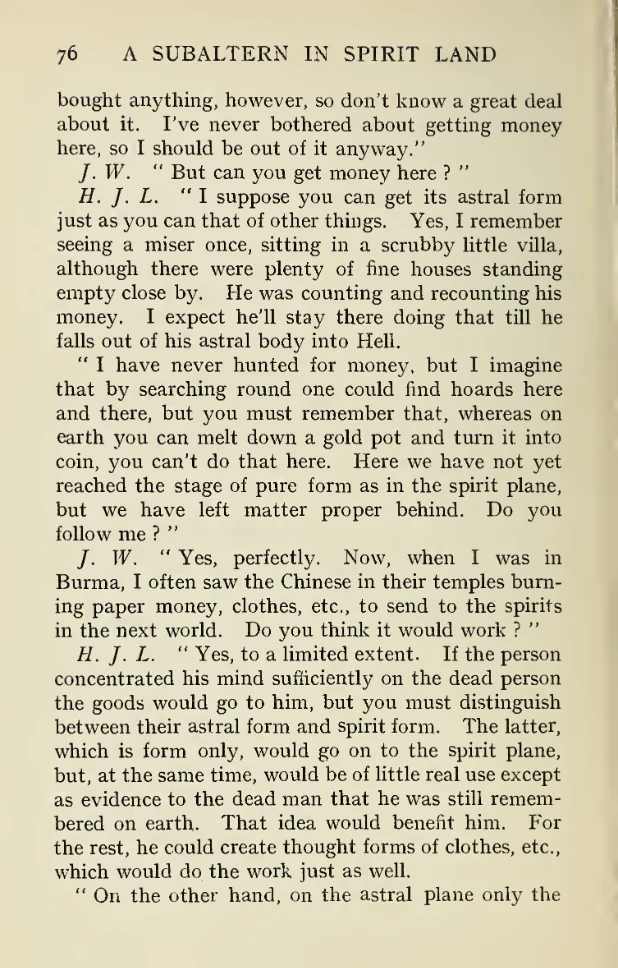
A Subaltern in Spirit Land (1920), printed p. 76, Library Reader page 91. Ward asks about burned paper offerings in a discussion about astral objects and money.
J. S. M. Ward, A Subaltern in Spirit Land. William Rider & Son, 1920. Public-domain historical text and page image, extracted from the checksum-verified retained Library scan. · Image source ↗ · Public Domain
Caring for the dead and interpreting the gift
The museum collections explain what the offerings mean to people who give them. Ward asks what form the supposed offering would have in his afterlife. The question he adds is whether a paper model keeps the shape of the paper object or becomes the thing it represents. [3][4][1][2]
Read further in the library
A Subaltern in Spirit Land: A Sequel to Gone West
Reading note
The separately titled account draws on exact passages in the consulted Library edition.
Sources
See references (5)
- Chinese Spirit Money ↗Timothy S. Y. Lam Museum of Anthropology, Wake Forest University. Collection interpretation, 2 January 2018; research credited to Carla Pena-Vega. Used for the offering’s ritual function, not the post’s unexamined early chronology.Return to text ↑
- Chinese paper offerings: Well-equipped for the afterlife ↗Bettina Volk, Museum of Sepulchral Culture, Kassel. Collection interpretation of contemporary Chinese paper offerings. The museum’s copyrighted photographs are not reproduced.Return to text ↑
- A Subaltern in Spirit Land, printed p. 76, Reader page 91J. S. M. Ward, A Subaltern in Spirit Land: A Sequel to Gone West. William Rider & Son, London, 1920. Narrated experiences and explanations are attributed to Ward and his reported spirit contributors, especially his brother Rex (R. L. W.) and H. J. L.Read this page in A Subaltern in Spirit Land: A Sequel to Gone West ↗Return to text ↑
- A Subaltern in Spirit Land, printed p. 77, Reader page 92J. S. M. Ward, A Subaltern in Spirit Land: A Sequel to Gone West. William Rider & Son, London, 1920. Narrated experiences and explanations are attributed to Ward and his reported spirit contributors, especially his brother Rex (R. L. W.) and H. J. L.Read this page in A Subaltern in Spirit Land: A Sequel to Gone West ↗Return to text ↑
- A Subaltern in Spirit Land, printed p. 75, Reader page 90J. S. M. Ward, A Subaltern in Spirit Land: A Sequel to Gone West. William Rider & Son, London, 1920. Narrated experiences and explanations are attributed to Ward and his reported spirit contributors, especially his brother Rex (R. L. W.) and H. J. L.Read this page in A Subaltern in Spirit Land: A Sequel to Gone West ↗Return to text ↑