Panoi
Panoi is a realm of the dead described in historical accounts from the Banks Islands. Read the story of Tangaro’s mistake and Codrington’s description of life there.
In this article
Understanding panoi
Panoi is a name for a realm of the dead in historical accounts of the Banks Islands. One story explains how people come to follow Mate, or Death, there after Tangaro mistakes the route for a way upwards. [2]
The writers use Hades as a comparison for English-language readers. The details that give Panoi its place in these accounts are the path people follow and the villages they are said to live in after death. [2]
The Encyclopaedia of Death and Life, Volume I, compiled by J. R. Francis
In the version Andrew Lang retells in J. R. Francis’s anthology, there was no death at first. The older generations keep their property, leaving little for younger people. Qat sends for Mate. A funeral is arranged so that Tangaro can watch which way Death goes. [2]
Tangaro is asked to watch the path by which Mate leaves, so that people can avoid it. He notices the route but mistakes its meaning and points it out as the way upward. People subsequently follow Mate to Panoi. Direction, memory and the loss of a possible escape determine the story’s outcome. [2]
Lang briefly mentions another telling with the same error. The emphasis in his account is on how a mistaken direction becomes the route people follow after death. [2]
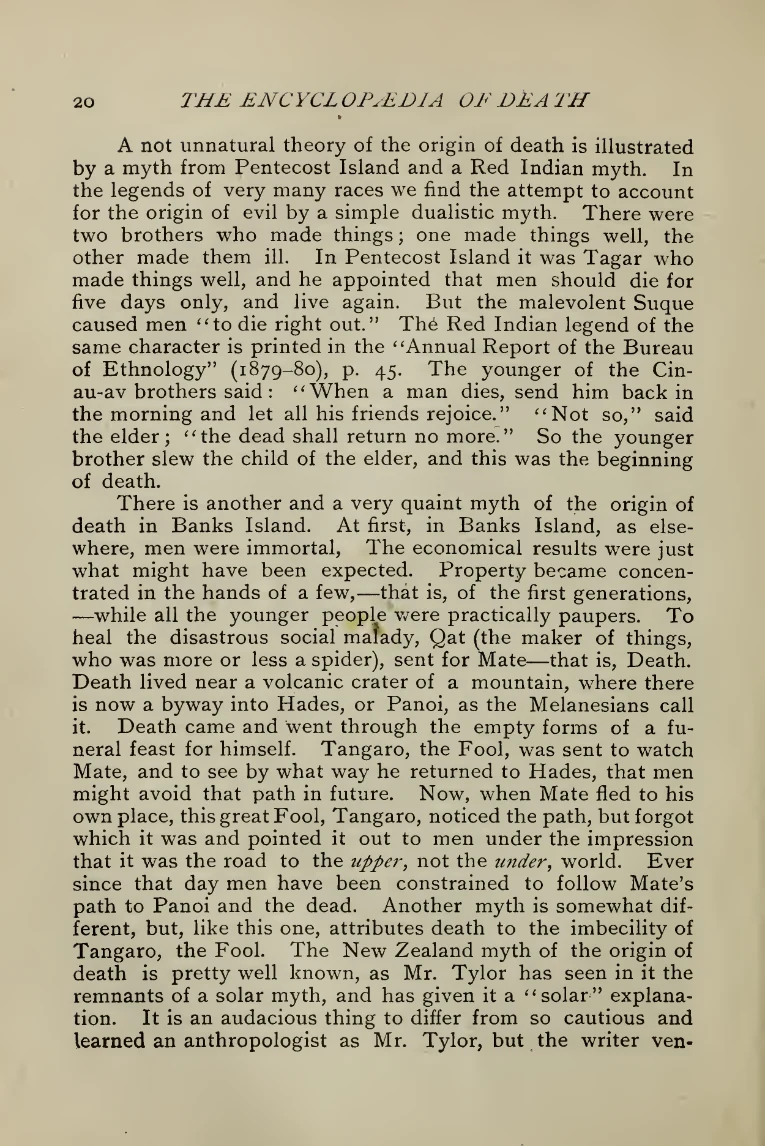
Source facsimile: The Encyclopaedia of Death and Life in the Spirit-World, Volume I (1903), printed p. 20, Reader page 19.
The Encyclopaedia of Death and Life in the Spirit-World, Volume I, fourth edition, 1903. Public-domain historical page extracted from the checksum-verified Library PDF. · Image source ↗ · Public Domain
Melanesians by R. H. Codrington
In his 1915 article Melanesians, Robert Henry Codrington describes the dead in the Banks Islands living in villages. A person of standing can arrive in Panoi carrying the appearances of their ornaments. His article describes different destinations for other islands. [1]
Codrington says the people he asked distinguished a place of harmony in Panoi from a troubled condition for those excluded by their conduct. His account gives some of the answers he records and then translates them into categories familiar to his own readers. [1]
The route to Panoi and life there
Tangaro’s mistake explains why people take the path to the dead. Codrington’s description asks what people find after arriving. The route is the subject of one story, while the other gives the departed a place in which social life continues in a changed form. [2]
Read further in the library
The Encyclopaedia of Death and Life in the Spirit-World, Volume I
Reading note
The separately titled account draws on exact passages in the consulted Library edition.
Sources
See references (2)
- R. H. Codrington: Melanesians, section 12, Death and after death ↗Robert Henry Codrington, Encyclopaedia of Religion and Ethics, vol. VIII, 1915, pp. 529–538, especially section 12, pp. 536–537. Transcription by Terry Brown, Project Canterbury. Historical missionary account, not a present-day community statement.Return to text ↑
- The Encyclopaedia of Death and Life in the Spirit-World, Volume I, printed p. 20, Reader page 19J. R. Francis (compiler), The Encyclopaedia of Death and Life in the Spirit-World, Volume I, fourth edition. The Progressive Thinker Publishing House, Chicago, 1903. Individual authors, communicators and quoted sources identified in each account.Read this page in The Encyclopaedia of Death and Life in the Spirit-World, Volume I ↗Return to text ↑