One Solid, Many Outlines
Can one solid fit circular, square and triangular holes? Explore Bragdon’s wooden stopper and what it shows about different views of the same object.
In this article
A stopper for three differently shaped holes
A solid can show different outlines when it is turned. Claude Bragdon illustrates this with a wooden stopper that can fit a circular, square or triangular hole. The orientation changes what the opening encounters while the solid keeps its shape. [2][3]
A Primer of Higher Space by Claude Bragdon
On Plate 13 of A Primer of Higher Space, Claude Bragdon draws a wedge with a circular base, a square section and a triangular section. Turning it to meet each opening reveals a different profile. He then asks whether a sphere, cube and tetrahedron could all be sections or boundaries of a single four-dimensional form. [2][3]
The plate also proposes that different personalities could be presentations of one higher self. In Man the Square, differently oriented cubes make different outlines in the plane, giving the geometric example a role in the story of identity. [3][4][5][6]
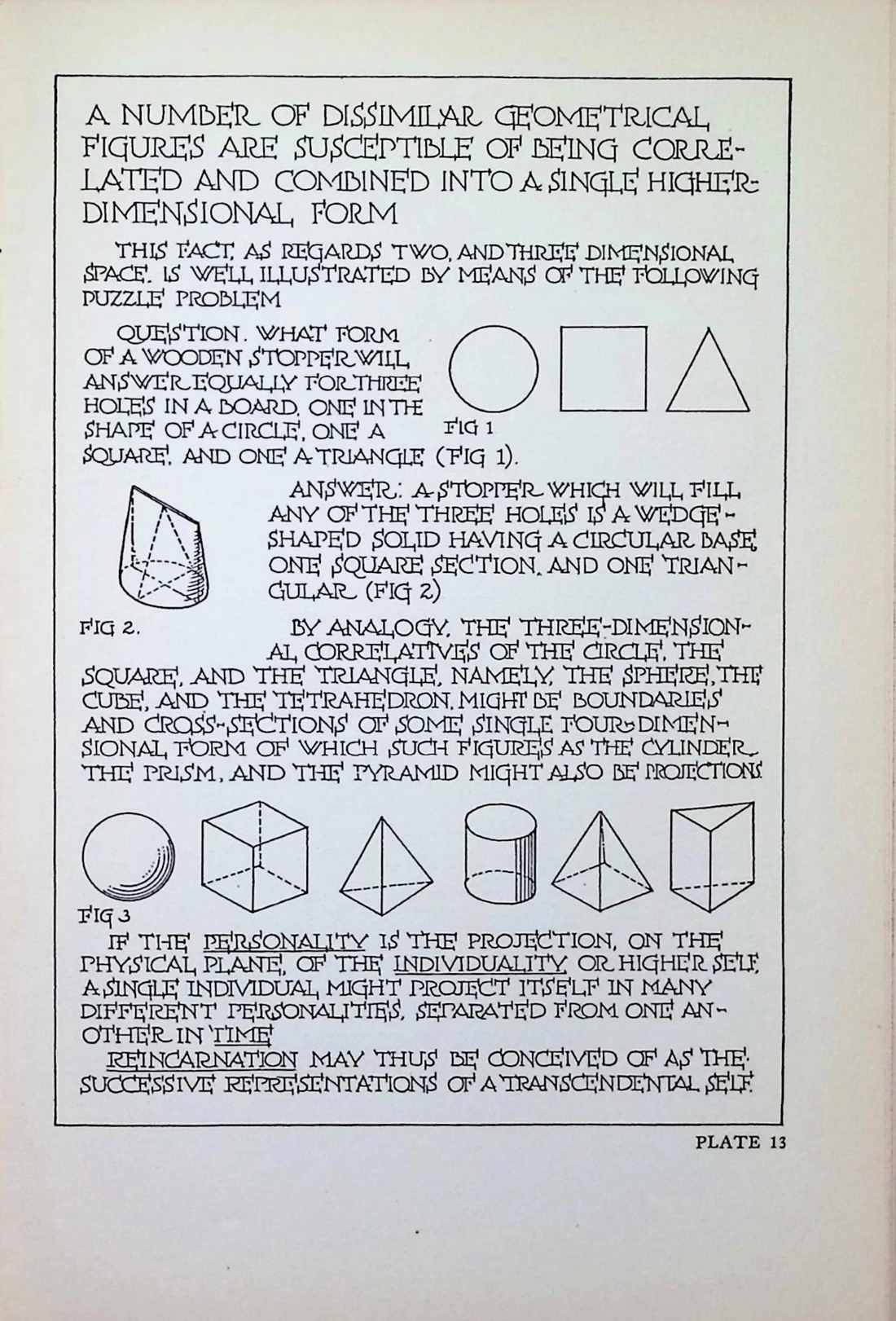
On Plate 13, Bragdon sets one wedge-shaped stopper next to three differently shaped openings.
Claude Bragdon, A Primer of Higher Space, The Manas Press, 1913. Stickley Museum scan via Internet Archive. · Image source ↗ · Public Domain
A profile gives only part of the evidence
A projection shows what lines up along a chosen viewing direction. A section shows what meets a chosen cutting plane. Turning the stopper changes what it can fit, which makes it easy to see why one outline leaves much of the solid unknown. [7][2][3][8]
In the library
A Primer of Higher Space
Reading note
The separately titled account draws on exact passages in the consulted Library edition.
Sources
See references (8)
- Plate 13, a wooden stopper for three differently shaped openings ↗Claude Bragdon, A Primer of Higher Space, The Manas Press, 1913. Stickley Museum scan via Internet Archive.
- A Primer of Higher Space, Plate 12, Reader page 41Claude Bragdon, A Primer of Higher Space (The Fourth Dimension), The Manas Press, Rochester, New York, 1913. Lumitheca Library edition IMJ-0599-E001.Read this page in A Primer of Higher Space ↗
- A Primer of Higher Space, Plate 13, Reader page 42Claude Bragdon, A Primer of Higher Space (The Fourth Dimension), The Manas Press, Rochester, New York, 1913. Lumitheca Library edition IMJ-0599-E001.Read this page in A Primer of Higher Space ↗
- A Primer of Higher Space, printed p. 64, Reader page 67Claude Bragdon, A Primer of Higher Space (The Fourth Dimension), The Manas Press, Rochester, New York, 1913. Lumitheca Library edition IMJ-0599-E001.Read this page in A Primer of Higher Space ↗
- A Primer of Higher Space, printed p. 65, Reader page 68Claude Bragdon, A Primer of Higher Space (The Fourth Dimension), The Manas Press, Rochester, New York, 1913. Lumitheca Library edition IMJ-0599-E001.Read this page in A Primer of Higher Space ↗
- A Primer of Higher Space, printed p. 66, Reader page 69Claude Bragdon, A Primer of Higher Space (The Fourth Dimension), The Manas Press, Rochester, New York, 1913. Lumitheca Library edition IMJ-0599-E001.Read this page in A Primer of Higher Space ↗
- A Primer of Higher Space, Plate 4, Reader page 33Claude Bragdon, A Primer of Higher Space (The Fourth Dimension), The Manas Press, Rochester, New York, 1913. Lumitheca Library edition IMJ-0599-E001.Read this page in A Primer of Higher Space ↗
- A Primer of Higher Space, Plate 30, Reader page 59Claude Bragdon, A Primer of Higher Space (The Fourth Dimension), The Manas Press, Rochester, New York, 1913. Lumitheca Library edition IMJ-0599-E001.Read this page in A Primer of Higher Space ↗