Odic Force
Odic force was Karl von Reichenbach’s proposed vital force. See how his accounts of luminous magnets became part of Edwin D. Babbitt’s theory of invisible colour.
In this article
What was Od?
Odic force, also called Od or Odyl, was Karl von Reichenbach’s proposed vital force. People he called sensitives reported seeing coloured glows around magnets and other objects. He interpreted their reports as signs of a force he believed was present throughout nature. [3][2]
Man the Grand Symbol of the Mysteries by Manly P. Hall
Manly P. Hall discusses Reichenbach in the chapter on the spinal column in Man the Grand Symbol of the Mysteries. Hall places the investigations alongside accounts of animal magnetism and the idea that the body has poles. [10][11][12]
A figure from Gregor Reisch’s Margarita Philosophica shows spears marked longitude and latitude crossing a human body. Hall reads the figure as a parallel between bodily and terrestrial polarity. [12][13]
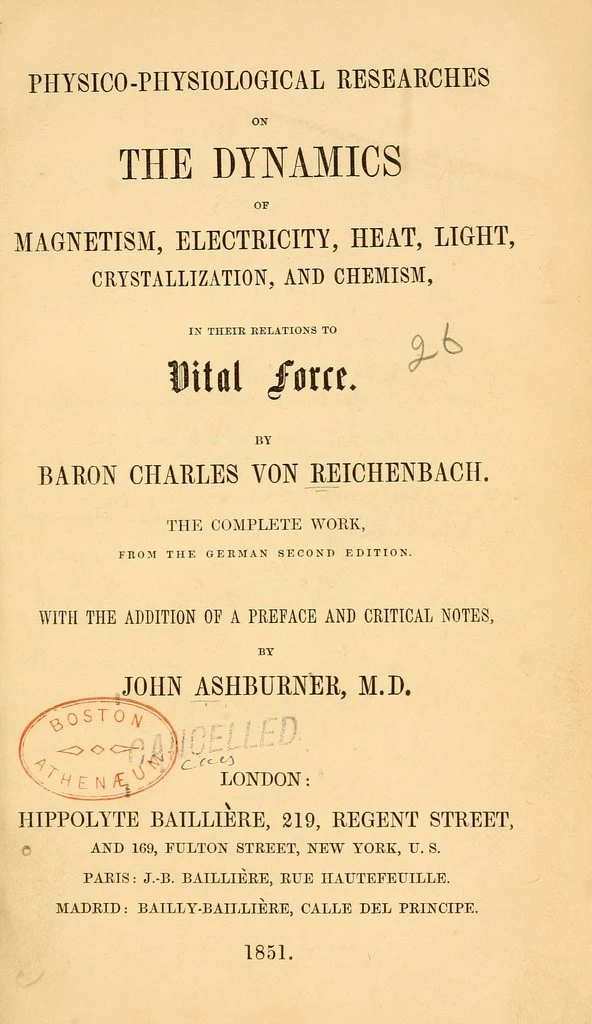
The title page of the 1851 English edition lists phenomena Reichenbach investigated, including magnetism, heat and crystallisation.
Karl von Reichenbach, Physico-physiological Researches, translated and annotated by John Ashburner, 1851. Wellcome Collection, supplied by the Francis A. Countway Library of Medicine. Public Domain Mark. · Image source ↗ · Public Domain
The Principles of Light and Color by Edwin D. Babbitt
In The Principles of Light and Color, Edwin D. Babbitt recounts reports of coloured flames around a magnet as air was withdrawn from a glass enclosure. He takes the reports as support for a finer medium and places odic light in what he calls another octave of colour. [4][5]
Babbitt cites Reichenbach’s distinction between ordinary magnetism and Od. A magnet attracts iron filings, while Od supposedly leaves them unmoved. The colours reported at opposite poles inform Babbitt’s model of the Earth. [6][7][8]
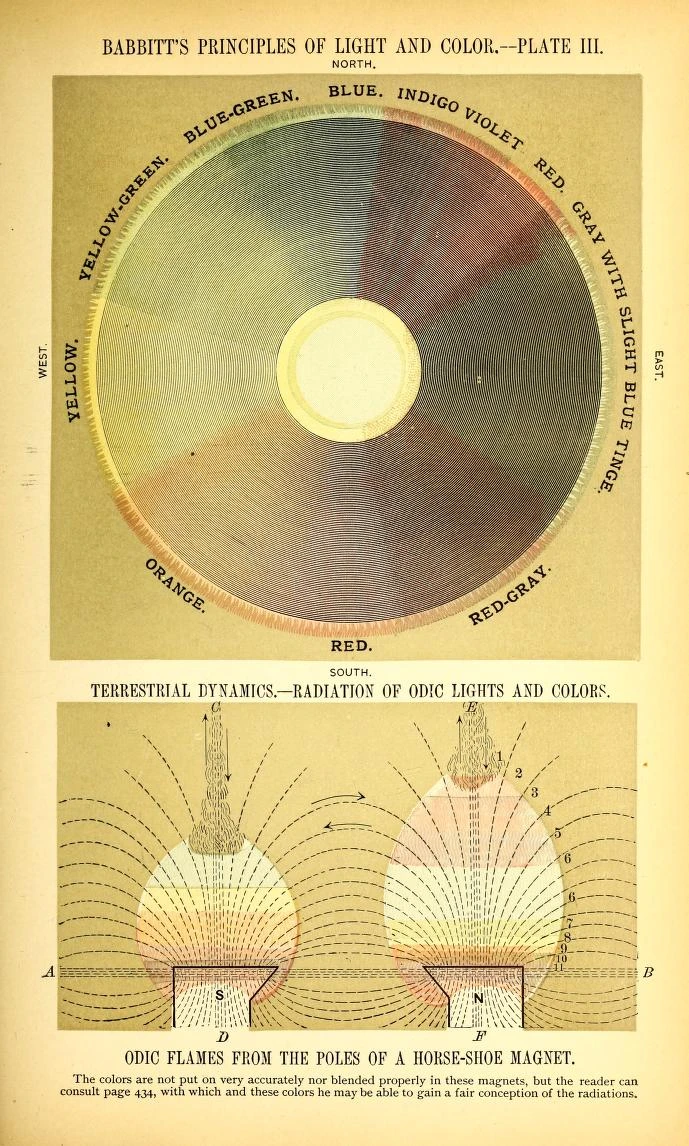
Plate III in Babbitt’s 1878 edition shows the Earth’s supposed odic lights beside coloured rays at the poles of a horseshoe magnet.
Edwin D. Babbitt, The Principles of Light and Color, first edition (1878), Plate III. Smithsonian Libraries and Archives. · Image source ↗ · CC0
See references (5)
- The Principles of Light and Color, printed p. 415, Reader page 422
- The Principles of Light and Color, printed p. 419, Reader page 426
- The Principles of Light and Color, printed p. 426, Reader page 433
- The Principles of Light and Color, printed p. 433, Reader page 440
- The Principles of Light and Color, Reader page 442
From reported glows to theories of colour and the body
Reichenbach organised reports by the objects and conditions in which glows were seen. Babbitt interpreted them through a proposed spectrum beyond ordinary vision. The historical observations do not establish the existence of an additional physical force. [2][5][6]
Hall uses the same vocabulary of invisible forces to connect the body’s supposed poles to the Earth’s directions. Reichenbach’s investigations thus became a reference for a theory of colour and a system of symbolic anatomy. [10][12][13][2][4][6][7]
See references (8)
- Researches on Magnetism, Electricity, Heat, Light, Crystallization, and Chemical Attraction, pp. 243 and 277
- The Principles of Light and Color, printed p. 415, Reader page 422
- The Principles of Light and Color, printed p. 419, Reader page 426
- The Principles of Light and Color, printed p. 426, Reader page 433
- The Principles of Light and Color, printed p. 433, Reader page 440
- Man the Grand Symbol of the Mysteries, printed p. 290, Reader page 284
- Man the Grand Symbol of the Mysteries, printed p. 292, Reader page 286
- Man the Grand Symbol of the Mysteries, printed p. 293, Reader page 287
In the library
The Principles of Light and Color
Reading note
The separately titled account draws on exact passages in the consulted Library edition.
Man the Grand Symbol of the Mysteries
Reading note
The separately titled account draws on exact passages in the consulted Library edition.
Sources
See references (13)
- The Principles of Light and Color, 1878, Plate III ↗Edwin D. Babbitt, The Principles of Light and Color, first edition (1878), Plate III. Smithsonian Libraries and Archives.
- Researches on Magnetism, Electricity, Heat, Light, Crystallization, and Chemical Attraction, pp. 243 and 277 ↗Karl von Reichenbach, translated and edited by William Gregory, 1850.
- The Principles of Light and Color, printed p. 416, Reader page 423Edwin D. Babbitt, The Principles of Light and Color, second edition, College of Fine Forces, East Orange, New Jersey, 1896. Lumitheca Library edition IMJ-0607-E001.Read this page in The Principles of Light and Color ↗
- The Principles of Light and Color, printed p. 415, Reader page 422Edwin D. Babbitt, The Principles of Light and Color, second edition, College of Fine Forces, East Orange, New Jersey, 1896. Lumitheca Library edition IMJ-0607-E001.Read this page in The Principles of Light and Color ↗
- The Principles of Light and Color, printed p. 419, Reader page 426Edwin D. Babbitt, The Principles of Light and Color, second edition, College of Fine Forces, East Orange, New Jersey, 1896. Lumitheca Library edition IMJ-0607-E001.Read this page in The Principles of Light and Color ↗
- The Principles of Light and Color, printed p. 426, Reader page 433Edwin D. Babbitt, The Principles of Light and Color, second edition, College of Fine Forces, East Orange, New Jersey, 1896. Lumitheca Library edition IMJ-0607-E001.Read this page in The Principles of Light and Color ↗
- The Principles of Light and Color, printed p. 433, Reader page 440Edwin D. Babbitt, The Principles of Light and Color, second edition, College of Fine Forces, East Orange, New Jersey, 1896. Lumitheca Library edition IMJ-0607-E001.Read this page in The Principles of Light and Color ↗
- The Principles of Light and Color, Reader page 442Edwin D. Babbitt, The Principles of Light and Color, second edition, College of Fine Forces, East Orange, New Jersey, 1896. Lumitheca Library edition IMJ-0607-E001.Read this page in The Principles of Light and Color ↗
- Physico-physiological Researches, title page ↗Karl von Reichenbach, Physico-physiological Researches, translated and annotated by John Ashburner, 1851. Wellcome Collection, supplied by the Francis A. Countway Library of Medicine. Public Domain Mark.
- Man the Grand Symbol of the Mysteries, printed p. 290, Reader page 284Manly P. Hall, Man the Grand Symbol of the Mysteries, Fourth Edition, The Philosophers Press, Los Angeles, 1937. Lumitheca Library edition IMJ-0603-E001.Read this page in Man the Grand Symbol of the Mysteries ↗
- Man the Grand Symbol of the Mysteries, printed p. 291, Reader page 285Manly P. Hall, Man the Grand Symbol of the Mysteries, Fourth Edition, The Philosophers Press, Los Angeles, 1937. Lumitheca Library edition IMJ-0603-E001.Read this page in Man the Grand Symbol of the Mysteries ↗
- Man the Grand Symbol of the Mysteries, printed p. 292, Reader page 286Manly P. Hall, Man the Grand Symbol of the Mysteries, Fourth Edition, The Philosophers Press, Los Angeles, 1937. Lumitheca Library edition IMJ-0603-E001.Read this page in Man the Grand Symbol of the Mysteries ↗
- Man the Grand Symbol of the Mysteries, printed p. 293, Reader page 287Manly P. Hall, Man the Grand Symbol of the Mysteries, Fourth Edition, The Philosophers Press, Los Angeles, 1937. Lumitheca Library edition IMJ-0603-E001.Read this page in Man the Grand Symbol of the Mysteries ↗