Occult Embryology
Explore how Manly P. Hall read early accounts of prenatal development through esoteric ideas about the soul and the cosmos.
In this article
How esoteric writers understood embodiment
Occult embryology interprets prenatal development through beliefs about how a soul enters bodily life. It belongs to the history of esotericism and speculative anatomy. The germ, womb and developing body each acquire a place in an account of embodiment. [3][4][5][6]
The question of how a body takes shape can lead into a second question about what a soul is believed to do during that process. Manly P. Hall treats both questions in the same chapter. [4][7][6][8]
See references (6)
- Man the Grand Symbol of the Mysteries, Reader page 123
- Man the Grand Symbol of the Mysteries, printed p. 126, Reader page 124
- Man the Grand Symbol of the Mysteries, printed p. 131, Reader page 129
- Man the Grand Symbol of the Mysteries, printed p. 136, Reader page 134
- Man the Grand Symbol of the Mysteries, printed p. 128, Reader page 126
- Man the Grand Symbol of the Mysteries, printed p. 137, Reader page 135
Man the Grand Symbol of the Mysteries by Manly P. Hall
In Man the Grand Symbol of the Mysteries, Manly P. Hall compares the development of the ovum with the formation of the world. The comparison gives him a way to read older cosmologies through the beginnings of an individual body. [3][4][5]
Hall imagines an ego establishing ties with the developing body and acting through them as it forms. He uses an image from Hildegard’s Scivias alongside this account to consider how a soul might arrive. [6][8][9]
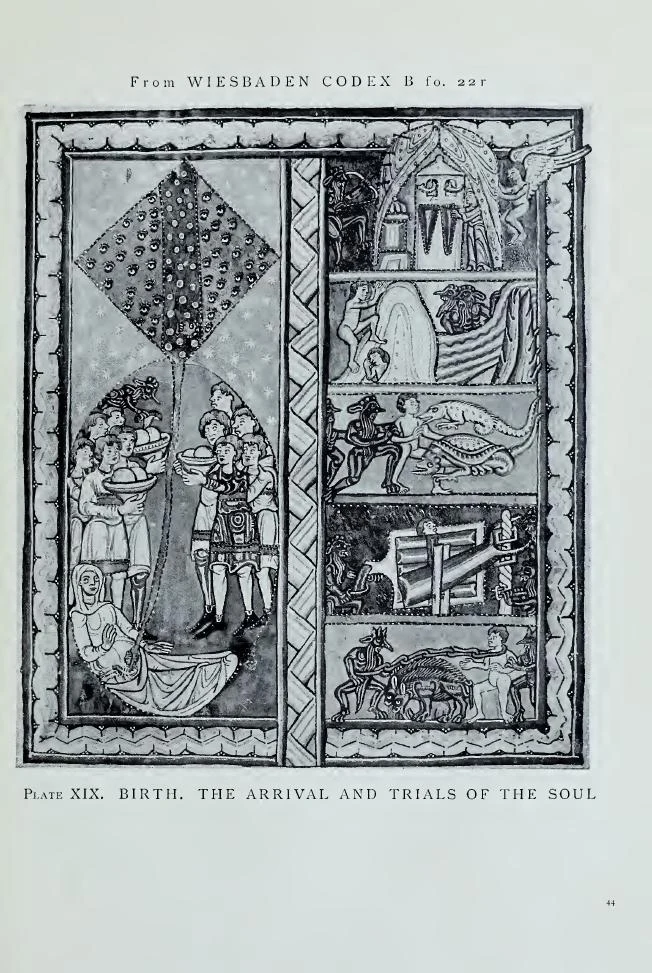
A medieval vision of the arrival and trials of the soul, shown in the 1917 facsimile from the Wiesbaden Scivias manuscript.
Hildegard of Bingen, Scivias, Wiesbaden Codex B, fol. 22r, reproduced in Charles Singer, Studies in the History and Method of Science, 1917, plate XIX. Public domain. · Image source ↗ · Public Domain
See references (6)
- Man the Grand Symbol of the Mysteries, Reader page 123
- Man the Grand Symbol of the Mysteries, printed p. 126, Reader page 124
- Man the Grand Symbol of the Mysteries, printed p. 131, Reader page 129
- Man the Grand Symbol of the Mysteries, printed p. 136, Reader page 134
- Man the Grand Symbol of the Mysteries, printed p. 137, Reader page 135
- Man the Grand Symbol of the Mysteries, printed p. 140, Reader page 138
A miniature body and a forming body
Nicolaas Hartsoeker’s drawing pictures a conjecture that a miniature human is already present inside a sperm cell. Hall discusses this historical proposal alongside his own claim about the continuing influence of an ego as a body develops. [7][6][8][2]
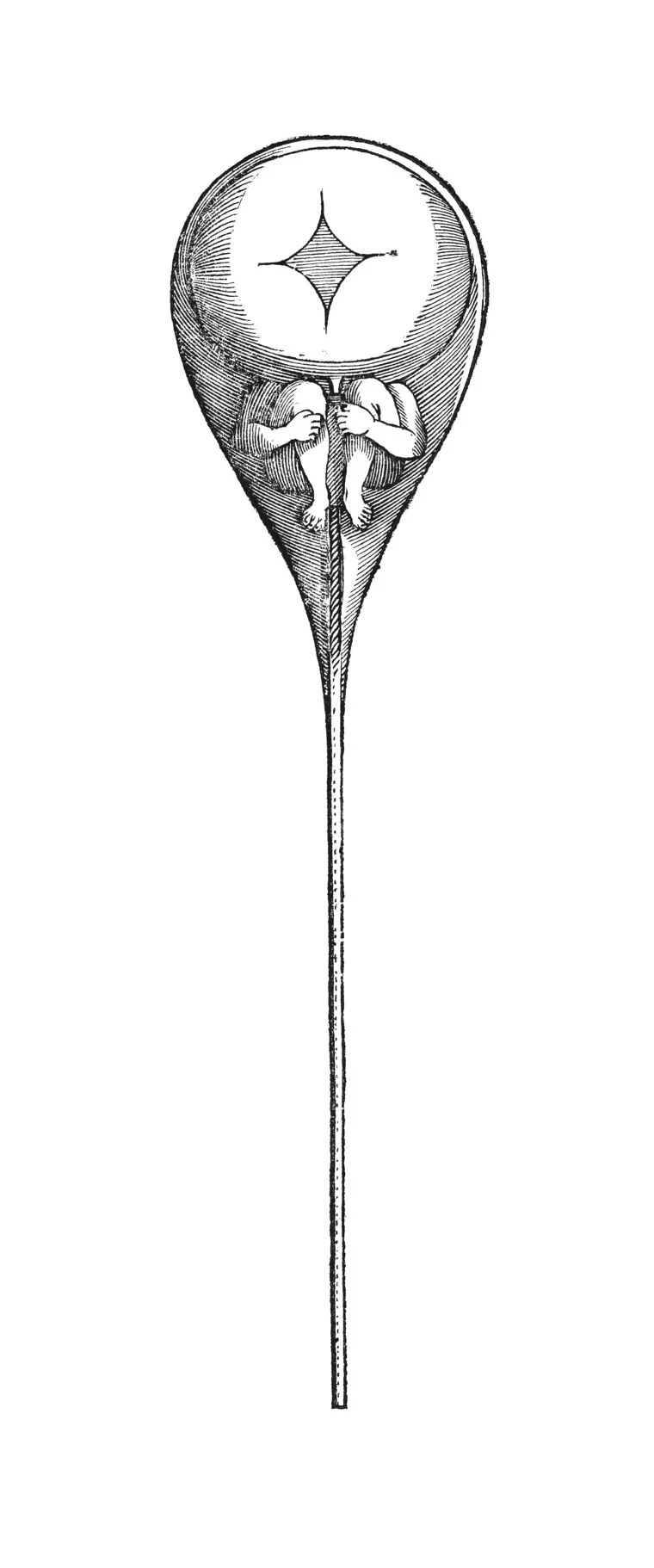
Hartsoeker’s figure illustrates an early conjecture about development. Hall reproduces it in his chapter on occult embryology.
Nicolaas Hartsoeker, Essay de dioptrique, 1694, p. 230. Wellcome Collection, M0016638. Public Domain Mark. · Image source ↗ · Public Domain
In the library
Man the Grand Symbol of the Mysteries
Reading note
The separately titled account draws on exact passages in the consulted Library edition.
Sources
See references (10)
- Hartsoeker’s speculative figure, Essay de dioptrique ↗Nicolaas Hartsoeker, Essay de dioptrique, 1694, p. 230. Wellcome Collection, M0016638. Public Domain Mark.
- Essay de dioptrique, p. 230 ↗Nicolaas Hartsoeker, Essay de dioptrique, Paris, 1694. Wellcome Collection, M0016638.
- Man the Grand Symbol of the Mysteries, Reader page 123Manly P. Hall, Man the Grand Symbol of the Mysteries, Fourth Edition, The Philosophers Press, Los Angeles, 1937. Lumitheca Library edition IMJ-0603-E001.Read this page in Man the Grand Symbol of the Mysteries ↗
- Man the Grand Symbol of the Mysteries, printed p. 126, Reader page 124Manly P. Hall, Man the Grand Symbol of the Mysteries, Fourth Edition, The Philosophers Press, Los Angeles, 1937. Lumitheca Library edition IMJ-0603-E001.Read this page in Man the Grand Symbol of the Mysteries ↗
- Man the Grand Symbol of the Mysteries, printed p. 131, Reader page 129Manly P. Hall, Man the Grand Symbol of the Mysteries, Fourth Edition, The Philosophers Press, Los Angeles, 1937. Lumitheca Library edition IMJ-0603-E001.Read this page in Man the Grand Symbol of the Mysteries ↗
- Man the Grand Symbol of the Mysteries, printed p. 136, Reader page 134Manly P. Hall, Man the Grand Symbol of the Mysteries, Fourth Edition, The Philosophers Press, Los Angeles, 1937. Lumitheca Library edition IMJ-0603-E001.Read this page in Man the Grand Symbol of the Mysteries ↗
- Man the Grand Symbol of the Mysteries, printed p. 128, Reader page 126Manly P. Hall, Man the Grand Symbol of the Mysteries, Fourth Edition, The Philosophers Press, Los Angeles, 1937. Lumitheca Library edition IMJ-0603-E001.Read this page in Man the Grand Symbol of the Mysteries ↗
- Man the Grand Symbol of the Mysteries, printed p. 137, Reader page 135Manly P. Hall, Man the Grand Symbol of the Mysteries, Fourth Edition, The Philosophers Press, Los Angeles, 1937. Lumitheca Library edition IMJ-0603-E001.Read this page in Man the Grand Symbol of the Mysteries ↗
- Man the Grand Symbol of the Mysteries, printed p. 140, Reader page 138Manly P. Hall, Man the Grand Symbol of the Mysteries, Fourth Edition, The Philosophers Press, Los Angeles, 1937. Lumitheca Library edition IMJ-0603-E001.Read this page in Man the Grand Symbol of the Mysteries ↗
- Birth. The Arrival and Trials of the Soul ↗Hildegard of Bingen, Scivias, Wiesbaden Codex B, fol. 22r, reproduced in Charles Singer, Studies in the History and Method of Science, 1917, plate XIX. Public domain.