Occult Anatomy
What is occult anatomy? Explore how Western esoteric writers used organs, bones and bodily proportions to describe the soul and cosmos.
In this article
The body as a map of the cosmos
Occult anatomy interprets bodily structures as signs of the soul, the cosmos or spiritual development. In Western esoteric works, a diagram of organs can also map relationships between the human body and the universe. [3][4][2]
The heart, for example, has a location in the chest. In an esoteric diagram it can also stand in relation to a sphere of life. The second reading asks what the organ symbolises. [5][6]
See references (5)
- Utriusque cosmi historia, title-page engraving, 1617
- Man the Grand Symbol of the Mysteries, printed p. 7, Reader page 6
- Man the Grand Symbol of the Mysteries, printed p. 8, Reader page 7
- Man the Grand Symbol of the Mysteries, printed p. 77, Reader page 76
- Man the Grand Symbol of the Mysteries, printed p. 81, Reader page 80
Man the Grand Symbol of the Mysteries by Manly P. Hall
In Man the Grand Symbol of the Mysteries, Manly P. Hall names Vesalius among his sources for anatomical drawings and Robert Fludd and other Rosicrucians among his sources for mystical figures. He places both kinds of image within the study of the body and soul. [3][4][7]
In The Mystery of the Three Worlds, Hall places Vesalius’s drawing of the abdomen beside Fludd’s depiction of the elemental world. Hall sees a resemblance between the digestive tract and the shape given to that cosmic region. He uses the resemblance to read the figures together. [5][8][9]
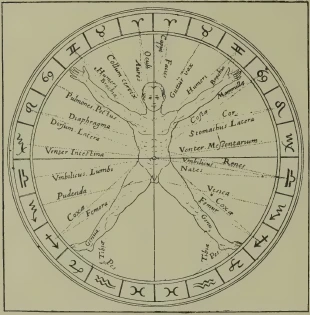
This figure from Robert Fludd, reproduced by Grillot de Givry, aligns body parts with zodiacal signs. It is one example of interpreting the body through a cosmic scheme.
Robert Fludd, Utriusque cosmi historia. Double zodiac reproduced by De Givry. · Image source ↗ · Public Domain
See references (6)
- Man the Grand Symbol of the Mysteries, printed p. 7, Reader page 6
- Man the Grand Symbol of the Mysteries, printed p. 8, Reader page 7
- Man the Grand Symbol of the Mysteries, printed p. 77, Reader page 76
- Man the Grand Symbol of the Mysteries, Reader page 16
- Man the Grand Symbol of the Mysteries, printed p. 78, Reader page 77
- Man the Grand Symbol of the Mysteries, printed p. 79, Reader page 78
The body as a small world
Theodorus de Bry’s 1617 title-page engraving for Robert Fludd’s Utriusque cosmi historia presents the microcosm and macrocosm together. Hall carries that way of comparing body and world into the shapes of particular organs. [4][5][9][2]
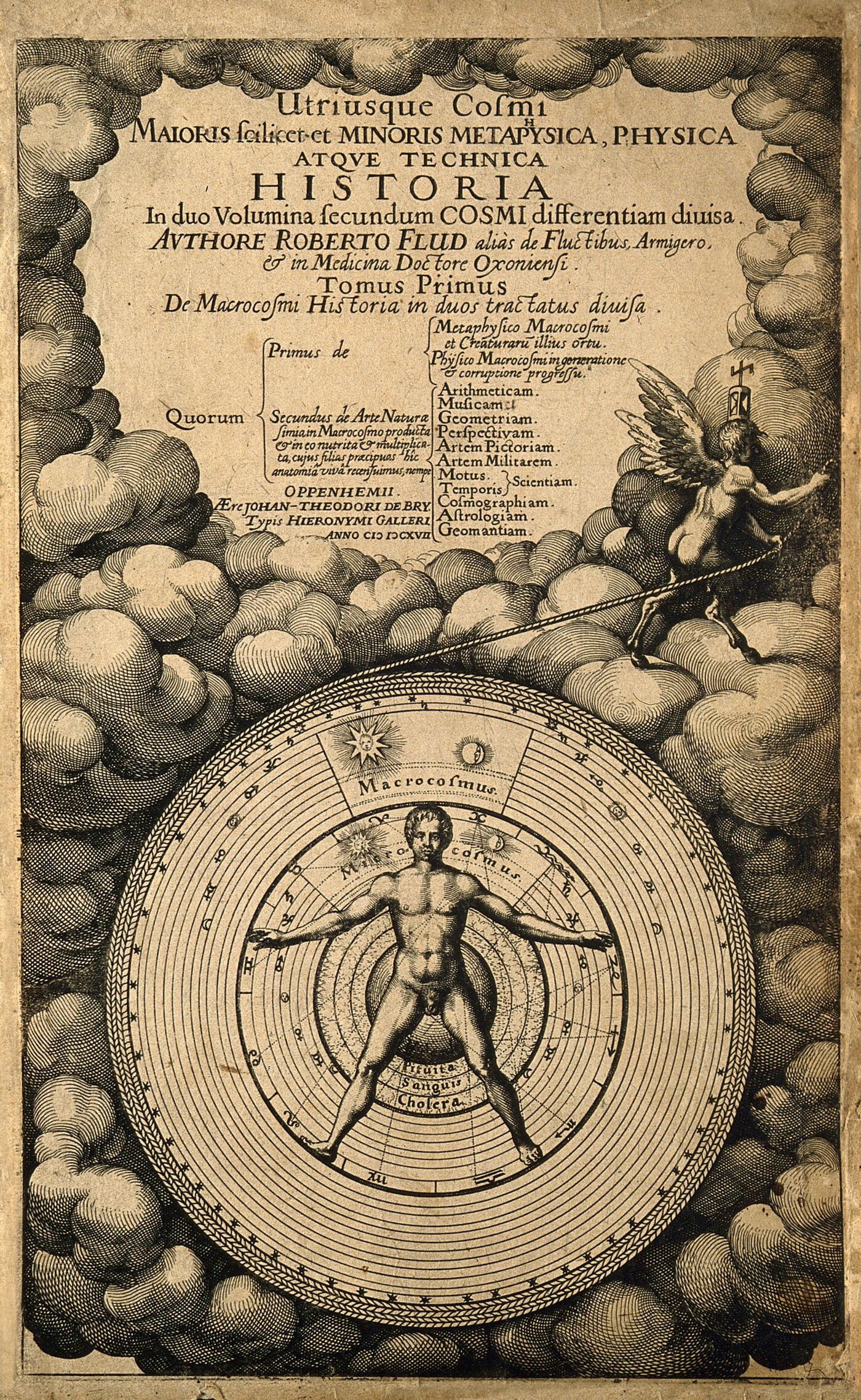
The 1617 title-page engraving for Robert Fludd’s history places a human figure within concentric rings. The arrangement brings the microcosm and macrocosm into one image.
Wellcome Collection, 2989i. Public Domain Mark. · Image source ↗ · Public Domain
In the library
Witchcraft Magic and Alchemy
Reading note
Separately attributed primary Library account, cited on exact verified Reader leaves.
Man the Grand Symbol of the Mysteries
Reading note
The separately titled account draws on exact passages in the consulted Library edition.
Sources
See references (9)
- Witchcraft Magic & Alchemy, printed p. 242, Reader page 235Grillot de Givry, Witchcraft Magic & Alchemy, translated by J. Courtenay Locke. Boston and New York, Houghton Mifflin Company, 1931.Read this page in Witchcraft Magic and Alchemy ↗
- Utriusque cosmi historia, title-page engraving, 1617 ↗Robert Fludd, Utriusque cosmi historia, volume I. Title-page engraving by Theodor de Bry, 1617. Wellcome Collection 2989i.
- Man the Grand Symbol of the Mysteries, printed p. 7, Reader page 6Manly P. Hall, Man the Grand Symbol of the Mysteries, Fourth Edition, The Philosophers Press, Los Angeles, 1937. Lumitheca Library edition IMJ-0603-E001.Read this page in Man the Grand Symbol of the Mysteries ↗
- Man the Grand Symbol of the Mysteries, printed p. 8, Reader page 7Manly P. Hall, Man the Grand Symbol of the Mysteries, Fourth Edition, The Philosophers Press, Los Angeles, 1937. Lumitheca Library edition IMJ-0603-E001.Read this page in Man the Grand Symbol of the Mysteries ↗
- Man the Grand Symbol of the Mysteries, printed p. 77, Reader page 76Manly P. Hall, Man the Grand Symbol of the Mysteries, Fourth Edition, The Philosophers Press, Los Angeles, 1937. Lumitheca Library edition IMJ-0603-E001.Read this page in Man the Grand Symbol of the Mysteries ↗
- Man the Grand Symbol of the Mysteries, printed p. 81, Reader page 80Manly P. Hall, Man the Grand Symbol of the Mysteries, Fourth Edition, The Philosophers Press, Los Angeles, 1937. Lumitheca Library edition IMJ-0603-E001.Read this page in Man the Grand Symbol of the Mysteries ↗
- Man the Grand Symbol of the Mysteries, Reader page 16Manly P. Hall, Man the Grand Symbol of the Mysteries, Fourth Edition, The Philosophers Press, Los Angeles, 1937. Lumitheca Library edition IMJ-0603-E001.Read this page in Man the Grand Symbol of the Mysteries ↗
- Man the Grand Symbol of the Mysteries, printed p. 78, Reader page 77Manly P. Hall, Man the Grand Symbol of the Mysteries, Fourth Edition, The Philosophers Press, Los Angeles, 1937. Lumitheca Library edition IMJ-0603-E001.Read this page in Man the Grand Symbol of the Mysteries ↗
- Man the Grand Symbol of the Mysteries, printed p. 79, Reader page 78Manly P. Hall, Man the Grand Symbol of the Mysteries, Fourth Edition, The Philosophers Press, Los Angeles, 1937. Lumitheca Library edition IMJ-0603-E001.Read this page in Man the Grand Symbol of the Mysteries ↗