Nirvana in Bragdon’s Parable
What does Nirvana mean in Claude Bragdon’s Man the Square? Compare its vision of shared experience with the Buddhist discourse Udāna 8.1.
In this article
What Nirvana names in Man the Square
In Claude Bragdon’s Man the Square, Nirvana names the peace that would follow if every higher self could share the experiences of every other. Bragdon gives this union the shape of cubes joined through love. He also calls it the Sabbath of the Lord. [3][4][5]
A Primer of Higher Space by Claude Bragdon
In Man the Square, Claude Bragdon’s Christos says that when two cubes join, each can share the other’s past experience. If every cube joined, each would have access to the experiences of all the others throughout the cycle of manifestation. [4][5]
The parable brings this account together with Christian language about divine rest and unity. Bragdon closes his interpretation by quoting Helena P. Blavatsky’s description of the visible person as a cross-section of a whole that persists through time. [4][5][6][7]
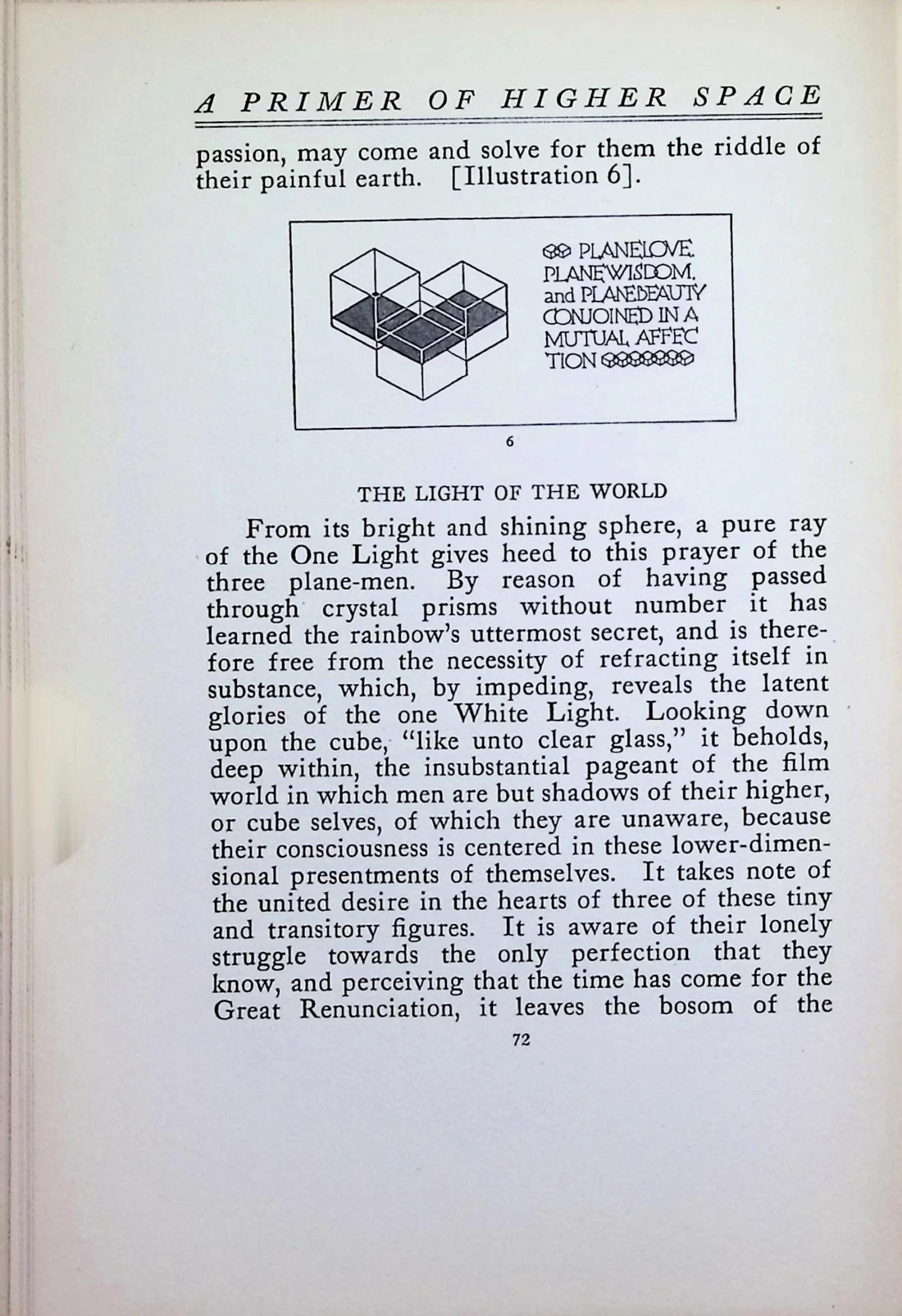
Illustration 6 depicts three cubes touching along their faces. The sermon later imagines this relation extended to every cube.
Claude Bragdon, A Primer of Higher Space, The Manas Press, 1913. Stickley Museum scan via Internet Archive. · Image source ↗ · Public Domain
The Secret Doctrine by Helena P. Blavatsky
In The Secret Doctrine, Helena P. Blavatsky compares a person’s appearance at one moment with the cross-section of a metal bar as it passes through the surface of water. The intersection shows only part of the object. Bragdon quotes this comparison when explaining the longer identity he represents by a cube. [7][6]
Unbinding in the Udāna, translated by Ṭhānissaro Bhikkhu
Udāna 8.1 describes unbinding as an end to stress. It rules out coming and going, passing away and arising, and even the sphere of infinite consciousness. [2]
Two uses of the same word
Udāna 8.1 describes release in terms that exclude ordinary processes and even refined states of consciousness. Bragdon gives Nirvana a specific meaning within his parable, in which the union of higher selves allows experience to be shared. [4][5][2]
In the library
A Primer of Higher Space
Reading note
The separately titled account draws on exact passages in the consulted Library edition.
Sources
See references (8)
- Man the Square, illustration 6, the three plane dwellers joined ↗Claude Bragdon, A Primer of Higher Space, The Manas Press, 1913. Stickley Museum scan via Internet Archive.
- Udāna 8.1, Unbinding ↗Nibbāna Sutta, Udāna 8.1, translated by Ṭhānissaro Bhikkhu.
- A Primer of Higher Space, printed p. 76, Reader page 79Claude Bragdon, A Primer of Higher Space (The Fourth Dimension), The Manas Press, Rochester, New York, 1913. Lumitheca Library edition IMJ-0599-E001.Read this page in A Primer of Higher Space ↗
- A Primer of Higher Space, printed p. 77, Reader page 80Claude Bragdon, A Primer of Higher Space (The Fourth Dimension), The Manas Press, Rochester, New York, 1913. Lumitheca Library edition IMJ-0599-E001.Read this page in A Primer of Higher Space ↗
- A Primer of Higher Space, printed p. 78, Reader page 81Claude Bragdon, A Primer of Higher Space (The Fourth Dimension), The Manas Press, Rochester, New York, 1913. Lumitheca Library edition IMJ-0599-E001.Read this page in A Primer of Higher Space ↗
- A Primer of Higher Space, Reader page 82Claude Bragdon, A Primer of Higher Space (The Fourth Dimension), The Manas Press, Rochester, New York, 1913. Lumitheca Library edition IMJ-0599-E001.Read this page in A Primer of Higher Space ↗
- The Secret Doctrine, vol. I, Stanza I.2, printed p. 37 ↗Helena P. Blavatsky, The Secret Doctrine, vol. I, Stanza I.2, printed p. 37.
- A Primer of Higher Space, printed p. 72, Reader page 75Claude Bragdon, A Primer of Higher Space (The Fourth Dimension), The Manas Press, Rochester, New York, 1913. Lumitheca Library edition IMJ-0599-E001.Read this page in A Primer of Higher Space ↗