Nezha
Nezha is a protector deity in Chinese folk religion. In the tales, a clash with the Dragon Kings ends his first life and a teacher gives him a body made of lotus plants.
In this article
Who is Nezha?
Nezha is a protector deity in Chinese folk religion. Look for a boy with a spear, a ring and a flowing sash, borne aloft on wheels of wind and fire. The wheels come late in his story, after the quarrel with the Dragon Kings and his return to life in a body made of lotus plants. [1][2][3]
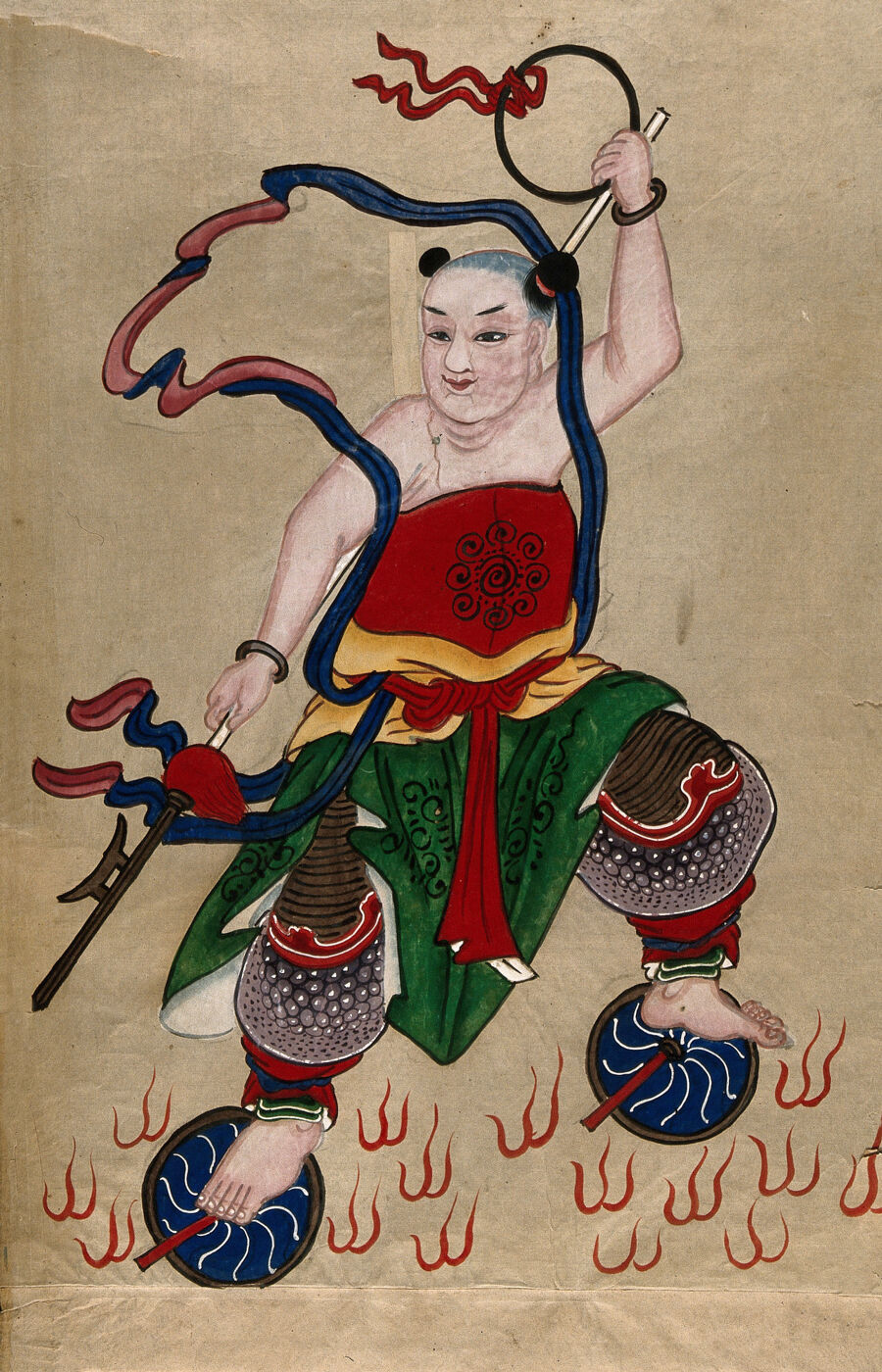
An unidentified nineteenth-century Chinese artist shows Nezha with the ring, sash, spear and wind-fire wheels that identify him.
Unidentified Chinese artist. Nezha, a Chinese deity with spear, walking on fire. ca. 1850. Wellcome Collection. Public Domain. · Image source ↗ · Public Domain
In The Chinese Fairy Book
Richard Wilhelm’s The Chinese Fairy Book, translated by Frederick H. Martens, calls the boy Notscha. At his birth a teacher identifies him as a primordial pearl given to Li Jing’s family. A dispute with the Dragon King of the Eastern Sea draws in the other rulers of the four seas, and Nezha takes responsibility when the dragons threaten his parents. [4][5]
After Nezha dies, his teacher first asks his mother to build a shrine where incense offerings might return him to bodily life. The teacher later gives him a body made from lotus plants and equips him with fiery wheels. The conflict with his father continues until another sacred figure confines Nezha in a magic pagoda and gives it to Li Jing. [5][2][3]
The same story gives Nezha three heads and eight arms. In The Ape Sun Wu Kung, Nezha confronts the Monkey King in a form with three heads and six arms. Sun Wukong copies that appearance. [6][7]
How to recognise Nezha in art
The Wellcome painting shows one face and two hands. In Wilhelm’s collection, Nezha takes a form with three heads and eight arms in his own tale, and one with three heads and six arms when he fights Sun Wukong. The ring, sash and wheels can identify him even as his form changes. [1][4][2][6][7]
In the library
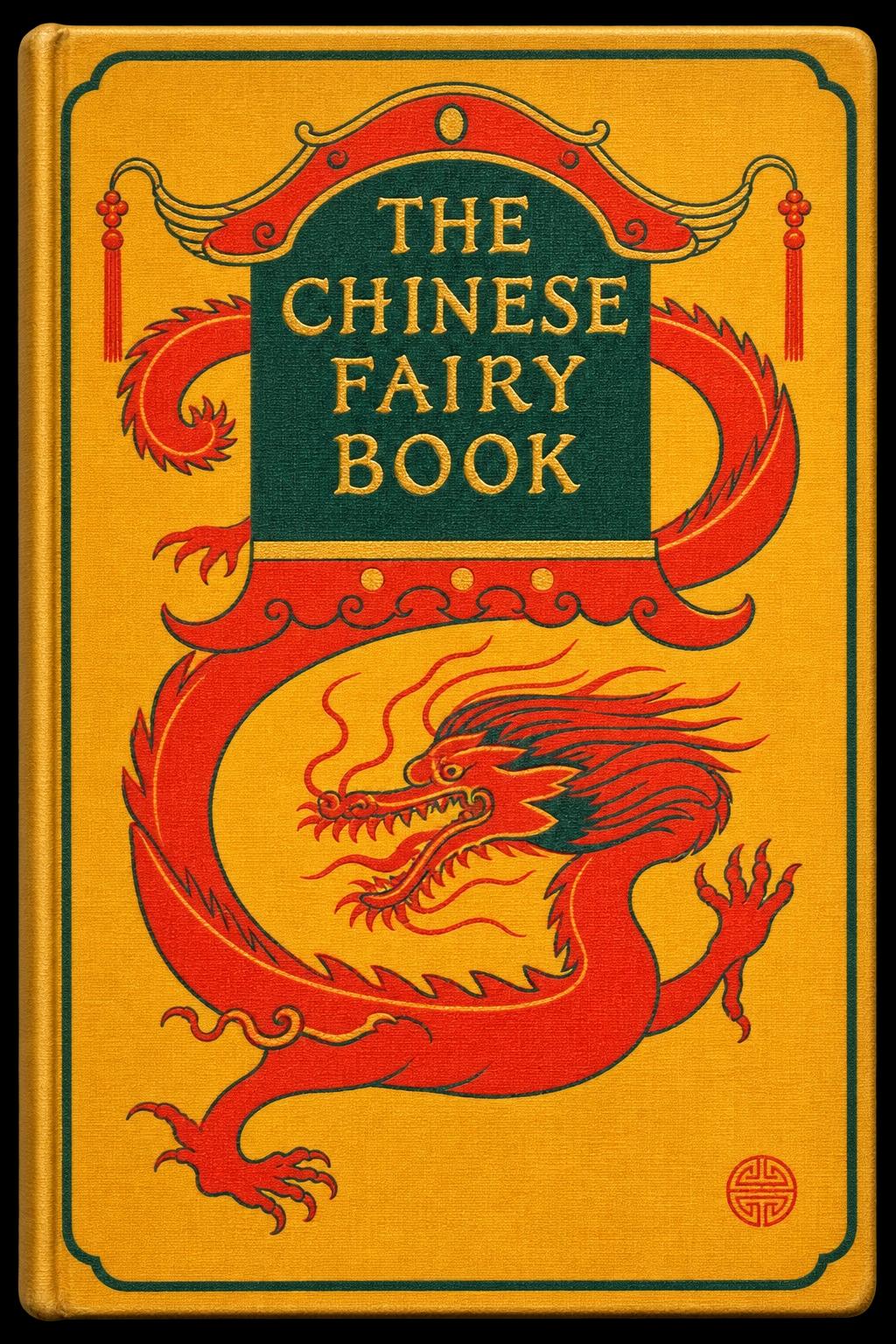
The Chinese Fairy Book
Reading note
Read how Nezha receives the lotus body and compare his appearance when he confronts the Monkey King.
Sources
See references (7)
- Nezha, a Chinese deity with spear, walking on fire ↗Unidentified Chinese artist. Nezha, a Chinese deity with spear, walking on fire. ca. 1850. Wellcome Collection. Public Domain.
- The Chinese Fairy Book, Library Reader page 62Richard Wilhelm, editor. Frederick H. Martens, translator. The Chinese Fairy Book. Frederick A. Stokes Company, New York, 1921. Lumitheca Library edition IMJ-0478-E002.Read this page in The Chinese Fairy Book ↗
- The Chinese Fairy Book, Library Reader page 63Richard Wilhelm, editor. Frederick H. Martens, translator. The Chinese Fairy Book. Frederick A. Stokes Company, New York, 1921. Lumitheca Library edition IMJ-0478-E002.Read this page in The Chinese Fairy Book ↗
- The Chinese Fairy Book, Library Reader page 57Richard Wilhelm, editor. Frederick H. Martens, translator. The Chinese Fairy Book. Frederick A. Stokes Company, New York, 1921. Lumitheca Library edition IMJ-0478-E002.Read this page in The Chinese Fairy Book ↗
- The Chinese Fairy Book, Library Reader page 60Richard Wilhelm, editor. Frederick H. Martens, translator. The Chinese Fairy Book. Frederick A. Stokes Company, New York, 1921. Lumitheca Library edition IMJ-0478-E002.Read this page in The Chinese Fairy Book ↗
- The Chinese Fairy Book, Library Reader page 64Richard Wilhelm, editor. Frederick H. Martens, translator. The Chinese Fairy Book. Frederick A. Stokes Company, New York, 1921. Lumitheca Library edition IMJ-0478-E002.Read this page in The Chinese Fairy Book ↗
- The Chinese Fairy Book, Library Reader page 336Richard Wilhelm, editor. Frederick H. Martens, translator. The Chinese Fairy Book. Frederick A. Stokes Company, New York, 1921. Lumitheca Library edition IMJ-0478-E002.Read this page in The Chinese Fairy Book ↗