Nested Dimensional Spaces
How can a plane contain infinitely many lines? Follow Bragdon from points and parallel slices to his analogy for collective consciousness.
In this article
A family of slices inside a space
A space can contain sections with fewer dimensions than the whole. Fix a height in a plane and you select a line. Fix a height in three-dimensional space and you select a plane. Varying the height gives a family of parallel sections, each with one fewer free coordinate. [3][4][5][6]
A Primer of Higher Space by Claude Bragdon
In A Primer of Higher Space, Claude Bragdon follows points within a line, lines within a plane, and planes within a solid. The containing space also makes new relations possible. A plane gives a circle room for chords and tangents. In three dimensions the circle can appear as a section through a sphere or cone. [7][5][6]
On Plate 11, Bragdon uses those families of sections as an analogy for consciousness. He compares each person’s limited view with a lower-dimensional section and imagines all those views together as a larger consciousness. [6]
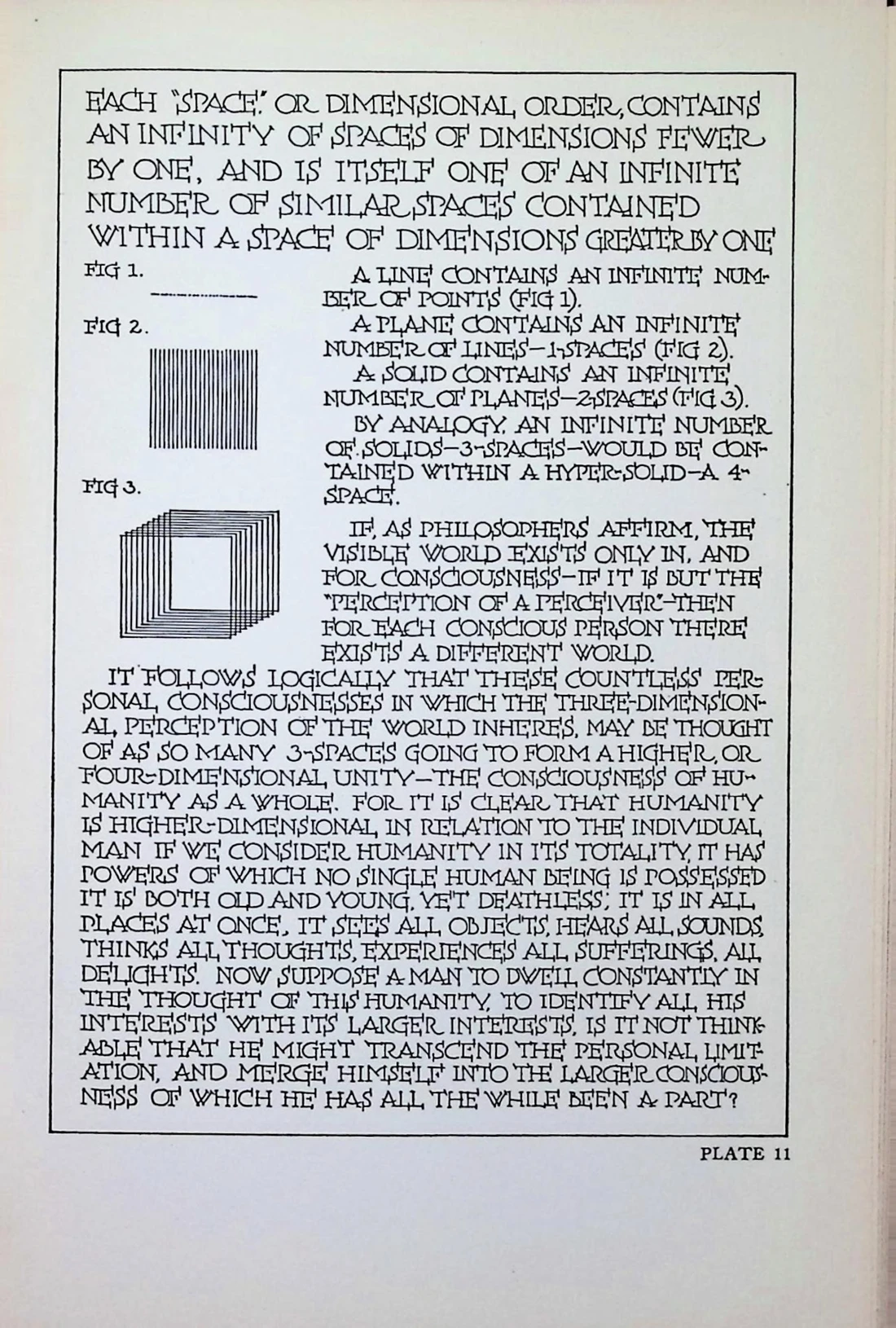
Plate 11 pictures a plane as a family of lines and a solid as a stack of planes. A note below the drawings applies the analogy to consciousness.
Claude Bragdon, A Primer of Higher Space, The Manas Press, 1913. Stickley Museum scan via Internet Archive. · Image source ↗ · Public Domain
Flatland by Edwin A. Abbott
In Edwin A. Abbott’s Flatland, the Sphere leads the Square to Pointland after reviewing Flatland, Lineland and Spaceland. The Point has no way to conceive of another being. It even takes the Square’s words as thoughts of its own. [2]
Different ways to use a hierarchy of spaces
Abbott asks what a being at each level can know. Bragdon asks how the parts can belong to a larger whole, then uses that relation to imagine a consciousness larger than the individual’s. [7][6][2]
In the library
A Primer of Higher Space
Reading note
The separately titled account draws on exact passages in the consulted Library edition.
Sources
See references (7)
- Plate 11, lower-dimensional spaces contained in higher ones ↗Claude Bragdon, A Primer of Higher Space, The Manas Press, 1913. Stickley Museum scan via Internet Archive.
- Flatland, second edition, Part II, section 20 ↗Edwin A. Abbott, Flatland: A Romance of Many Dimensions, second edition, Part II, section 20, How the Sphere Encouraged Me in a Vision.
- A Primer of Higher Space, printed p. 7, Reader page 14Claude Bragdon, A Primer of Higher Space (The Fourth Dimension), The Manas Press, Rochester, New York, 1913. Lumitheca Library edition IMJ-0599-E001.Read this page in A Primer of Higher Space ↗
- A Primer of Higher Space, printed p. 8, Reader page 15Claude Bragdon, A Primer of Higher Space (The Fourth Dimension), The Manas Press, Rochester, New York, 1913. Lumitheca Library edition IMJ-0599-E001.Read this page in A Primer of Higher Space ↗
- A Primer of Higher Space, Plate 10, Reader page 39Claude Bragdon, A Primer of Higher Space (The Fourth Dimension), The Manas Press, Rochester, New York, 1913. Lumitheca Library edition IMJ-0599-E001.Read this page in A Primer of Higher Space ↗
- A Primer of Higher Space, Plate 11, Reader page 40Claude Bragdon, A Primer of Higher Space (The Fourth Dimension), The Manas Press, Rochester, New York, 1913. Lumitheca Library edition IMJ-0599-E001.Read this page in A Primer of Higher Space ↗
- A Primer of Higher Space, Plate 9, Reader page 38Claude Bragdon, A Primer of Higher Space (The Fourth Dimension), The Manas Press, Rochester, New York, 1913. Lumitheca Library edition IMJ-0599-E001.Read this page in A Primer of Higher Space ↗