Nama-Rupa
Nama-rupa means name and form. Compare the Buddhist analysis of experience in SN 12.2 with Vivekananda on thought, symbols and conditioned existence.
In this article
Understanding the concept
Nama-rupa means name and form. Its meaning changes with the teaching that uses it. In SN 12.2, the Buddhist analysis joins mental activity and material form. Vivekananda uses the pair to discuss both how thought finds expression and how existence becomes subject to causation. [2][3][1]
A reader can meet the same words while reading about different things. One passage explains what belongs to an experience. Another asks how a thought becomes connected to a word or symbol. [2][4][3]
The Buddhist discourse on dependent co-arising: SN 12.2
In Saṃyutta Nikāya 12.2, translated by Thanissaro Bhikkhu, name includes feeling, perception, intention, contact and attention. Form comprises the four great elements and the material form dependent on them. The pair is one link in the sequence the discourse uses to explain the arising of suffering. [1]
Karma-Yoga by Swami Vivekananda
Swami Vivekananda introduces nama-rupa while arguing that words and ideas belong together. He includes forms of expression other than sound, then describes a form corresponding to a thought. This provides a bridge from language to the concrete symbols of religious practice. [5][2]
His claim is stronger than saying that communities use convenient labels. He argues against language and religious symbols being inventions made by agreement alone. The passage expresses his view of a natural association between mind and form; it is not offered here as a settled account of how languages originate. [5][2]
In the chapter on freedom, Vivekananda uses the pair again. He says the world a person can think about is bounded by space, time and causation. Once existence takes on name and form, it enters that field of conditions. [4][3]
This later use explains why the term matters to a book about work. Action and its effects belong to the conditioned world from which the spiritual discipline seeks freedom. A discussion that began with symbols consequently enters Vivekananda’s account of bondage and liberation. [6][4][3][7]
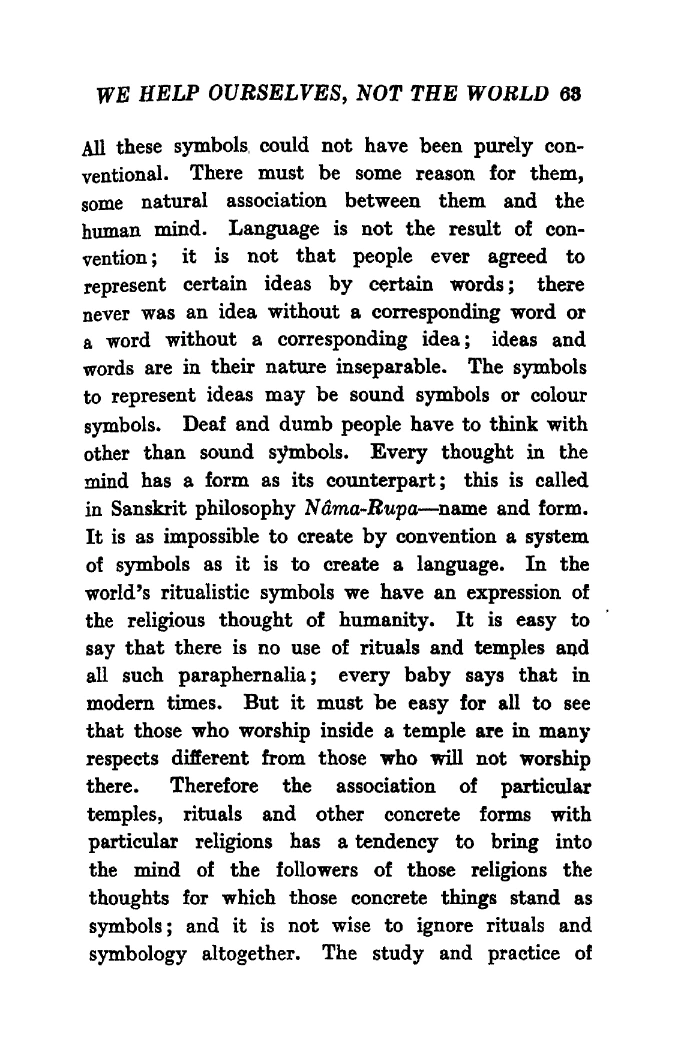
Karma-Yoga (1939), Library Reader page 65. Vivekananda introduces name and form while discussing thought and language.
Swami Vivekananda, Karma-Yoga, English second printing in the 1939 combined volume. Historical public-domain text, exact checksum-verified Library scan. · Image source ↗ · Public Domain
Experience, expression and causation
SN 12.2 uses name for activities such as attention and contact. In his discussion of symbols, Vivekananda follows the relation between a thought, the word that expresses it and the form associated with it. His chapter on freedom takes the pair into a further argument about the conditions under which action has effects. [1][2][3]
Read further in the library
Karma Yoga
Reading note
The separately titled account draws on exact passages in the consulted Library edition.
Sources
See references (7)
- Analysis of Dependent Co-arising, SN 12.2, translated by Thanissaro Bhikkhu ↗Samyutta Nikaya 12.2, translated from Pali by Thanissaro Bhikkhu, Access to Insight, BCBS edition, 30 November 2013. The definitions and dependent-arising sequence were consulted; not an unverified Library edition.Return to text ↑
- Karma-Yoga, Reader page 65Swami Vivekananda, Karma-Yoga, in Karma-Yoga & Bhakti-Yoga, English second printing, Ramakrishna-Vivekananda Center of New York, Inc., 1939. Exact Library edition IMJ-0097-E002. Only the Karma-Yoga part is used in this crawl; the old Work slug mentioning Hindi does not identify this edition’s language.Read this page in Karma Yoga ↗Return to text ↑
- Karma-Yoga, Reader page 95Swami Vivekananda, Karma-Yoga, in Karma-Yoga & Bhakti-Yoga, English second printing, Ramakrishna-Vivekananda Center of New York, Inc., 1939. Exact Library edition IMJ-0097-E002. Only the Karma-Yoga part is used in this crawl; the old Work slug mentioning Hindi does not identify this edition’s language.Read this page in Karma Yoga ↗Return to text ↑
- Karma-Yoga, Reader page 94Swami Vivekananda, Karma-Yoga, in Karma-Yoga & Bhakti-Yoga, English second printing, Ramakrishna-Vivekananda Center of New York, Inc., 1939. Exact Library edition IMJ-0097-E002. Only the Karma-Yoga part is used in this crawl; the old Work slug mentioning Hindi does not identify this edition’s language.Read this page in Karma Yoga ↗Return to text ↑
- Karma-Yoga, Reader page 64Swami Vivekananda, Karma-Yoga, in Karma-Yoga & Bhakti-Yoga, English second printing, Ramakrishna-Vivekananda Center of New York, Inc., 1939. Exact Library edition IMJ-0097-E002. Only the Karma-Yoga part is used in this crawl; the old Work slug mentioning Hindi does not identify this edition’s language.Read this page in Karma Yoga ↗Return to text ↑
- Karma-Yoga, Reader page 93Swami Vivekananda, Karma-Yoga, in Karma-Yoga & Bhakti-Yoga, English second printing, Ramakrishna-Vivekananda Center of New York, Inc., 1939. Exact Library edition IMJ-0097-E002. Only the Karma-Yoga part is used in this crawl; the old Work slug mentioning Hindi does not identify this edition’s language.Read this page in Karma Yoga ↗Return to text ↑
- Karma-Yoga, printed p. 96, Reader page 98Swami Vivekananda, Karma-Yoga, in Karma-Yoga & Bhakti-Yoga, English second printing, Ramakrishna-Vivekananda Center of New York, Inc., 1939. Exact Library edition IMJ-0097-E002. Only the Karma-Yoga part is used in this crawl; the old Work slug mentioning Hindi does not identify this edition’s language.Read this page in Karma Yoga ↗Return to text ↑