Mucalinda, the Nāga Who Sheltered the Buddha
Meet Mucalinda, the nāga king who sheltered the newly awakened Buddha. Compare the Pāli account with Alice Getty’s retelling and the serpent canopy in Buddhist art.
In this article
Who is Mucalinda?
Mucalinda, also spelled Muccalinda, is the nāga king who shelters the Buddha from a storm shortly after his awakening. A nāga is a serpent being. In this story, the serpent’s coils and spread hood protect the seated Buddha. [4][1]
The Muccalinda Sutta in the Udāna
In Ṭhānissaro Bhikkhu’s translation of the Pāli Muccalinda Sutta, the newly awakened Buddha sits near the Nerañjarā River. The storm lasts seven days. Muccalinda wraps seven coils around him and spreads his hood over him. When the skies clear, the nāga takes human form and pays homage. [4]
The sutta leaves the cause of the storm open and closes with a verse on solitude, restraint and letting go of conceit. Getty’s account uses the same act of shelter to emphasise a different teaching. The seven coils in the sutta describe the serpent’s body. [4][1][3]
The Gods of Northern Buddhism by Alice Getty
Alice Getty’s account gives the storm an adversary. Māra sends the elements to disturb the Buddha’s meditation, and Mucalinda’s shelter illustrates the protection the Buddha gains through practising the perfections. [1]
Getty’s illustrations distinguish two episodes. Plate VII shows the young Gautama’s first bath. In Plate LVIII, the lower figures show the Buddha seated under a nāga hood. The seat and canopy identify the iconography associated with shelter. [2][3]
The serpent canopy in Buddhist art
Seven heads fan out above the Buddha in this Angkor-period sandstone. The Metropolitan Museum of Art reconstructs the missing lower part with the Buddha seated on the nāga’s coils. What survives shows how the spread hood becomes a canopy over a figure deep in meditation. [5][3]
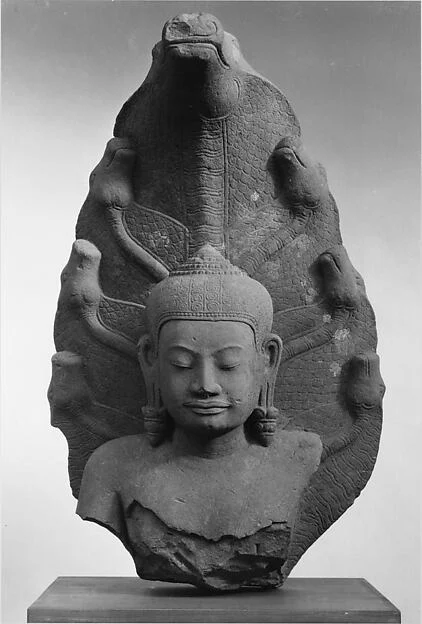
Buddha Protected by a Seven-headed Naga, a Cambodian sandstone fragment from the Angkor period. The serpent’s hood survives above the Buddha, while the lower sculpture is lost.
The Metropolitan Museum of Art. Buddha Protected by a Seven-headed Naga. Angkor period, Cambodia, late 12th to early 13th century. Fletcher Fund, 1936. Accession 36.96.5. · Image source ↗ · CC0
In the library
The Gods of Northern Buddhism
Reading note
Getty’s account of nāgas, the storm and serpent-hood images.
Sources
See references (5)
- The Gods of Northern Buddhism, printed p. 172, Reader page 219Alice Getty, The Gods of Northern Buddhism, 1928 revised second edition, Munshiram Manoharlal reprint. Lumitheca Library edition IMJ-0597-E001.Read this page in The Gods of Northern Buddhism ↗
- The Gods of Northern Buddhism, Plate VII, Reader page 273Alice Getty, The Gods of Northern Buddhism, 1928 revised second edition, Munshiram Manoharlal reprint. Lumitheca Library edition IMJ-0597-E001.Read this page in The Gods of Northern Buddhism ↗
- The Gods of Northern Buddhism, Plate LVIII, Reader page 325Alice Getty, The Gods of Northern Buddhism, 1928 revised second edition, Munshiram Manoharlal reprint. Lumitheca Library edition IMJ-0597-E001.Read this page in The Gods of Northern Buddhism ↗
- Muccalinda Sutta, Udāna 2.1 ↗Muccalinda Sutta, Udāna 2.1, translated from the Pāli by Ṭhānissaro Bhikkhu.
- Buddha Protected by a Seven-headed Naga ↗The Metropolitan Museum of Art. Buddha Protected by a Seven-headed Naga. Angkor period, Cambodia, late 12th to early 13th century. Fletcher Fund, 1936. Accession 36.96.5.