Motion-in-Inertia in Walter Russell
Walter Russell’s motion-in-inertia describes a balance between opposing pressures. Learn how he relates it to visible form, wave motion and inertia.
In this article
What is in balance?
Motion-in-inertia is Walter Russell’s term for the condition in which opposing pressures balance. He calls the condition associated with visible matter motion-in-opposition. The two terms describe parts of a cycle in his cosmology. [3][4][5]
The Universal One by Walter Russell
In The Universal One, Walter Russell calls the place where opposed pressures neutralise the inertial plane. He puts it between areas of opposing potential and assigns the gases he calls master tones to motion-in-inertia. [3][4][5]
In his account of generation and radiation, an earlier impulse carries motion through the point of balance. Russell calls that continuation inertial energy. He compares the crossing to passing the dead centre in a mechanism. [6][7]
Principia by Isaac Newton
In the Principia, Isaac Newton describes a body that remains at rest or in uniform straight motion until an impressed force changes that state. [2]

A seventeenth-century Fromanteel wall clock gives the mechanical pendulum in the comparison a historical example.
Ahasuerus I Fromanteel, Hooded Wall Clock with Calendar. The Metropolitan Museum of Art. Bequest of Irwin Untermyer, 1973. · Image source ↗ · CC0
Inertia in two systems
Newton’s law describes the persistence of a body’s state of motion. Russell’s terminology describes a balance of pressures and the passage from one phase of his cycle into another. [3][6][7][2]
In the library
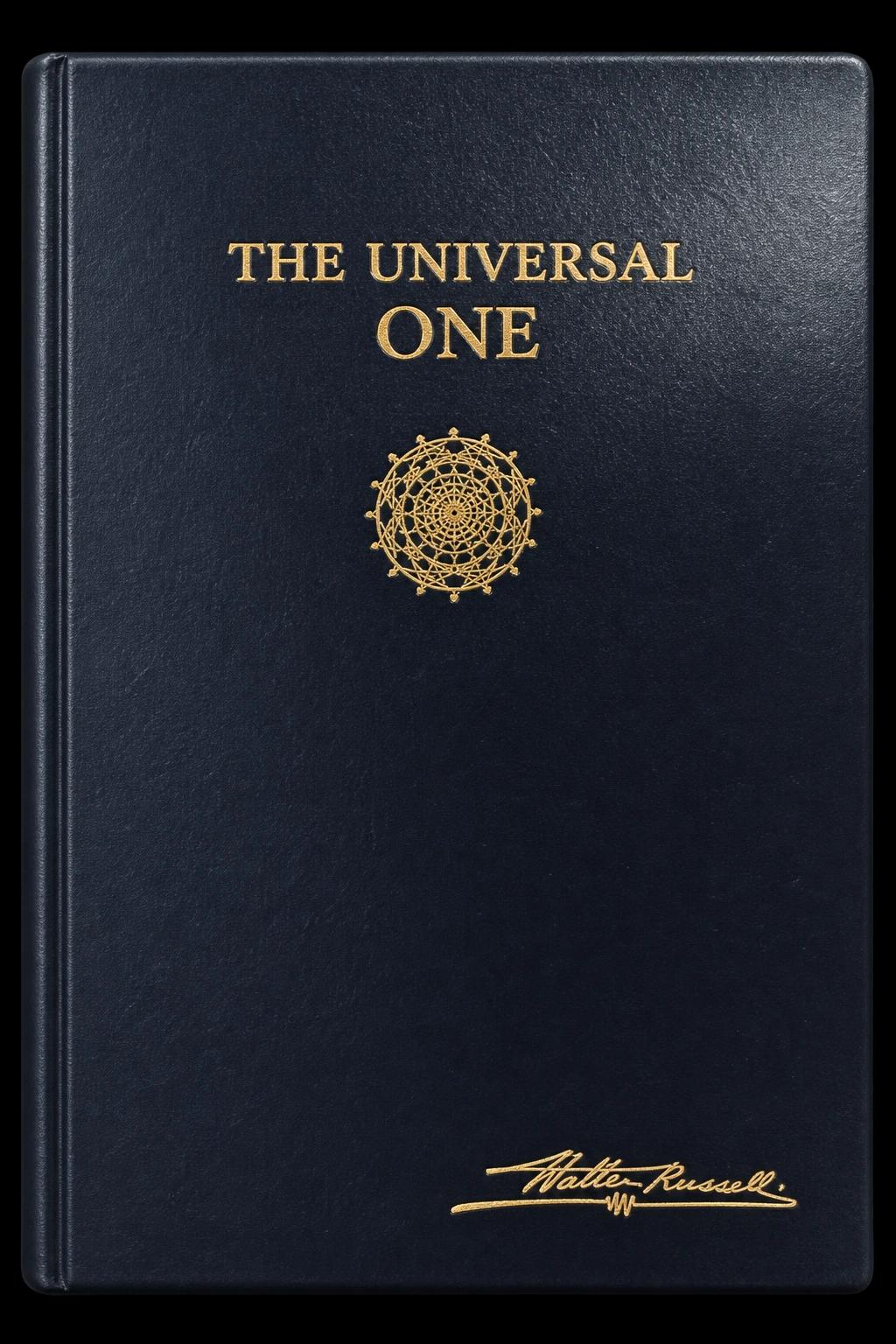
The Universal One
Reading note
The separately titled account draws on exact passages in the consulted Library edition.
Sources
See references (7)
- Ahasuerus I Fromanteel, Hooded Wall Clock with Calendar ↗Ahasuerus I Fromanteel, Hooded Wall Clock with Calendar. The Metropolitan Museum of Art. Bequest of Irwin Untermyer, 1973.
- Principia, Axioms or Laws of Motion, Law I ↗Isaac Newton, The Mathematical Principles of Natural Philosophy, volume I, translated by Andrew Motte, 1729, first law of motion.
- The Universal One, printed p. 22, Reader page 21Walter Russell, The Universal One, edited by Louise Russell, University of Science and Philosophy, Limited Edition De Luxe. Lumitheca Library edition IMJ-0605-E001.Read this page in The Universal One ↗
- The Universal One, printed p. 23, Reader page 22Walter Russell, The Universal One, edited by Louise Russell, University of Science and Philosophy, Limited Edition De Luxe. Lumitheca Library edition IMJ-0605-E001.Read this page in The Universal One ↗
- The Universal One, printed p. 28, Reader page 27Walter Russell, The Universal One, edited by Louise Russell, University of Science and Philosophy, Limited Edition De Luxe. Lumitheca Library edition IMJ-0605-E001.Read this page in The Universal One ↗
- The Universal One, printed p. 35, Reader page 34Walter Russell, The Universal One, edited by Louise Russell, University of Science and Philosophy, Limited Edition De Luxe. Lumitheca Library edition IMJ-0605-E001.Read this page in The Universal One ↗
- The Universal One, printed p. 36, Reader page 35Walter Russell, The Universal One, edited by Louise Russell, University of Science and Philosophy, Limited Edition De Luxe. Lumitheca Library edition IMJ-0605-E001.Read this page in The Universal One ↗