Money in the afterlife
Does money matter after death in J. S. M. Ward’s books? Compare an astral curio shop, a miser’s hoard and the shopkeeper who cannot stop selling.
In this article
Understanding money in the afterlife
In J. S. M. Ward’s afterlife stories, a shop can still have a dealer, goods and visitors even when an exchange requires no money. The stories ask which parts of buying and selling would remain if the need to pay for everyday things ended. [1][2][3]
Ward gives trade more than one purpose. A dealer can share an interest and let a visitor take something. A miser can continue to count his money. A sale can also keep someone repeating an activity they cannot imagine leaving. [1][3]
A Subaltern in Spirit Land by J. S. M. Ward
In J. S. M. Ward’s A Subaltern in Spirit Land, H. J. L. obtains chessmen from an astral curio shop. Destroyed ivory objects gather among others of their kind, and an old dealer has settled in the shop because it suits his interests. H. J. L. is shown several sets and allowed to choose without paying. [1]
The guide admits that some people sell and cheat as they did on earth, but he has not sought money himself. He supposes that its astral forms can survive like other objects and recalls a miser counting a hoard in a small villa despite larger empty houses nearby. [1][2]
H. J. L. doubts that astral gold could be melted into coin or that the money in a paper offering would circulate. He has never tried to acquire money there himself. The curio shop is an encounter he recounts; his answer about currency is a conjecture. [2][3]
He finally describes monetary trade as a habit best relinquished. Food and new clothing are not necessities in the setting he describes, and objects such as chessmen can be obtained without money. The criticism concerns treating an obsolete earthly requirement as the organising principle of continued life. [3]
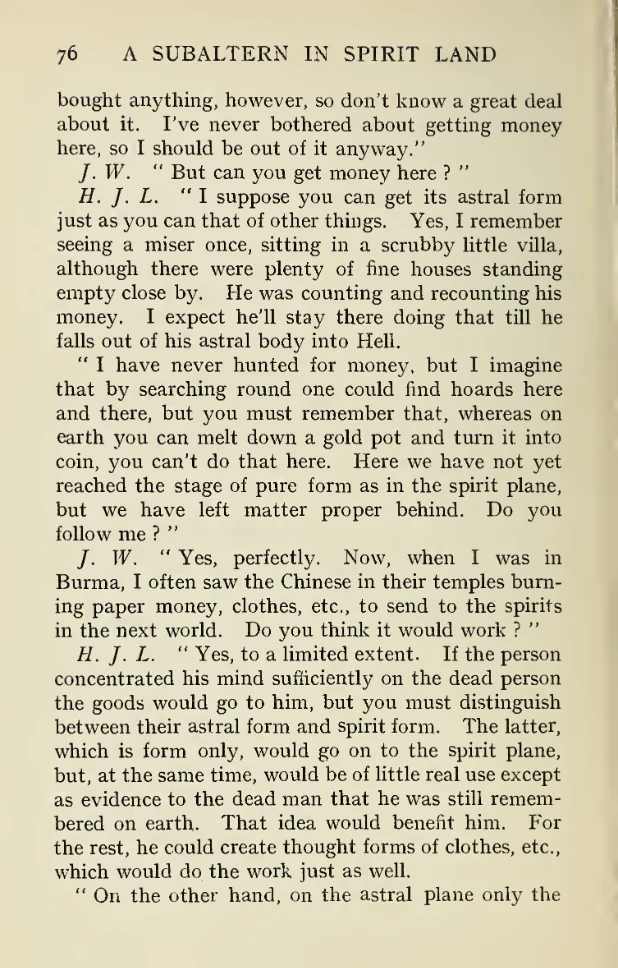
Source facsimile: A Subaltern in Spirit Land (1920), printed p. 76, Reader page 91.
J. S. M. Ward, A Subaltern in Spirit Land. William Rider & Son, 1920. Public-domain historical text and page image, extracted from the checksum-verified retained Library scan. · Image source ↗ · Public Domain
Gone West by J. S. M. Ward
The shopkeeper in Gone West remains bound to selling goods that return immediately after sale. His inability to imagine another activity makes trade a form of repetition. Factories in the same division continue producing objects they cannot permanently dispose of. [4][5]
What is left of a sale when payment is optional?
The curio dealer lets H. J. L. choose chessmen. The shopkeeper in Gone West keeps selling the same goods as they come back to him. An object can give two collectors something to share, or it can keep a person absorbed in a routine. [1][2][3][4][5]
H. J. L. speaks from experience about the chessmen. He is less certain about how coins might be made or used. That difference between seeing an exchange and inferring how currency would work limits what the sequel claims. [1][2]
Read further in the library
A Subaltern in Spirit Land: A Sequel to Gone West
Reading note
The separately titled account draws on exact passages in the consulted Library edition.

Gone West
Reading note
Separately attributed comparison with exact previously researched Library passages.
Sources
See references (5)
- A Subaltern in Spirit Land, printed p. 75, Reader page 90J. S. M. Ward, A Subaltern in Spirit Land: A Sequel to Gone West. William Rider & Son, London, 1920. Narrated experiences and explanations are attributed to Ward and his reported spirit contributors, especially his brother Rex (R. L. W.) and H. J. L.Read this page in A Subaltern in Spirit Land: A Sequel to Gone West ↗Return to text ↑
- A Subaltern in Spirit Land, printed p. 76, Reader page 91J. S. M. Ward, A Subaltern in Spirit Land: A Sequel to Gone West. William Rider & Son, London, 1920. Narrated experiences and explanations are attributed to Ward and his reported spirit contributors, especially his brother Rex (R. L. W.) and H. J. L.Read this page in A Subaltern in Spirit Land: A Sequel to Gone West ↗Return to text ↑
- A Subaltern in Spirit Land, printed p. 77, Reader page 92J. S. M. Ward, A Subaltern in Spirit Land: A Sequel to Gone West. William Rider & Son, London, 1920. Narrated experiences and explanations are attributed to Ward and his reported spirit contributors, especially his brother Rex (R. L. W.) and H. J. L.Read this page in A Subaltern in Spirit Land: A Sequel to Gone West ↗Return to text ↑
- Gone West, printed p. 153, Reader page 166J. S. M. Ward, Gone West: Three Narratives of After-Death Experiences, third impression, William Rider & Son, London, 1920, as reproduced in Geoff Cutler’s December 2009 digital transcription. Ward’s introduction is distinct from the supplied 1974 foreword.Read this page in Gone West ↗Return to text ↑
- Gone West, printed p. 154, Reader page 167J. S. M. Ward, Gone West: Three Narratives of After-Death Experiences, third impression, William Rider & Son, London, 1920, as reproduced in Geoff Cutler’s December 2009 digital transcription. Ward’s introduction is distinct from the supplied 1974 foreword.Read this page in Gone West ↗Return to text ↑