Mirror Reversal in Astral Perception
In Steiner’s account of astral perception, a number appears reversed and an outward wish seems to approach its maker. The mirror is a model for interpretation.
In this article
Understanding the concept
Mirror reversal is a rule Rudolf Steiner proposes for interpreting astral perception. An inward wish can appear outside the person who made it, moving back towards them even when they had directed it outwards. [1][2]
Steiner explains the reversal with a number as well as a wish. The examples ask how someone can recognise their own part in an image that seems to have come from elsewhere. [3][1][2][4]
Initiation and Its Results by Rudolf Steiner
In Initiation and Its Results, Rudolf Steiner says inner qualities appear as outward shapes. The student may be able to affect some forms but be unable to alter others already projected from the student’s own desires. The field therefore includes expressions of the observer as well as things initially treated as separate objects. [5][3][1]
A person sees 265 and, by Steiner’s proposed rule, reads it as 562. A wish appears to travel in the opposite direction from the one in which it was sent. The same reversal makes an outgoing passion look like an animal rushing towards its maker. [2]
Self-examination gives the learner something to compare the image with. Someone who recognises a familiar desire can consider whether the shape comes from that desire before assuming it belongs to another being. [2][4]
Steiner treats this encounter as a stage before relations to higher beings become possible. A vivid or menacing appearance cannot, in his account, be classified correctly merely from its intensity. Its origin and relation to the observer must be considered. [1][2][4][6]
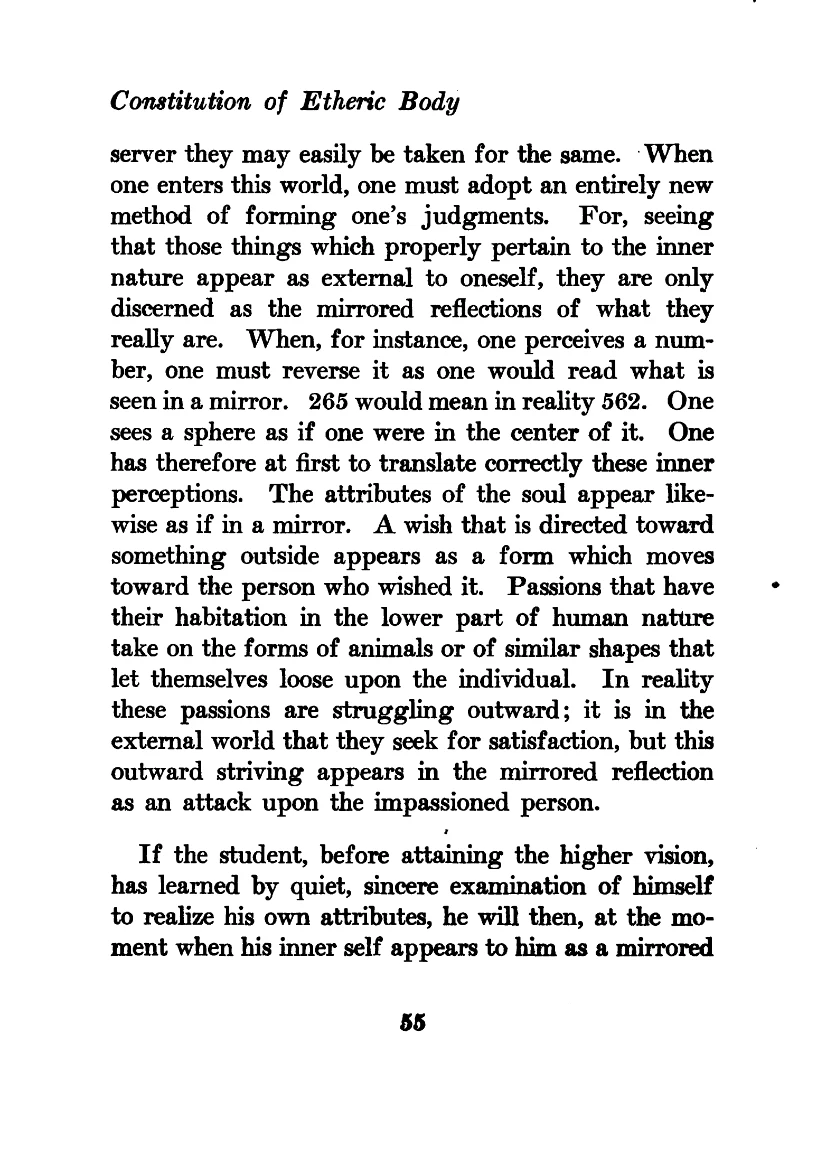
Initiation and Its Results (1909), printed p. 55, Library Reader page 54. Steiner gives the reversed number and the wish that appears to approach its maker.
Rudolf Steiner, Initiation and Its Results, Clifford Bax translation, First American Edition, 1909. Public-domain historical page from the checksum-verified Library PDF. · Image source ↗ · Public Domain
See references (6)
- Initiation and Its Results, printed p. 54, Reader page 53
- Initiation and Its Results, printed p. 55, Reader page 54
- Initiation and Its Results, printed p. 53, Reader page 52
- Initiation and Its Results, printed p. 56, Reader page 55
- Initiation and Its Results, printed p. 52, Reader page 51
- Initiation and Its Results, printed p. 57, Reader page 56
A Wanderer in the Spirit Lands: Franchezzo, transcribed by A. Farnese
Franchezzo, in the narrative transcribed by A. Farnese, enters a valley where his own doubts and suspicions take threatening shapes. He recognises them as thought-creations from his past. The ordeal ends with their dispersal, exhaustion and a subsequent period of care. [7][8][9]
Recognising what the image belongs to
Steiner uses the mirror to explain why an appearance can seem foreign and still belong to the observer. Recognising the source is part of what he means by learning to interpret a perception. [1][2][4][3]
Franchezzo recognises what he sees in the Valley of Phantom Mists as the suspicions he carried there. Steiner sets out a more general account in which both order and direction can change. The valley offers a story of recognising a thought, while the number illustrates a specific interpretive rule. [7][8][9][3][1][2][4]
See references (7)
- Initiation and Its Results, printed p. 54, Reader page 53
- Initiation and Its Results, printed p. 55, Reader page 54
- Initiation and Its Results, printed p. 53, Reader page 52
- Initiation and Its Results, printed p. 56, Reader page 55
- A Wanderer in the Spirit Lands, printed p. 244, Reader page 253
- A Wanderer in the Spirit Lands, printed p. 245, Reader page 254
- A Wanderer in the Spirit Lands, printed p. 246, Reader page 255
Read further in the library

Initiation and Its Results
Reading note
The separately titled account draws on exact passages in the consulted Library edition.

A Wanderer in the Spirit Lands
Reading note
Separately attributed comparison with exact previously researched Library passages.
Sources
See references (9)
- Initiation and Its Results, printed p. 54, Reader page 53Rudolf Steiner, Initiation and Its Results: A Sequel to The Way of Initiation, translated by Clifford Bax. First American Edition, 1909. Macoy Publishing and Masonic Supply Co., New York; Max Gysi, London. Claims of clairvoyant perception and subtle organs remain attributed. References identify the exact consulted Library edition.Read this page in Initiation and Its Results ↗Return to text ↑
- Initiation and Its Results, printed p. 55, Reader page 54Rudolf Steiner, Initiation and Its Results: A Sequel to The Way of Initiation, translated by Clifford Bax. First American Edition, 1909. Macoy Publishing and Masonic Supply Co., New York; Max Gysi, London. Claims of clairvoyant perception and subtle organs remain attributed. References identify the exact consulted Library edition.Read this page in Initiation and Its Results ↗Return to text ↑
- Initiation and Its Results, printed p. 53, Reader page 52Rudolf Steiner, Initiation and Its Results: A Sequel to The Way of Initiation, translated by Clifford Bax. First American Edition, 1909. Macoy Publishing and Masonic Supply Co., New York; Max Gysi, London. Claims of clairvoyant perception and subtle organs remain attributed. References identify the exact consulted Library edition.Read this page in Initiation and Its Results ↗Return to text ↑
- Initiation and Its Results, printed p. 56, Reader page 55Rudolf Steiner, Initiation and Its Results: A Sequel to The Way of Initiation, translated by Clifford Bax. First American Edition, 1909. Macoy Publishing and Masonic Supply Co., New York; Max Gysi, London. Claims of clairvoyant perception and subtle organs remain attributed. References identify the exact consulted Library edition.Read this page in Initiation and Its Results ↗Return to text ↑
- Initiation and Its Results, printed p. 52, Reader page 51Rudolf Steiner, Initiation and Its Results: A Sequel to The Way of Initiation, translated by Clifford Bax. First American Edition, 1909. Macoy Publishing and Masonic Supply Co., New York; Max Gysi, London. Claims of clairvoyant perception and subtle organs remain attributed. References identify the exact consulted Library edition.Read this page in Initiation and Its Results ↗Return to text ↑
- Initiation and Its Results, printed p. 57, Reader page 56Rudolf Steiner, Initiation and Its Results: A Sequel to The Way of Initiation, translated by Clifford Bax. First American Edition, 1909. Macoy Publishing and Masonic Supply Co., New York; Max Gysi, London. Claims of clairvoyant perception and subtle organs remain attributed. References identify the exact consulted Library edition.Read this page in Initiation and Its Results ↗Return to text ↑
- A Wanderer in the Spirit Lands, printed p. 244, Reader page 253A Wanderer in the Spirit Lands, attributed to the spirit Franchezzo and transcribed by A. Farnese. W. J. Sinkins, London. Title page undated; preface dated 1896. The narrator’s experiences and the guides’ explanations are reported claims, not independently established observations.Read this page in A Wanderer in the Spirit Lands ↗Return to text ↑
- A Wanderer in the Spirit Lands, printed p. 245, Reader page 254A Wanderer in the Spirit Lands, attributed to the spirit Franchezzo and transcribed by A. Farnese. W. J. Sinkins, London. Title page undated; preface dated 1896. The narrator’s experiences and the guides’ explanations are reported claims, not independently established observations.Read this page in A Wanderer in the Spirit Lands ↗Return to text ↑
- A Wanderer in the Spirit Lands, printed p. 246, Reader page 255A Wanderer in the Spirit Lands, attributed to the spirit Franchezzo and transcribed by A. Farnese. W. J. Sinkins, London. Title page undated; preface dated 1896. The narrator’s experiences and the guides’ explanations are reported claims, not independently established observations.Read this page in A Wanderer in the Spirit Lands ↗Return to text ↑