Miracles
A miracle is an event understood as a sign of divine power. Explore the role of testimony, religious recognition and different explanations of an extraordinary event.
In this article
What is a miracle?
A miracle is an event understood as an extraordinary act or sign of divine power. In Christianity the meaning of a miracle includes what an event is taken to reveal about God. Two people may agree that something unexpected happened and disagree about what caused it. [5][6]
In John 11:38–44, Jesus calls Lazarus from the tomb. The Gospel links the event to belief that Jesus was sent by God. Salvator Rosa’s drawing gives that Gospel scene a visible form. The story makes clear why the event and its religious significance are considered together. [25][4]
Christian writers have asked whether a miracle departs from nature’s usual course or belongs to an order people only partly understand. A further question is how testimony could support either interpretation in a particular case. [5][6][21][22]
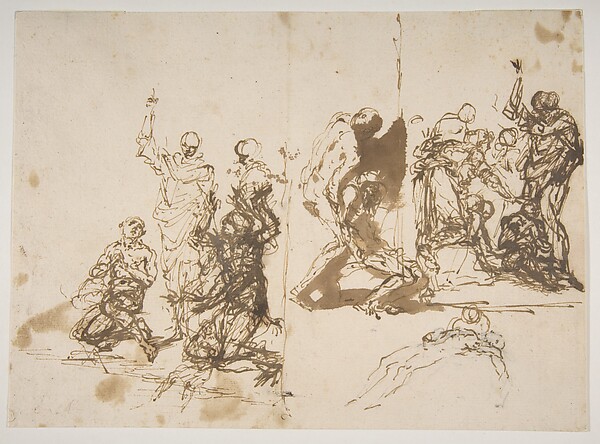
Salvator Rosa, The Raising of Lazarus, seventeenth century. The drawing depicts the Gospel episode in which Jesus calls Lazarus from the tomb.
Salvator Rosa. The Metropolitan Museum of Art, Harris Brisbane Dick Fund, 1938; 38.179.2. Public Domain. · Image source ↗ · Public Domain
See references (9)
- Dicastery for the Doctrine of the Faith, Norms for proceeding in the Discernment of alleged Supernatural Phenomena, 17 May 2024
- Salvator Rosa, The Raising of Lazarus, The Met 38.179.2
- The Other World, Reader page 36
- The Other World, Reader page 37
- The Other World, Reader page 527
- The Other World, Reader page 528
- Evolution of Immortality, printed p. 20, Reader page 17
- Evolution of Immortality, printed p. 21, Reader page 18
- John 11:38–44: The raising of Lazarus
The Other World, edited by Frederick George Lee
Frederick George Lee’s The Other World grounds miracles in divine freedom. God creates the laws of nature and can act beyond their ordinary course for a religious purpose. Lee invokes Thomas Aquinas in support of this definition. The miracle is meaningful because it points to an agent and intention; its wonder is not simply that something rare has happened. [5]
Lee distinguishes the possibility of a miracle from the credibility of a report. He says that a reader could accept God’s capacity to act and still have reason to doubt a particular witness. [5][6]
Lee also considers laws of nature that people do not yet know. An observer might see a departure from an ordinary pattern or a consequence within a wider order. He leaves that question open in principle. [6]
His discussion of ecclesiastical inquiry gives the question an institutional setting. He describes requirements for reported recoveries, scrutiny of witnesses and an official whose task is to raise objections. The passage’s interest lies partly in the distinction between a person being persuaded and an investigating body deciding that the evidence meets its own standard. [7][8][9]
Lee supports that distinction with stories of outsiders who allegedly consider cases conclusive, only to learn that the church authorities have not accepted them as sufficiently proved. The anecdotes are his evidence for a rigorous process. They do not independently demonstrate that every investigation was adequate, or turn an appeal to an institution’s reputation into proof of a particular recovery. [8][9]
The chapter also crosses a confessional boundary. Lee quotes Bishop Joseph Hall on a reported recovery at Madron’s Well and on the inference of unseen angelic assistance. The narrative supplies a claimed change in the man’s condition and a theological interpretation of it. These remain separate contributions even when the witness finds their connection compelling. [9][10]
Evolution of Immortality: Rosicruciæ, catalogued as Freeman Benjamin Dowd
Evolution of Immortality, written as Rosicruciæ and catalogued as Freeman Benjamin Dowd, explains Jesus’ appearances through developed spiritual powers. A perfected body is said to become perceptible and to be withdrawn again. In the concluding chapter, the Christ spirit takes up the body and later causes its disappearance. The author treats such events as expressions of a wider account of spirit, form and human development. The account is a particular esoteric interpretation of Christian narratives, not a statement accepted by all Christians. [21][22][23][24]
David Hume on miraculous testimony
David Hume’s Enquiry approaches the problem through competing evidence. In Section X, especially paragraphs 11–13, he weighs testimony for an extraordinary event against experience supporting the regularity it would overturn. He asks whether a witness being mistaken or deceptive is more probable than the event reported. The issue is the strength of an inference, not merely the sincerity of the teller. [1]
Lee begins by asking whether God can act beyond the ordinary course. Hume starts with the relative weight of evidence for two explanations. Together they show why possibility and proof are separate questions. [1][5][6]
Recognition and religious purpose
Lee describes a historical process, including numerical requirements that should not be read as a current checklist. The USCCB’s published explanation gives a different usual pattern for beatification and canonization, notes the exception concerning a martyr’s beatification and allows papal dispensations. The purpose of the particular decision matters alongside its evidential standard. [3]
The 2024 norms for discerning alleged supernatural phenomena describe another kind of judgement. A nihil obstat can acknowledge pastoral value without certifying supernatural authenticity. Encouraging a devotion and proving a divine cause are therefore distinct conclusions in that document. This should not be confused with approval of a miracle in an individual cause of sainthood. [2]
What can the report establish?
An unexplained event and a demonstrated suspension of nature are different conclusions. To call an event unexplained identifies a limit in the available account. To identify divine intervention supplies a cause and religious meaning. Lee’s own discussion of hidden laws makes it especially important to keep that additional step visible. [5][6]
Likewise, an account of recovery should retain its actual sequence. Did the person appear close to death, was death established, or does the narrative concern restored movement or relief from pain? Lee’s collection includes different kinds of episodes. Their devotional importance need not be reduced to one stronger claim that every witness described a return from death. [11][12][13][14][15][16][17][18][19][20]
Lee begins with God’s freedom to act beyond the ordinary course, while also allowing that hidden laws may widen our understanding of nature. Dowd places extraordinary bodily appearances within a theory of developed spiritual powers. They can therefore discuss related Christian narratives while giving a different account of how the extraordinary belongs to the world. Agreement on religious vocabulary does not establish agreement on causation. [21][22][23][24][5][6]
See references (16)
- The Other World, Reader page 36
- The Other World, Reader page 37
- The Other World, Reader page 102
- The Other World, Reader page 103
- The Other World, Reader page 104
- The Other World, Reader page 121
- The Other World, Reader page 122
- The Other World, Reader page 123
- The Other World, Reader page 124
- The Other World, Reader page 116
- The Other World, Reader page 117
- The Other World, Reader page 118
- Evolution of Immortality, printed p. 20, Reader page 17
- Evolution of Immortality, printed p. 21, Reader page 18
- Evolution of Immortality, printed p. 127, Reader page 126
- Evolution of Immortality, printed p. 128, Reader page 127
In the library
The Other World
Reading note
The separately titled account draws on exact passages in the consulted Library edition.
Evolution of Immortality
Reading note
Separately attributed comparison with exact previously researched Library passages.
Sources
See references (25)
- David Hume, An Enquiry Concerning Human Understanding, Section X, especially E 10.11–13 ↗David Hume’s primary text, consulted through Hume Texts Online, using its section and paragraph identifiers. This is a separately consulted philosophical argument, not a passage assigned an invented Library page reference.
- Dicastery for the Doctrine of the Faith, Norms for proceeding in the Discernment of alleged Supernatural Phenomena, 17 May 2024 ↗Official primary document, especially Presentation, Part I B 17 and Part II Article 22. A pastoral nihil obstat does not certify supernatural authenticity. Distinct from the requirements for a miracle in a cause of sainthood.
- United States Conference of Catholic Bishops, Saints: beatification and canonization ↗USCCB’s own published explanation of causes of sainthood. Consulted for its account of required miracles, martyrdom and papal dispensations; nineteenth-century numbers in Lee are not treated as current universal requirements.
- Salvator Rosa, The Raising of Lazarus, The Met 38.179.2 ↗The Metropolitan Museum of Art, Harris Brisbane Dick Fund, 1938. Seventeenth-century pen-and-ink drawing with wash. Own catalogue and Open Access API confirm public-domain image status.
- The Other World, Reader page 36Frederick George Lee, editor, The Other World; or, Glimpses of the Supernatural, two volumes, Henry S. King and Co., London, 1875. Exact consulted Library edition IMJ-0657-E001. Narratives and embedded quotations are attributed to this compilation; an original author is not represented as independently consulted merely because Lee quotes them. Reader positions are verified separately from printed pagination.Read this page in The Other World ↗
- The Other World, Reader page 37Frederick George Lee, editor, The Other World; or, Glimpses of the Supernatural, two volumes, Henry S. King and Co., London, 1875. Exact consulted Library edition IMJ-0657-E001. Narratives and embedded quotations are attributed to this compilation; an original author is not represented as independently consulted merely because Lee quotes them. Reader positions are verified separately from printed pagination.Read this page in The Other World ↗
- The Other World, Reader page 527Frederick George Lee, editor, The Other World; or, Glimpses of the Supernatural, two volumes, Henry S. King and Co., London, 1875. Exact consulted Library edition IMJ-0657-E001. Narratives and embedded quotations are attributed to this compilation; an original author is not represented as independently consulted merely because Lee quotes them. Reader positions are verified separately from printed pagination.Read this page in The Other World ↗
- The Other World, Reader page 528Frederick George Lee, editor, The Other World; or, Glimpses of the Supernatural, two volumes, Henry S. King and Co., London, 1875. Exact consulted Library edition IMJ-0657-E001. Narratives and embedded quotations are attributed to this compilation; an original author is not represented as independently consulted merely because Lee quotes them. Reader positions are verified separately from printed pagination.Read this page in The Other World ↗
- The Other World, Reader page 529Frederick George Lee, editor, The Other World; or, Glimpses of the Supernatural, two volumes, Henry S. King and Co., London, 1875. Exact consulted Library edition IMJ-0657-E001. Narratives and embedded quotations are attributed to this compilation; an original author is not represented as independently consulted merely because Lee quotes them. Reader positions are verified separately from printed pagination.Read this page in The Other World ↗
- The Other World, Reader page 530Frederick George Lee, editor, The Other World; or, Glimpses of the Supernatural, two volumes, Henry S. King and Co., London, 1875. Exact consulted Library edition IMJ-0657-E001. Narratives and embedded quotations are attributed to this compilation; an original author is not represented as independently consulted merely because Lee quotes them. Reader positions are verified separately from printed pagination.Read this page in The Other World ↗
- The Other World, Reader page 102Frederick George Lee, editor, The Other World; or, Glimpses of the Supernatural, two volumes, Henry S. King and Co., London, 1875. Exact consulted Library edition IMJ-0657-E001. Narratives and embedded quotations are attributed to this compilation; an original author is not represented as independently consulted merely because Lee quotes them. Reader positions are verified separately from printed pagination.Read this page in The Other World ↗
- The Other World, Reader page 103Frederick George Lee, editor, The Other World; or, Glimpses of the Supernatural, two volumes, Henry S. King and Co., London, 1875. Exact consulted Library edition IMJ-0657-E001. Narratives and embedded quotations are attributed to this compilation; an original author is not represented as independently consulted merely because Lee quotes them. Reader positions are verified separately from printed pagination.Read this page in The Other World ↗
- The Other World, Reader page 104Frederick George Lee, editor, The Other World; or, Glimpses of the Supernatural, two volumes, Henry S. King and Co., London, 1875. Exact consulted Library edition IMJ-0657-E001. Narratives and embedded quotations are attributed to this compilation; an original author is not represented as independently consulted merely because Lee quotes them. Reader positions are verified separately from printed pagination.Read this page in The Other World ↗
- The Other World, Reader page 121Frederick George Lee, editor, The Other World; or, Glimpses of the Supernatural, two volumes, Henry S. King and Co., London, 1875. Exact consulted Library edition IMJ-0657-E001. Narratives and embedded quotations are attributed to this compilation; an original author is not represented as independently consulted merely because Lee quotes them. Reader positions are verified separately from printed pagination.Read this page in The Other World ↗
- The Other World, Reader page 122Frederick George Lee, editor, The Other World; or, Glimpses of the Supernatural, two volumes, Henry S. King and Co., London, 1875. Exact consulted Library edition IMJ-0657-E001. Narratives and embedded quotations are attributed to this compilation; an original author is not represented as independently consulted merely because Lee quotes them. Reader positions are verified separately from printed pagination.Read this page in The Other World ↗
- The Other World, Reader page 123Frederick George Lee, editor, The Other World; or, Glimpses of the Supernatural, two volumes, Henry S. King and Co., London, 1875. Exact consulted Library edition IMJ-0657-E001. Narratives and embedded quotations are attributed to this compilation; an original author is not represented as independently consulted merely because Lee quotes them. Reader positions are verified separately from printed pagination.Read this page in The Other World ↗
- The Other World, Reader page 124Frederick George Lee, editor, The Other World; or, Glimpses of the Supernatural, two volumes, Henry S. King and Co., London, 1875. Exact consulted Library edition IMJ-0657-E001. Narratives and embedded quotations are attributed to this compilation; an original author is not represented as independently consulted merely because Lee quotes them. Reader positions are verified separately from printed pagination.Read this page in The Other World ↗
- The Other World, Reader page 116Frederick George Lee, editor, The Other World; or, Glimpses of the Supernatural, two volumes, Henry S. King and Co., London, 1875. Exact consulted Library edition IMJ-0657-E001. Narratives and embedded quotations are attributed to this compilation; an original author is not represented as independently consulted merely because Lee quotes them. Reader positions are verified separately from printed pagination.Read this page in The Other World ↗
- The Other World, Reader page 117Frederick George Lee, editor, The Other World; or, Glimpses of the Supernatural, two volumes, Henry S. King and Co., London, 1875. Exact consulted Library edition IMJ-0657-E001. Narratives and embedded quotations are attributed to this compilation; an original author is not represented as independently consulted merely because Lee quotes them. Reader positions are verified separately from printed pagination.Read this page in The Other World ↗
- The Other World, Reader page 118Frederick George Lee, editor, The Other World; or, Glimpses of the Supernatural, two volumes, Henry S. King and Co., London, 1875. Exact consulted Library edition IMJ-0657-E001. Narratives and embedded quotations are attributed to this compilation; an original author is not represented as independently consulted merely because Lee quotes them. Reader positions are verified separately from printed pagination.Read this page in The Other World ↗
- Evolution of Immortality, printed p. 20, Reader page 17Rosicruciæ (catalogued as Freeman Benjamin Dowd), Evolution of Immortality. Eulian Publishing Company, Salem, 1900.Read this page in Evolution of Immortality ↗
- Evolution of Immortality, printed p. 21, Reader page 18Rosicruciæ (catalogued as Freeman Benjamin Dowd), Evolution of Immortality. Eulian Publishing Company, Salem, 1900.Read this page in Evolution of Immortality ↗
- Evolution of Immortality, printed p. 127, Reader page 126Rosicruciæ (catalogued as Freeman Benjamin Dowd), Evolution of Immortality. Eulian Publishing Company, Salem, 1900.Read this page in Evolution of Immortality ↗
- Evolution of Immortality, printed p. 128, Reader page 127Rosicruciæ (catalogued as Freeman Benjamin Dowd), Evolution of Immortality. Eulian Publishing Company, Salem, 1900.Read this page in Evolution of Immortality ↗
- John 11:38–44: The raising of Lazarus ↗Gospel of John, New American Bible, USCCB