The Minotaur, Ariadne and the Labyrinth
Follow Ariadne’s thread through the Minotaur myth. Compare the ancient versions, a Knossos labyrinth coin and Dante’s later encounter.
In this article
From the doorway to the centre and back
Follow the part Ariadne plays before Theseus enters, then see what the coin and the artworks make of the story.
Follow Ariadne’s thread
Open each stop in the route from Pseudo-Apollodorus’s Epitome.
1Ariadne asks DaedalusBefore the entrance
Ariadne makes an agreement with Theseus and asks Daedalus to show her the way out. She obtains the thread that makes the return possible.
Read about this stop2Theseus ties the threadAt the doorway
Theseus secures one end at the entrance. As he walks in, he draws the line after him.
Read about this stop3Theseus meets the MinotaurIn the innermost part
The Epitome brings Theseus and the Minotaur together in the interior. The Attic vase gives the struggle a visual form, with Theseus gripping the creature.
Read about this stop4He follows the thread outBack to the doorway
The line that led inward is still attached at the entrance. Theseus follows it back to the door.
Read about this stop5Ariadne and Theseus leave CreteOut at sea
They sail away with the rescued young people. Accounts diverge over what subsequently happens to Ariadne.
Read about this stop
What is the Minotaur’s labyrinth?
The Minotaur is the bull-headed creature that Minos confines in a labyrinth built by Daedalus in Greek myth. Theseus enters the enclosure with a way to find the exit: the thread Ariadne has obtained from Daedalus. It guides him back after the fight. A successful return depends on keeping track of the entrance while travelling inward. [2][1][7]
The Library calls the Minotaur Asterius and connects his birth to Pasiphae and the bull. It describes the confinement as Minos’s response after the birth. Ovid places a different emphasis on the design. His Daedalus makes passages so deceptive that even the builder has trouble retracing them. That feature makes the thread’s purpose plain. [2][3]
Why does Ariadne give Theseus the thread?
In Pseudo-Apollodorus’s Epitome, Ariadne offers to help if Theseus will take her to Athens and make her his wife. She then asks Daedalus to show her the way out. Theseus receives the thread through her. The plot therefore gives the three figures different tasks: Daedalus knows how the enclosure works, Ariadne obtains help and Theseus puts it to use. [1]
Plutarch reports that many writers credit Ariadne with the thread and the instructions, then goes on to give other accounts of the Cretan expedition. When a later retelling says simply that Theseus outwitted the maze, compare the moment in the two ancient texts that explains who made the return possible. [1][4]
What happens inside the labyrinth?
Theseus fastens the thread at the door, then draws it behind him on his way in. He meets the Minotaur in the innermost part. The Epitome says he kills it with his fists, then follows the thread back out. On the Attic amphora, he grapples with the creature while wearing a scabbard at his side. The possible figure of Ariadne stands beside the action. The change from text to image makes the fight recognisable by a different means. [1][8]
Ovid gives the enclosure much of the attention. He pictures its paths with the bends of a river and passes quickly over the contest before returning to Ariadne’s thread. The winding itself explains the need to find the route back. The story’s point of difficulty can shift between the creature, the building and the act of leaving it. [3][1]
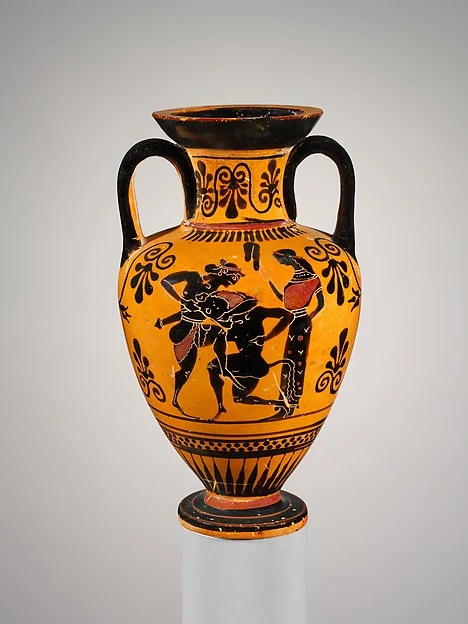
The Met identifies the female onlooker tentatively as Ariadne. The small amphora concentrates on the fight, while the later Roman relief below gives the thread and the departure their own scenes.
Attributed to the Edinburgh Painter, Attic neck-amphora, ca. 500 BCE. The Metropolitan Museum of Art, Rogers Fund, 1921, 21.88.92. Open Access. · Image source ↗ · Public Domain
What happens to Ariadne after the escape?
The Epitome has Theseus and Ariadne sail away with the rescued young people. It then gives Dionysus a role in her departure from Naxos. Ovid makes Theseus abandon her and Bacchus come to her aid. Plutarch records multiple incompatible stories about her fate. The escape from the labyrinth is shared, while the account of what follows depends on the author. [1][3][4]
The Roman sarcophagus puts the gift of the thread, the fight and the sleeping Ariadne into separate scenes. Its sculptor makes the sequence legible even though the scenes are surrounded by elaborate garlands. Follow the relief across the front and compare its chosen moments with the greater attention to the actual path in Ovid. [9][3]
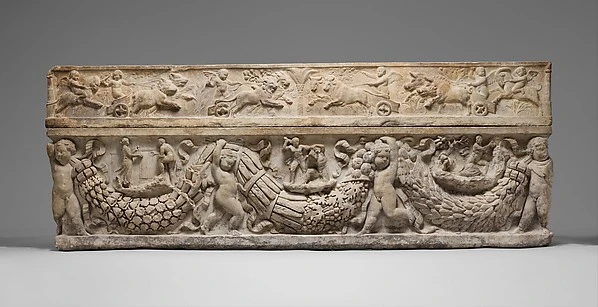
Read the front from left to right above the garlands: Ariadne gives the thread, Theseus fights the Minotaur, and Ariadne sleeps on Naxos. The scenes occupy the front of a Roman sarcophagus.
Roman, Marble sarcophagus with garlands and the myth of Theseus and Ariadne, ca. 130–150 CE. The Metropolitan Museum of Art, Purchase by subscription, 1890, 90.12a, b. Open Access. · Image source ↗ · Public Domain
What does the Knossos labyrinth coin show?
The pictured silver stater carries a square labyrinth on its reverse. The photograph’s record dates it to roughly 300–270 BCE. The Ashmolean’s separate Knossian example illustrates how the labyrinth became a civic emblem and how some coins added a small Minotaur. That choice can be seen on the coin even when the work gives no continuous narrative alongside it. [10][5]
The Ashmolean distinguishes a coin pattern that offers a single route from the bewildering passages found in the literature. The palace complex at Knossos belongs to Bronze Age archaeological history. Much later, Arthur Evans named it the Palace of Minos and drew connections with the myth. For a careful reading, keep each piece of evidence with its date and purpose: a story’s route, a city’s emblem and an excavated building. [5][6][3]
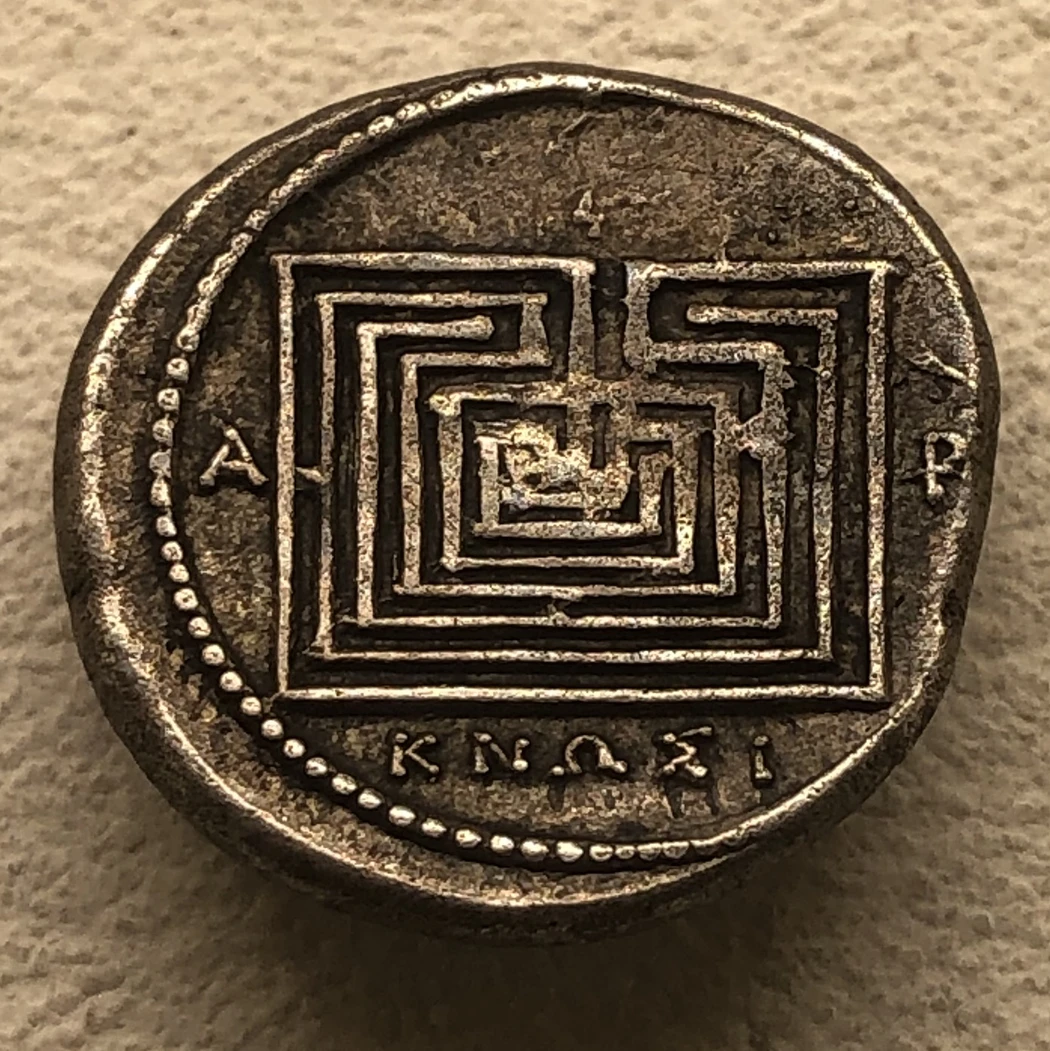
Labyrinth reverse of a silver stater attributed to Knossos, ca. 300–270 BCE, photographed at TEFAF. The small square design is a civic coin type from the Greek period.
Hispalois, Knossos stater with labyrinth, photograph taken at TEFAF, 2020, via Wikimedia Commons. Resized and converted to WebP. CC BY-SA 4.0. · Image source ↗ · CC BY-SA 4.0
Where does Dante put the Minotaur?
Dante places the Minotaur at the broken descent into the seventh circle in Inferno XII. Virgil reminds the enraged creature of its encounter with the king of Athens and uses the moment to lead Dante down the slope. The allusion brings the old story into a different kind of passage: the travellers need to get past the guardian. Both exact Cary pages show how the rage and descent follow one another. [11][12]
Read further in the library
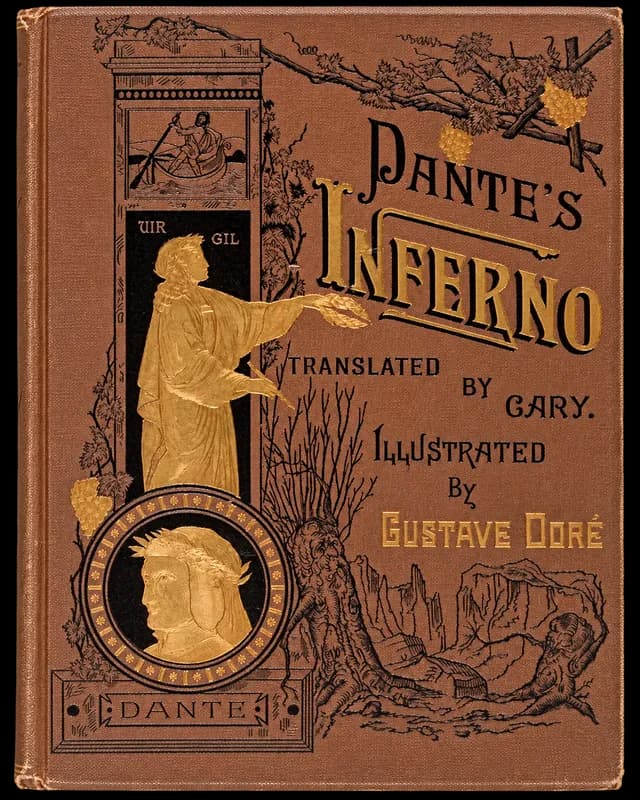
Dante's Inferno
Reading note
Read how Cary’s Dante reuses the defeat of the Minotaur at a different threshold.
Sources
See references (12)
- Pseudo-Apollodorus, Epitome 1.6–10 · The expedition, thread and return ↗James George Frazer’s translation, Perseus Digital Library.Return to text ↑
- Pseudo-Apollodorus, Library 3.1.4 · Pasiphae, the Minotaur and the enclosure ↗James George Frazer’s translation, Theoi Classical Texts Library.Return to text ↑
- Ovid, Metamorphoses 8.152–182 · Daedalus builds the labyrinth and Ariadne aids the return ↗Brookes More’s translation, Theoi Classical Texts Library.Return to text ↑
- Plutarch, Life of Theseus 19–20 · The thread and competing reports ↗Bernadotte Perrin’s translation, University of Chicago LacusCurtius.Return to text ↑
- Ashmolean Museum · The Knossian labyrinth coin type ↗Ashmolean Museum exhibition essay, including a separate example HCR 4579.Return to text ↑
- Ashmolean Museum · Knossos, Arthur Evans and the Palace of Minos ↗Ashmolean Museum exhibition resource on Minoan Crete and later myths.Return to text ↑
- The Met · Theseus, Hero of Athens ↗Department of Greek and Roman Art, object-based overview.Return to text ↑
- Attic neck-amphora with Theseus and the Minotaur ↗Attributed to the Edinburgh Painter, Attic neck-amphora, ca. 500 BCE. The Metropolitan Museum of Art, Rogers Fund, 1921, 21.88.92. Open Access.Return to text ↑
- Roman sarcophagus with scenes of Theseus and Ariadne ↗Roman, Marble sarcophagus with garlands and the myth of Theseus and Ariadne, ca. 130–150 CE. The Metropolitan Museum of Art, Purchase by subscription, 1890, 90.12a, b. Open Access.Return to text ↑
- Silver stater from Knossos with labyrinth reverse ↗Hispalois, Knossos stater with labyrinth, photograph taken at TEFAF, 2020, via Wikimedia Commons. Resized and converted to WebP. CC BY-SA 4.0.Return to text ↑
- Cary’s Inferno XII · The Minotaur at the broken ridgeDante Alighieri, Inferno, translated by Henry Francis Cary. Thompson & Thomas, Lumitheca edition IMJ-0082-E001, source leaf 97.Read this page in Dante's Inferno ↗Return to text ↑
- Cary’s Inferno XII · Virgil urges Dante to descendDante Alighieri, Inferno, translated by Henry Francis Cary. Thompson & Thomas, Lumitheca edition IMJ-0082-E001, source leaf 98.Read this page in Dante's Inferno ↗Return to text ↑