Mesmerism
Mesmerism, or animal magnetism, was a theory of an invisible fluid. See Mesmer’s magnetic tub, period caricatures and what the 1784 commission found.
In this article
What is mesmerism?
Mesmerism, or animal magnetism, was a theory and treatment associated with Franz Anton Mesmer in the late eighteenth century. Mesmer and his followers thought an invisible fluid acted on living bodies and that practitioners could influence it, sometimes treating several patients around a shared tub. [2][3][1]
In 1784 a royal commission investigated the work of Charles d’Eslon, a physician who practised animal magnetism. Its members found no evidence for the fluid and attributed the reactions they observed to factors including touch, expectation and imitation. [1]
Witchcraft Magic & Alchemy by Grillot de Givry
Grillot de Givry reproduces a print of patients gathered round the covered tub, called a baquet. He describes attendants sweeping their hands past patients and patients touching fingertips to form a chain. Practitioners interpreted fits and trances as part of a cure. [2][3]
De Givry describes supporters who compared the alleged fluid to electricity, and critics who interpreted the treatment in religious terms. The second print, a 1785 caricature, plays on that charge by showing demons swarming around the tub. [3][4]
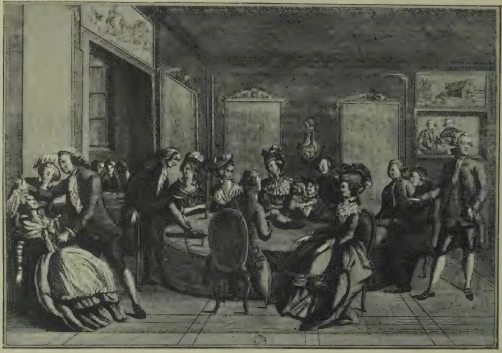
A popular print of Mesmer’s magnetic tub from the De Vinck collection. De Givry reproduces it as figure 307.
Historical print, Bibliothèque nationale de France, De Vinck collection no. 900. Reproduced by De Givry. · Image source ↗ · Public Domain
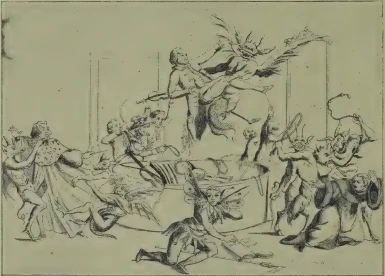
Mesmerism by All the Devils, reproduced as figure 309. The print portrays the controversy through religious satire.
Anonymous eighteenth-century caricature identified by De Givry as published in 1785. · Image source ↗ · Public Domain
How the commission tested the claim
The commission tried to separate the effect of expectation from the supposed fluid. Some subjects reacted when they believed they were being magnetized. The commissioners took those responses as evidence that expectation could produce the symptoms attributed to magnetism. [2][3][4][1]
In the library
Witchcraft Magic and Alchemy
Reading note
The separately titled account draws on exact passages in the consulted Library edition.
Sources
See references (4)
- Rapport des commissaires chargés par le Roi de l’examen du magnétisme animal, 1784 ↗Report of the French royal commission including Benjamin Franklin, Jean-Sylvain Bailly and Antoine Lavoisier. Wellcome Collection.
- Witchcraft Magic & Alchemy, printed p. 332, Reader page 328Grillot de Givry, Witchcraft Magic & Alchemy, translated by J. Courtenay Locke. Boston and New York, Houghton Mifflin Company, 1931.Read this page in Witchcraft Magic and Alchemy ↗
- Witchcraft Magic & Alchemy, printed p. 333, Reader page 329Grillot de Givry, Witchcraft Magic & Alchemy, translated by J. Courtenay Locke. Boston and New York, Houghton Mifflin Company, 1931.Read this page in Witchcraft Magic and Alchemy ↗
- Witchcraft Magic & Alchemy, printed p. 334, Reader page 330Grillot de Givry, Witchcraft Magic & Alchemy, translated by J. Courtenay Locke. Boston and New York, Houghton Mifflin Company, 1931.Read this page in Witchcraft Magic and Alchemy ↗