Memorial Trees
A memorial tree recalls a person, event, or place through planting, tending, or preserving a tree.
In this article
What is a memorial tree?
A memorial tree recalls a person, event or place. Some are planted to renew a memory. Others become memorials through a story told about where they grew. The tree gives that memory a place people can return to and tend. [1][2]
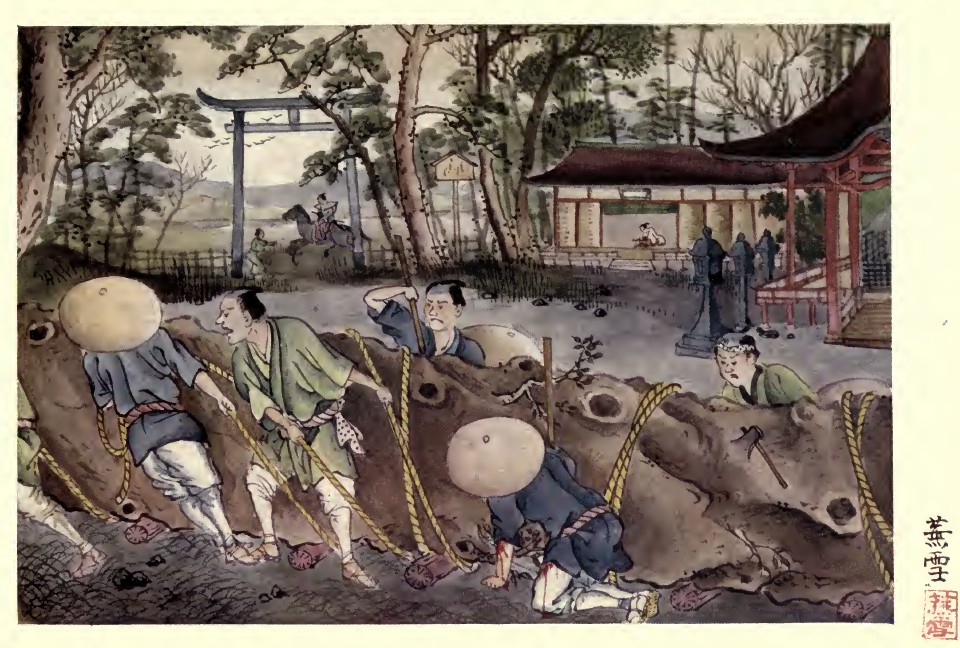
In the 1908 plate for The Camphor Tree Tomb, workers cannot move the fallen tree. The site later receives a new shrine in the story.
Mo-No-Yuki, after a sketch by Richard Gordon Smith, The workers fail to move the camphor tree, 1908. California Digital Library scan via Internet Archive. Public domain. · Image source ↗ · Public Domain
In Ancient Tales and Folk-lore of Japan
In Richard Gordon Smith’s The Memorial Cherry Tree, a new planting recalls a lost tree and its spirit. In The Chessboard Cherry Tree, a cherry grows from Ukon’s grave. Cracks in its bark recall the squares of the board buried with him. The story describes a game of go. [1][2]
In Smith’s account of the Yuasa household, Gobei promises to tend the willow that guarded an ancestor’s treasure. In The Camphor Tree Tomb, a foreman builds a shrine after a revered tree has been cut down. The two stories show how responsibility for a remembered place can continue after an encounter or loss. [3][4]
See references (4)
What the tree keeps in view
The first cherry is planted as a memorial. Ukon’s tree grows as a sign in the legend. The willow and camphor stories ask the living to care for something already remembered. Each gives continuing attention a different form. [1][2][3][4]
See references (4)
In the library
Ancient Tales and Folk-lore of Japan
Reading note
Read Richard Gordon Smith’s account in the verified 1908 Library edition.
Sources
See references (5)
- Ancient Tales and Folklore of Japan, printed p. 301, Reader page 415Richard Gordon Smith, Ancient Tales and Folklore of Japan. A. & C. Black, London, 1908. Lumitheca Library edition IMJ-0588-E001.Read this page in Ancient Tales and Folk-lore of Japan ↗
- Ancient Tales and Folklore of Japan, printed p. 330, Reader page 454Richard Gordon Smith, Ancient Tales and Folklore of Japan. A. & C. Black, London, 1908. Lumitheca Library edition IMJ-0588-E001.Read this page in Ancient Tales and Folk-lore of Japan ↗
- Ancient Tales and Folklore of Japan, printed p. 350, Reader page 480Richard Gordon Smith, Ancient Tales and Folklore of Japan. A. & C. Black, London, 1908. Lumitheca Library edition IMJ-0588-E001.Read this page in Ancient Tales and Folk-lore of Japan ↗
- Ancient Tales and Folklore of Japan, The Camphor Tree Tomb, ending, Reader page 493Richard Gordon Smith, Ancient Tales and Folklore of Japan. A. & C. Black, London, 1908. Lumitheca Library edition IMJ-0588-E001.Read this page in Ancient Tales and Folk-lore of Japan ↗
- The workers fail to move the camphor tree ↗Mo-No-Yuki, after a sketch by Richard Gordon Smith, The workers fail to move the camphor tree, 1908. California Digital Library scan via Internet Archive. Public domain.