Medicine Buddha, Bhaiṣajyaguru
Who is the Medicine Buddha? Explore Bhaiṣajyaguru’s aspirations, his eastern buddhafield and the bowl, sun and moon that help identify him in art.
In this article
Who is the Medicine Buddha?
Bhaiṣajyaguru, the Medicine Buddha, is associated with healing in Mahāyāna Buddhism. His vows address illness and the circumstances that deepen it, including lack of care, hunger and poverty. His eastern buddhafield, a realm shaped by his aspirations, is associated with the light of a blue jewel. [1][4]
The Gods of Northern Buddhism by Alice Getty
Alice Getty calls the Medicine Buddha Manla and sets his eastern realm beside Amitābha’s western Sukhāvatī. In one Tibetan form, a bowl rests in his lap and a medicinal myrobalan is in his other hand. The objects distinguish him in images where robes and pose also occur in portraits of Śākyamuni. [1][2]
In Getty’s account of the Japanese Yakushi, attendants can help identify the Buddha. A sun and a moon bodhisattva flank him, and twelve generals may appear around the group. [2][3]
The Medicine Buddha’s aspirations in Toh 504
In Adam Krug’s translation of the shorter Medicine Buddha sūtra, Śākyamuni tells Mañjuśrī about Bhaiṣajyaguru’s twelve aspirations. The seventh concerns people with no access to medicine or a caregiver. The eleventh and twelfth address food and clothing. The vows link recovery with the material conditions that make a life of practice possible. [4][2]
Reading the Lower Guangsheng mural
In this Chinese mural, a red disk and a white disk identify the sun and moon bodhisattvas. Smaller attendants carry the bowl and staff, and twelve guardians surround the assembly. The mural distributes the signs of the Medicine Buddha across the group. [5][2][3]
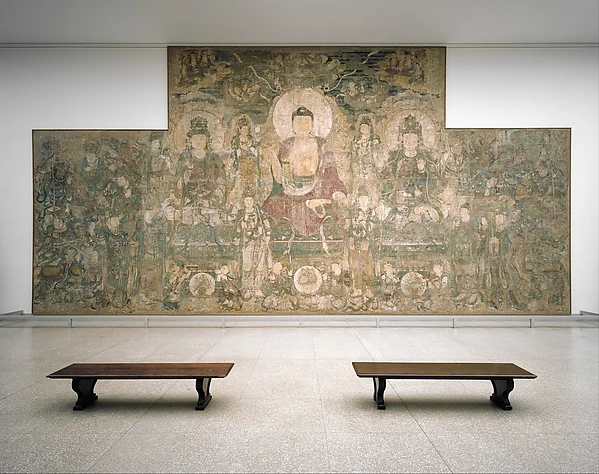
The Medicine Buddha’s assembly, from the Lower Guangsheng Temple, Shanxi, circa 1319. The sun and moon bodhisattvas stand near the centre.
The Metropolitan Museum of Art. Yuan dynasty, China, circa 1319. Gift of Arthur M. Sackler, in honor of his parents, Isaac and Sophie Sackler, 1965. Accession 65.29.2. · Image source ↗ · CC0
In the library
The Gods of Northern Buddhism
Reading note
Read Alice Getty’s illustrated discussion of Medicine Buddha.
Sources
See references (5)
- The Gods of Northern Buddhism, printed p. 24, Reader page 76Alice Getty, The Gods of Northern Buddhism, 1928 revised second edition, Munshiram Manoharlal reprint. Lumitheca Library edition IMJ-0597-E001.Read this page in The Gods of Northern Buddhism ↗
- The Gods of Northern Buddhism, printed p. 25, Reader page 77Alice Getty, The Gods of Northern Buddhism, 1928 revised second edition, Munshiram Manoharlal reprint. Lumitheca Library edition IMJ-0597-E001.Read this page in The Gods of Northern Buddhism ↗
- The Gods of Northern Buddhism, printed p. 26, Reader page 78Alice Getty, The Gods of Northern Buddhism, 1928 revised second edition, Munshiram Manoharlal reprint. Lumitheca Library edition IMJ-0597-E001.Read this page in The Gods of Northern Buddhism ↗
- The Detailed Account of the Previous Aspirations of the Blessed Bhaiṣajyaguru, Toh 504, §§ 1.7–1.21 ↗The Detailed Account of the Previous Aspirations of the Blessed Bhaiṣajyaguru, Toh 504, §§ 1.7–1.21. Translation credit: Dharmachakra Translation Committee, translated by Adam Krug and edited by Andreas Doctor. Published by 84000.
- Buddha of Medicine Bhaishajyaguru (Yaoshi fo) ↗The Metropolitan Museum of Art. Yuan dynasty, China, circa 1319. Gift of Arthur M. Sackler, in honor of his parents, Isaac and Sophie Sackler, 1965. Accession 65.29.2.