Mañjuśrī, the Bodhisattva of Wisdom
Meet Mañjuśrī, the Buddhist bodhisattva of wisdom. Learn what his sword and book signify and how he responds to Vimalakīrti’s famous silence.
In this article
Who is Mañjuśrī?
Mañjuśrī is a bodhisattva of wisdom in Mahāyāna Buddhism. His sword represents the insight that cuts through ignorance, and his book points to the Perfection of Wisdom. In scripture, Mañjuśrī urges fellow practitioners to examine the distinctions they take for granted. [1][2][4]
The Gods of Northern Buddhism by Alice Getty
Alice Getty records a Chinese story about Mañjuśrī’s appearance on the Mountain of Five Peaks, Wutai Shan. A ray from the Buddha calls forth a lotus, and Mañjuśrī emerges with his sword and book. The story places two familiar attributes on a mountain sacred to him. [1]
Getty’s examples show how the same attributes change position. The book may rest on the lap or on a lotus at the shoulder. The sword may be held aloft or supported by a flower. Some forms carry a lotus and leave the sword out altogether. [2][3]
The Teaching of Vimalakīrti
In the Teaching of Vimalakīrti, a gathering of bodhisattvas describes the way into nonduality. Mañjuśrī asks the lay practitioner Vimalakīrti to respond. Vimalakīrti is silent, and Mañjuśrī praises the response. The exchange lets the reader see what Mañjuśrī discerns when words have reached their limit. [4][2]
A book above the shoulder
In this Bengal bronze, Mañjuśrī’s hands show a teaching gesture. Look above his left shoulder for the manuscript resting on a lotus and below his seat for the lions. The book supplies the clue Getty’s survey leads us to look for, even without an upraised sword. [5][3]
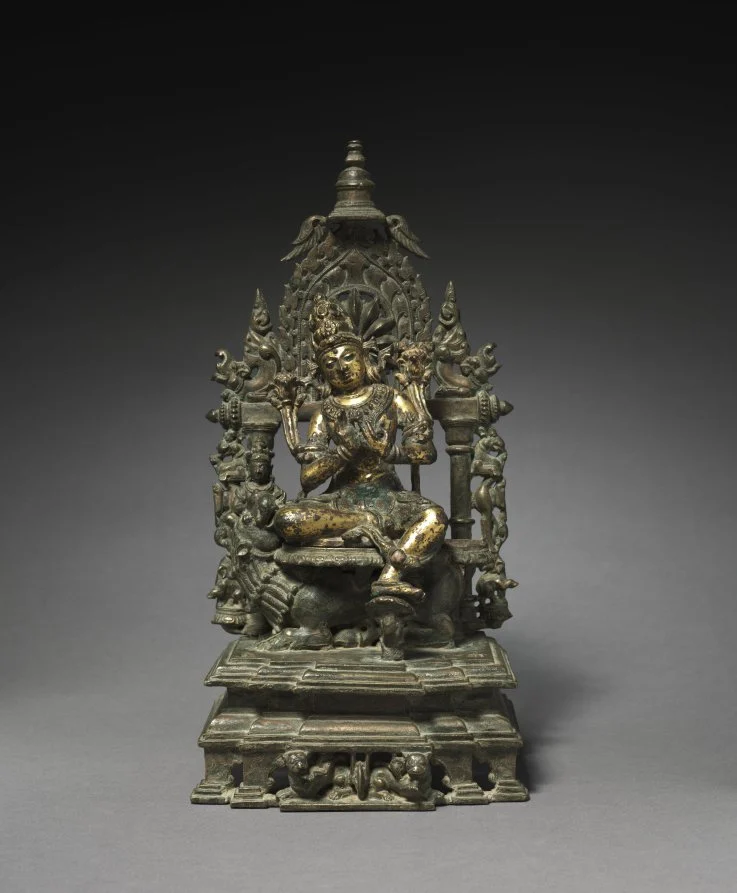
Mañjuśrī, Bengal, 11th or 12th century. A palm-leaf book rests on the lotus above his left shoulder.
The Cleveland Museum of Art. East India, Bengal, 11th or 12th century. Leonard C. Hanna Jr. Fund, 1960.285. · Image source ↗ · CC0
In the library
The Gods of Northern Buddhism
Reading note
Read Alice Getty’s illustrated discussion of Mañjuśrī.
Sources
See references (5)
- The Gods of Northern Buddhism, printed p. 110, Reader page 158Alice Getty, The Gods of Northern Buddhism, 1928 revised second edition, Munshiram Manoharlal reprint. Lumitheca Library edition IMJ-0597-E001.Read this page in The Gods of Northern Buddhism ↗
- The Gods of Northern Buddhism, printed p. 111, Reader page 159Alice Getty, The Gods of Northern Buddhism, 1928 revised second edition, Munshiram Manoharlal reprint. Lumitheca Library edition IMJ-0597-E001.Read this page in The Gods of Northern Buddhism ↗
- The Gods of Northern Buddhism, printed p. 112, Reader page 160Alice Getty, The Gods of Northern Buddhism, 1928 revised second edition, Munshiram Manoharlal reprint. Lumitheca Library edition IMJ-0597-E001.Read this page in The Gods of Northern Buddhism ↗
- The Teaching of Vimalakīrti, Toh 176, §§ 8.33–8.34 ↗The Teaching of Vimalakīrti, Toh 176, §§ 8.33–8.34. Translation credit: Robert A. F. Thurman. Published by 84000.
- Bodhisattva Manjushri: Lord of Wisdom ↗The Cleveland Museum of Art. East India, Bengal, 11th or 12th century. Leonard C. Hanna Jr. Fund, 1960.285.