Manibhadra
Manibhadra is a yaksha invoked by travellers in the Mahābhārata. Read what happens to Damayanti’s caravan and see the Pawaya sculpture.
In this article
Who is Manibhadra?
Manibhadra is a yaksha whom travellers invoke in the Mahābhārata. When wild elephants charge the caravan Damayanti is travelling with, survivors wonder whether they neglected Manibhadra. The question shows where they looked for protection and how they tried to make sense of disaster. [5][6][7]
A sculpture of Manibhadra from Pawaya
India’s National Mission on Monuments and Antiquities identifies this standing figure as Yaksha Manibhadra. It is held at the Gujari Mahal archaeological museum in Gwalior. [8][9]
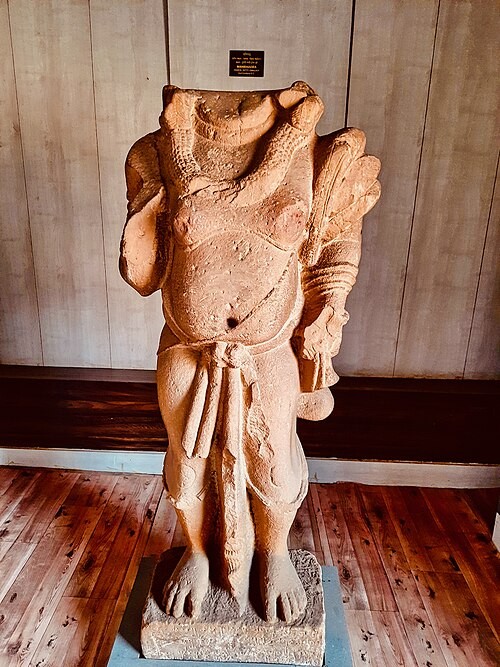
Manibhadra from Pawaya, photographed at the Gujari Mahal museum in Gwalior.
Ms Sarah Welch / Wikimedia Commons. CC0. · Image source ↗ · CC0
The caravan in the Mahabharata, Vana Parva LXIV–LXV
In Kisari Mohan Ganguli’s translation of Vana Parva LXIV, the caravan invokes Manibhadra, and its leader Suchi tells Damayanti where the company is going. In LXV, wild elephants find the encampment across their forest routes. Afterwards the survivors consider neglected worship, omens and the presence of Damayanti. [1][2]
Indian Myth and Legend by Donald A. Mackenzie
In Indian Myth and Legend, Donald A. Mackenzie describes Damayanti joining a caravan on its way to Chedi. Some travellers take her for a goddess and ask for protection. At night wild elephants catch the scent of their tame elephants and charge the camp by a lake. Damayanti escapes. [5][6]
Some survivors ask if they neglected Manibhadra, whom Mackenzie’s note compares with Kubera. Others blame Damayanti and threaten her life. She searches her memory for anything she might have done wrong and fears consequences from a former life. The retelling calls her innocent. [6][7][5]
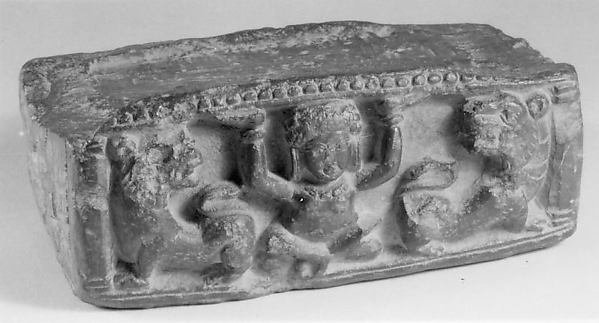
A yaksha and two lions appear on this ninth-century pedestal from Kashmir. The museum leaves the yaksha’s name open.
The Metropolitan Museum of Art, Gift of Dr. and Mrs. Roger Stoll, 1986, 1986.510. Open Access CC0; resized and converted to JPEG. · Image source ↗ · CC0
The Dhāraṇī of Māṇibhadra: an uncertain identification
In The Dhāraṇī of Māṇibhadra (Toh 764), translated by the Buddhapīṭha Translation Group, a figure named Māṇibhadra approaches the Buddha and promises support to people who recite his dhāraṇī. The editors say the spelling may refer to someone belonging to Maṇibhadra, possibly his son Jambhala, or may be a variant of the name of the same deity. [3]
Invocation before a journey and blame after it
The caravan invokes Manibhadra before anyone needs an explanation for the attack. After it, the survivors turn from the scene in front of them to questions about worship and blame. The Buddhist text gives a similarly named figure a different place, as someone who can promise support in his own voice. [6][1][7][2][3]
See references (5)
- Mahabharata, Vana Parva LXIV, translated by Kisari Mohan Ganguli
- Mahabharata, Vana Parva LXV, translated by Kisari Mohan Ganguli
- The Dhāraṇī of Māṇibhadra, Toh 764, introduction §§ i.1–i.2 and translation, Buddhapīṭha Translation Group
- Indian Myth and Legend, Reader page 440
- Indian Myth and Legend, Reader page 441
Read further in the library
Indian Myth and Legend
Reading note
The separately titled account draws on exact passages in the consulted Library edition.
Sources
See references (9)
- Mahabharata, Vana Parva LXIV, translated by Kisari Mohan Ganguli ↗Closing caravan exchange directly read in the hosted public-domain translation, including Suchi’s invocation of Manibhadra. No reading of the complete Mahabharata is claimed.Return to text ↑
- Mahabharata, Vana Parva LXV, translated by Kisari Mohan Ganguli ↗Elephant attack and aftermath directly read. The blocked paths, survivors’ ritual explanations and accusations against Damayanti are kept as distinct parts of the narrative.Return to text ↑
- The Dhāraṇī of Māṇibhadra, Toh 764, introduction §§ i.1–i.2 and translation, Buddhapīṭha Translation Group ↗84000’s introduction i.1–i.6 and short main text directly read. The article uses introduction i.2 and translation 1.2–1.3. Gergely Hidas and Péter-Dániel Szántó’s discussion of uncertain identity prevents merging Māṇibhadra/Jambhala with Maṇibhadra. No mantra or ritual recipe is reproduced.Return to text ↑
- Pedestal with Yaksha and Two Lions, 9th century ↗The Metropolitan Museum of Art, Gift of Dr. and Mrs. Roger Stoll, 1986, 1986.510. Open Access CC0; resized and converted to JPEG.
- Indian Myth and Legend, Reader page 439Donald A. Mackenzie, Indian Myth and Legend, Gresham Publishing Company Limited, London, undated consulted impression. Library edition IMJ-0649-E001. Persistent PageIDs and current Reader positions verified against the supplied PDF and cached Reader manifest. Embedded translations are Mackenzie’s presentation unless a separately consulted primary text is named.Read this page in Indian Myth and Legend ↗Return to text ↑
- Indian Myth and Legend, Reader page 440Donald A. Mackenzie, Indian Myth and Legend, Gresham Publishing Company Limited, London, undated consulted impression. Library edition IMJ-0649-E001. Persistent PageIDs and current Reader positions verified against the supplied PDF and cached Reader manifest. Embedded translations are Mackenzie’s presentation unless a separately consulted primary text is named.Read this page in Indian Myth and Legend ↗Return to text ↑
- Indian Myth and Legend, Reader page 441Donald A. Mackenzie, Indian Myth and Legend, Gresham Publishing Company Limited, London, undated consulted impression. Library edition IMJ-0649-E001. Persistent PageIDs and current Reader positions verified against the supplied PDF and cached Reader manifest. Embedded translations are Mackenzie’s presentation unless a separately consulted primary text is named.Read this page in Indian Myth and Legend ↗Return to text ↑
- National Mission on Monuments and Antiquities, Yaksha Manibhadra, registration 1360630 ↗Archaeological Survey of India, National Mission on Monuments and AntiquitiesReturn to text ↑
- Manibhadra from Pawaya at the Gujari Mahal museum, photograph by Ms Sarah Welch ↗Ms Sarah Welch / Wikimedia Commons. CC0.Return to text ↑