Mandala
A mandala arranges figures and symbols around a centre. Explore a Tibetan Buddhist ritual painting and Jung’s use of mandalas in psychology.
In this article
What is a mandala?
A mandala is a design that arranges figures, places or symbols around a centre. In Tibetan Buddhist ritual art, it can map a deity’s palace and the world around it. The positions of the gates, the other figures and the surrounding rings give each part of the image a place in that world. [9][1]
See references (2)
A Tibetan mandala of Jnanadakini
In this late fourteenth-century painting, six-armed Jnanadakini sits at the centre. Four protective goddesses occupy the gateways. Lotus petals, flames and burial grounds appear in the surrounding rings. The Met connects the painting with a set made for ritual texts known as the Garland of Vajras. [9][2][8]
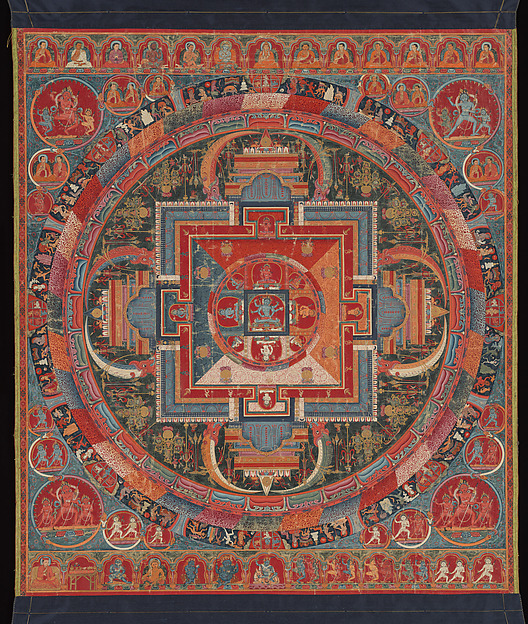
Mandala of Jnanadakini, Tibet, late 14th century. The central deity and her emanations occupy a palace whose gateways face four directions.
The Metropolitan Museum of Art, Purchase, Lita Annenberg Hazen Charitable Trust Gift, 1987. Public domain. · Image source ↗ · CC0
Jung’s commentary on The Secret of the Golden Flower
C. G. Jung’s commentary follows the text translated by Richard Wilhelm and rendered into English by Cary F. Baynes. Jung uses mandala for some of the abstract, centred forms he saw in drawings made by his patients. He draws parallels with Christian images of a central Christ and four surrounding figures and reads the Golden Flower through the same vocabulary. [1][2][3]
For Jung, drawing around a centre could gather the attention of the person making the image. He describes one figure as a luminous flower with rotating stars and eight gates. The image belongs to his psychological reading. The Tibetan painting above places its gates and figures within a ritual tradition. [4][5][6]
The edition’s plate captions describe several ways to picture a centre, including fish, a rotating star pattern and contrasts of light and darkness. Danke Zhang’s study of a longer Chinese version follows a different thread, the work of light in Daoist cultivation. [7][8]
See references (8)
- The Secret of the Golden Flower, Reader page 95
- The Secret of the Golden Flower, Reader page 96
- The Secret of the Golden Flower, Reader page 97
- The Secret of the Golden Flower, Reader page 98
- The Secret of the Golden Flower, Reader page 99
- The Secret of the Golden Flower, Reader page 104
- The Secret of the Golden Flower, Reader page 137
- Symbolic Transfigurations of Jinhua in The Secret of the Golden Flower, introduction
Read further in the library
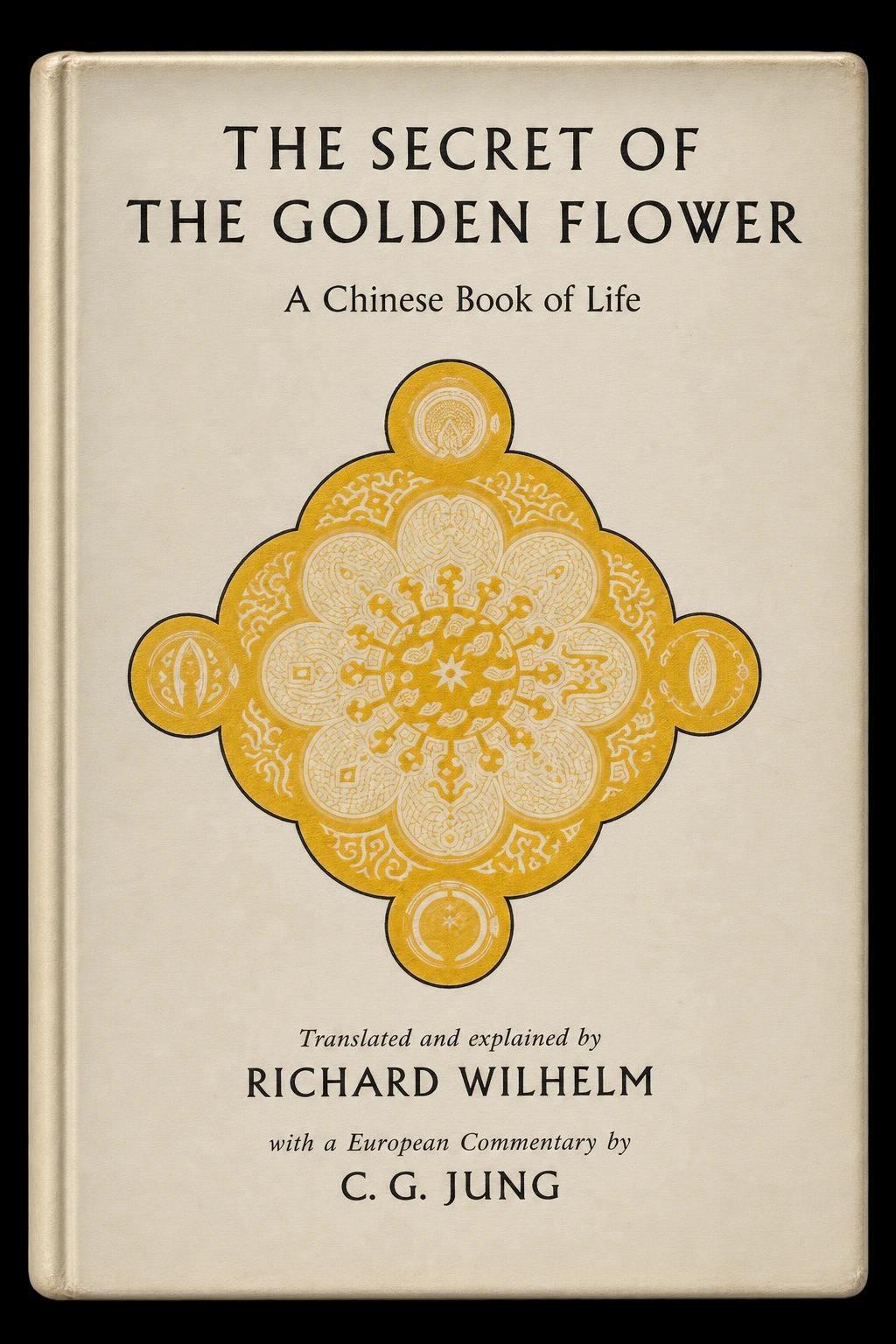
The Secret of the Golden Flower
Reading note
Read the account of Mandala in Jung’s commentary in the Wilhelm and Baynes edition.
Sources
See references (9)
- The Secret of the Golden Flower, Reader page 95The Secret of the Golden Flower: A Chinese Book of Life. Chinese text translated and explained by Richard Wilhelm, English translation by Cary F. Baynes, with separate commentary by C. G. Jung. London, Kegan Paul, Trench, Trubner & Co. Lumitheca Library edition IMJ-0596-E001.Read this page in The Secret of the Golden Flower ↗Return to text ↑
- The Secret of the Golden Flower, Reader page 96The Secret of the Golden Flower: A Chinese Book of Life. Chinese text translated and explained by Richard Wilhelm, English translation by Cary F. Baynes, with separate commentary by C. G. Jung. London, Kegan Paul, Trench, Trubner & Co. Lumitheca Library edition IMJ-0596-E001.Read this page in The Secret of the Golden Flower ↗Return to text ↑
- The Secret of the Golden Flower, Reader page 97The Secret of the Golden Flower: A Chinese Book of Life. Chinese text translated and explained by Richard Wilhelm, English translation by Cary F. Baynes, with separate commentary by C. G. Jung. London, Kegan Paul, Trench, Trubner & Co. Lumitheca Library edition IMJ-0596-E001.Read this page in The Secret of the Golden Flower ↗Return to text ↑
- The Secret of the Golden Flower, Reader page 98The Secret of the Golden Flower: A Chinese Book of Life. Chinese text translated and explained by Richard Wilhelm, English translation by Cary F. Baynes, with separate commentary by C. G. Jung. London, Kegan Paul, Trench, Trubner & Co. Lumitheca Library edition IMJ-0596-E001.Read this page in The Secret of the Golden Flower ↗Return to text ↑
- The Secret of the Golden Flower, Reader page 99The Secret of the Golden Flower: A Chinese Book of Life. Chinese text translated and explained by Richard Wilhelm, English translation by Cary F. Baynes, with separate commentary by C. G. Jung. London, Kegan Paul, Trench, Trubner & Co. Lumitheca Library edition IMJ-0596-E001.Read this page in The Secret of the Golden Flower ↗Return to text ↑
- The Secret of the Golden Flower, Reader page 104The Secret of the Golden Flower: A Chinese Book of Life. Chinese text translated and explained by Richard Wilhelm, English translation by Cary F. Baynes, with separate commentary by C. G. Jung. London, Kegan Paul, Trench, Trubner & Co. Lumitheca Library edition IMJ-0596-E001.Read this page in The Secret of the Golden Flower ↗Return to text ↑
- The Secret of the Golden Flower, Reader page 137The Secret of the Golden Flower: A Chinese Book of Life. Chinese text translated and explained by Richard Wilhelm, English translation by Cary F. Baynes, with separate commentary by C. G. Jung. London, Kegan Paul, Trench, Trubner & Co. Lumitheca Library edition IMJ-0596-E001.Read this page in The Secret of the Golden Flower ↗Return to text ↑
- Symbolic Transfigurations of Jinhua in The Secret of the Golden Flower, introduction ↗Danke Zhang, Religions 17(1), 113 (2026).Return to text ↑
- Mandala of Jnanadakini ↗The Metropolitan Museum of Art, Purchase, Lita Annenberg Hazen Charitable Trust Gift, 1987. Public domain.Return to text ↑