Maitreya, the Future Buddha
Who is Maitreya? Follow the future Buddha from the Heaven of Joy to a Northern Wei bronze dated 486, and see how Alice Getty identifies his images.
In this article
Who is Maitreya?
Maitreya is the future Buddha. Buddhist traditions also honour him in his present role as a bodhisattva. In accounts that place him in Tuṣita, the Heaven of Joy, devotees aspire to hear him teach there before he comes to earth as a Buddha. [6][2]
The Gods of Northern Buddhism by Alice Getty
Alice Getty describes Maitreya leaving Tuṣita to restore teachings that have been lost. Her survey follows him through images of a crowned bodhisattva and of a Buddha. A small stūpa can mark the crown. Getty also records a vase, a wheel and, in some standing figures, a raised palm that offers reassurance. [1][2][3][4]
A vase can also appear with Padmapāṇi, a form of Avalokiteśvara. Getty points to the stūpa on Maitreya’s crown as a clue when the two figures resemble one another. Plate LXVI shows another visual convention, with the seated figure’s feet lowered and crossed. [3][5]
See references (5)
The Sūtra on Maitreya’s Birth in the Heaven of Joy
In the discourse translated by the Dharmachakra Translation Committee, Śākyamuni tells Upāli how people can aspire to meet Maitreya in Tuṣita. The instructions include keeping vows, cultivating virtue, dedicating merit and remembering Maitreya. The discourse looks ahead to his awakening as a separate event. [6]
How an inscription identifies Maitreya
The right hand of this Northern Wei bronze is raised in reassurance. The Met identifies the Buddha from the inscription on the back of the base, which names Maitreya and dates the commission to 486. The inscription anchors the identification more firmly than the gesture alone. [7][4][6]
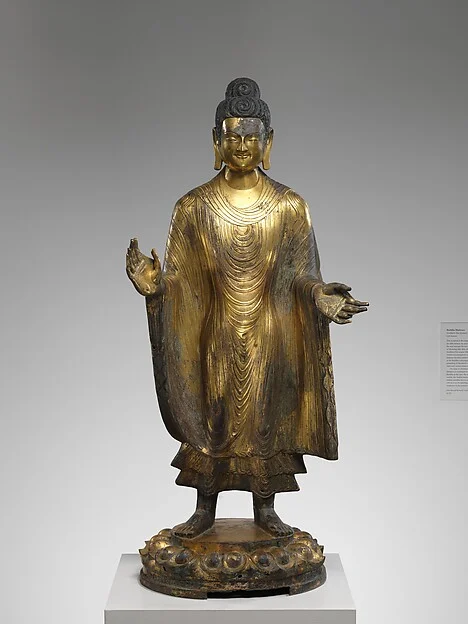
Buddha Maitreya (Mile), gilt bronze, China, 486. The Met identifies the figure from the inscription on the back of its base.
The Metropolitan Museum of Art. Buddha Maitreya (Mile), Northern Wei dynasty, China, dated 486. John Stewart Kennedy Fund, 1926. Accession 26.123. · Image source ↗ · CC0
In the library
The Gods of Northern Buddhism
Reading note
Getty compares Maitreya’s place in Buddhist tradition with his many forms in Buddhist art.
Sources
See references (7)
- The Gods of Northern Buddhism, printed p. 21, Reader page 73Alice Getty, The Gods of Northern Buddhism, 1928 revised second edition, Munshiram Manoharlal reprint. Lumitheca Library edition IMJ-0597-E001.Read this page in The Gods of Northern Buddhism ↗
- The Gods of Northern Buddhism, printed p. 22, Reader page 74Alice Getty, The Gods of Northern Buddhism, 1928 revised second edition, Munshiram Manoharlal reprint. Lumitheca Library edition IMJ-0597-E001.Read this page in The Gods of Northern Buddhism ↗
- The Gods of Northern Buddhism, printed p. 23, Reader page 75Alice Getty, The Gods of Northern Buddhism, 1928 revised second edition, Munshiram Manoharlal reprint. Lumitheca Library edition IMJ-0597-E001.Read this page in The Gods of Northern Buddhism ↗
- The Gods of Northern Buddhism, printed p. 24, Reader page 76Alice Getty, The Gods of Northern Buddhism, 1928 revised second edition, Munshiram Manoharlal reprint. Lumitheca Library edition IMJ-0597-E001.Read this page in The Gods of Northern Buddhism ↗
- The Gods of Northern Buddhism, Plate LXVI, Reader page 333Alice Getty, The Gods of Northern Buddhism, 1928 revised second edition, Munshiram Manoharlal reprint. Lumitheca Library edition IMJ-0597-E001.Read this page in The Gods of Northern Buddhism ↗
- The Sūtra on Maitreya’s Birth in the Heaven of Joy, Toh 199, §§ 1.27–1.29 ↗The Sūtra on Maitreya’s Birth in the Heaven of Joy, Toh 199, translated by the Dharmachakra Translation Committee for 84000.
- Buddha Maitreya (Mile) ↗The Metropolitan Museum of Art. Buddha Maitreya (Mile), Northern Wei dynasty, China, dated 486. John Stewart Kennedy Fund, 1926. Accession 26.123.