Mahāmāyūrī: The Buddhist Peacock Wisdom Queen
Mahāmāyūrī is a Buddhist protective deity associated with the Great Peahen incantation. Her peacock mount and feather appear in different regional forms, including Japanese paintings of Kujaku Myōō.
In this article
What is the Peacock Wisdom Queen?
Mahāmāyūrī, the Great Peahen, is associated with a Buddhist incantation for protection. A peacock mount or a feather helps identify her in art. In Japan she is known as Kujaku Myōō. [1][2][4]
In Alice Getty’s The Gods of Northern Buddhism
Alice Getty connects Mahāmāyūrī with a protective incantation against snakebite and identifies the feather as a distinctive emblem. Some figures carry a white parasol. In the Japanese images she describes, the bird can appear beneath her as a mount. [1][2]
Getty places Mahāmāyūrī at the head of the Five Protectors in one Nepalese account. In a ritual arrangement she cites through Alfred Foucher, Mahāsāhasrapramardanī sits at the centre. The two descriptions give the reader different ways to interpret the group’s composition. [2][3]
The snakebite in The Great Peahen
In The Great Peahen, the young monk Svāti is bitten while gathering wood. Ānanda asks the Buddha what to do, and the Buddha gives him the incantation. In James Gentry’s translation its protective scope extends beyond the opening episode to a wider range of dangers. [4][1]
Kujaku Myōō in Japanese painting
A bright red halo sits in front of the peacock’s spread tail in this Meiji-period painting. The two central hands meet at the chest and four more hold implements. The bird carries the lotus seat and identifies the figure even before the smaller objects come into view. [5][2]
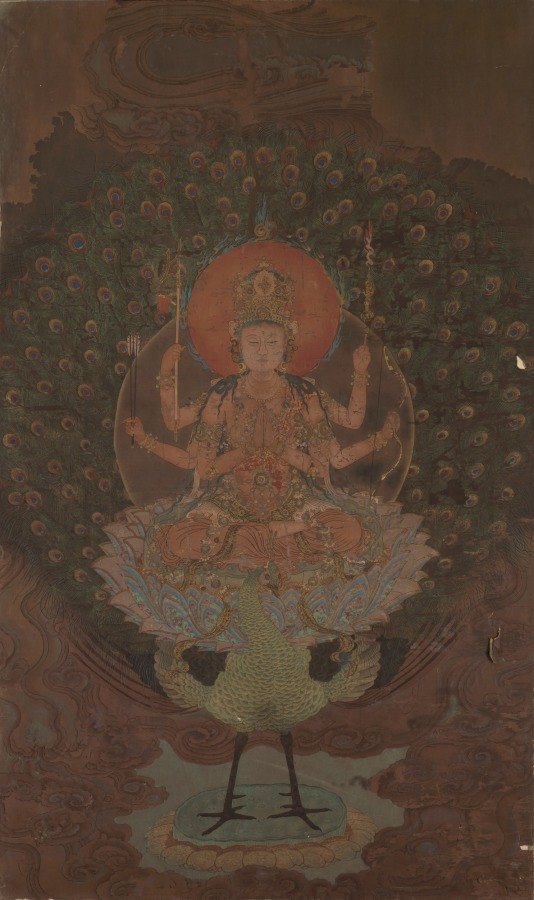
In this Meiji-period painting of Kujaku Myōō, the peacock’s tail frames the deity and her red halo. Japan, c. 1868–1912.
Cleveland Museum of Art, Gift of Mrs. Charles W. Mason, 1921.103. CC0. · Image source ↗ · CC0
In the library
The Gods of Northern Buddhism
Reading note
Read Alice Getty’s illustrated discussion of Mahāmāyūrī.
Sources
See references (5)
- The Gods of Northern Buddhism, printed p. 136, Reader page 184Alice Getty, The Gods of Northern Buddhism, 1928 revised second edition, Munshiram Manoharlal reprint. Lumitheca Library edition IMJ-0597-E001.Read this page in The Gods of Northern Buddhism ↗
- The Gods of Northern Buddhism, printed p. 137, Reader page 185Alice Getty, The Gods of Northern Buddhism, 1928 revised second edition, Munshiram Manoharlal reprint. Lumitheca Library edition IMJ-0597-E001.Read this page in The Gods of Northern Buddhism ↗
- The Gods of Northern Buddhism, printed p. 138, Reader page 186Alice Getty, The Gods of Northern Buddhism, 1928 revised second edition, Munshiram Manoharlal reprint. Lumitheca Library edition IMJ-0597-E001.Read this page in The Gods of Northern Buddhism ↗
- The Queen of Incantations: The Great Peahen, Toh 559, §§1.9–1.11 ↗The Queen of Incantations: The Great Peahen, Toh 559, §§1.9–1.11. Source credit: James Gentry, Dharmachakra Translation Committee, for 84000.
- Mahamayuri (Kujaku Myoo) ↗Cleveland Museum of Art, Gift of Mrs. Charles W. Mason, 1921.103. CC0.