Maenads
Maenads, or Bacchantes, are female followers of Dionysus in Greek myth and art. Compare Euripides’ Bacchae with Dion Fortune’s portrayal of Mona.
In this article
Who are the maenads?
Maenads, also called Bacchantes, are women who follow Dionysus in Greek myth, drama and art. On the mountain they sing, dance and take part in the god’s rites. A wine jug at The Met shows a maenad alongside Dionysus. [1][2]
In Euripides’ Bacchae, a herdsman finds the women at rest on Mount Cithaeron. They rise at Agave’s call. He reports springs of water and wine and then a clash with the herdsmen, bringing news of the god’s power back to the city that refuses to honour him. [1]
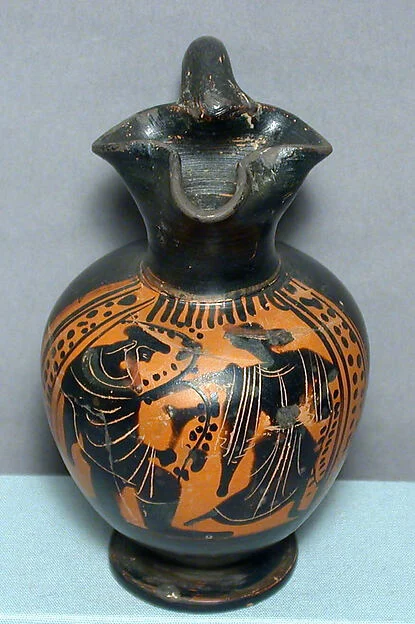
An Attic wine jug from the late sixth or early fifth century BCE. The decoration brings together the wine god Dionysus and one of his followers.
The Metropolitan Museum of Art. Bequest of Nanette B. Kelekian, 2020. 2021.40.8. · Image source ↗ · CC0
See references (2)
Mona’s image of the maenad in The Goat-Foot God
In Dion Fortune’s The Goat-Foot God, Mona imagines running in a landscape far from the industrial town where she grows up. Later she gives herself the role of a Bacchante in a fawnskin, following Dionysus over mountains. Sometimes she dances barefoot when she is alone. [3][4][5]
The Moon-dance Mona performs later belongs to another image in her imagination, one associated with priestesses of the sea and the moon. The Bacchante gives form to a freedom she sometimes feels by herself. The Moon-dance brings Hugh into an encounter she wants him to face. [4][6][7][8]
A band on the mountain and a dance in solitude
Euripides makes the movement of a whole band a public issue when a herdsman describes it to Pentheus. Fortune follows how one person comes to identify with the maenad over years of reading, imagining and sometimes dancing on her own. [1][3][4][5]
Read further in the library
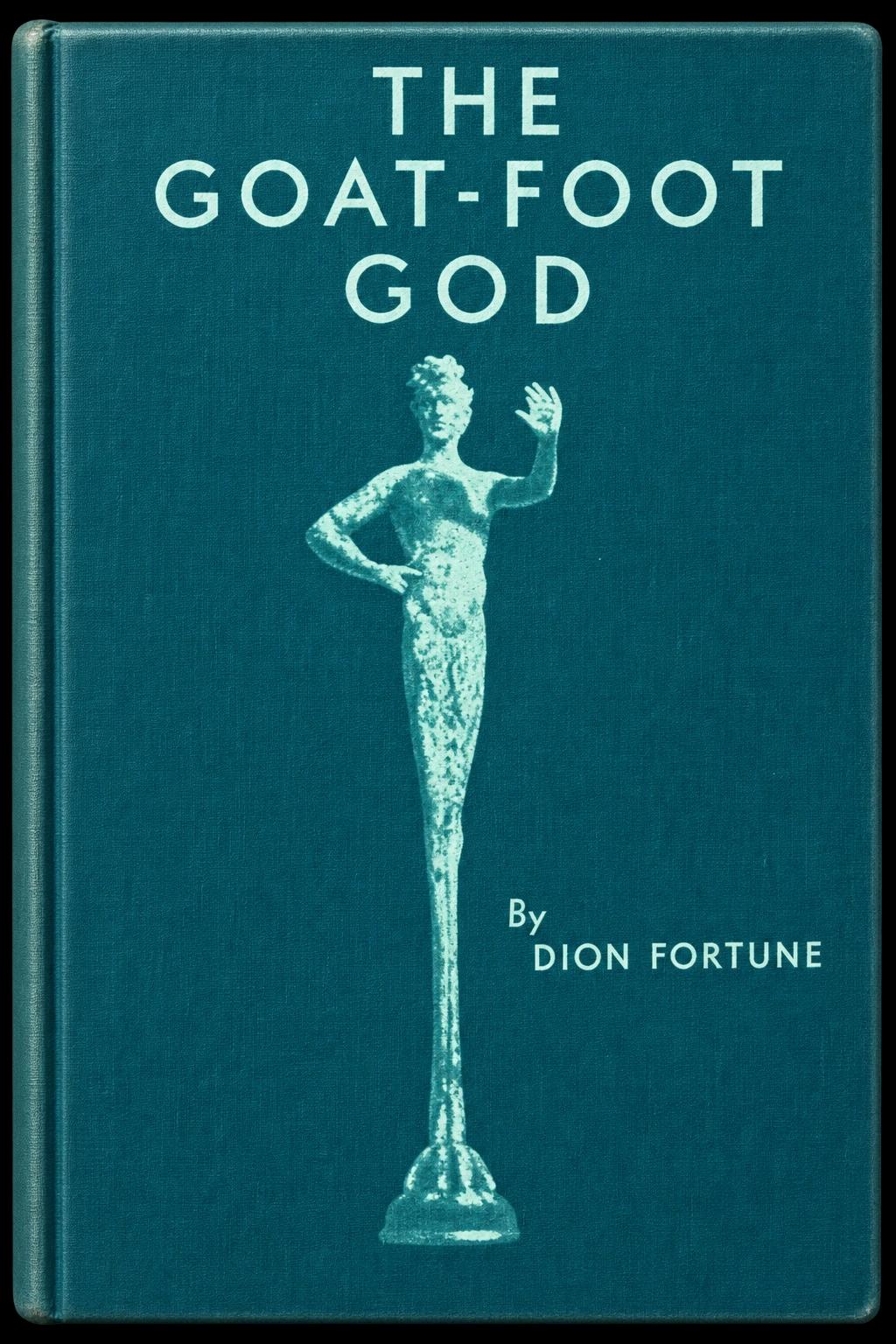
The Goat-Foot God
Reading note
The separately titled account draws on exact passages in the consulted Library edition.
Sources
See references (8)
- Euripides, Bacchae, lines 677–774 ↗Euripides, Bacchae, the herdsman’s speech on Mount Cithaeron, T. A. Buckley translation.Return to text ↑
- Terracotta oinochoe with trefoil mouth ↗The Metropolitan Museum of Art. Bequest of Nanette B. Kelekian, 2020. 2021.40.8.Return to text ↑
- The Goat-Foot God, Reader page 247Dion Fortune, The Goat-Foot God. Undated digital Library edition IMJ-0643-E001. Numbered references use the Library Reader sequence.Read this page in The Goat-Foot God ↗Return to text ↑
- The Goat-Foot God, Reader page 248Dion Fortune, The Goat-Foot God. Undated digital Library edition IMJ-0643-E001. Numbered references use the Library Reader sequence.Read this page in The Goat-Foot God ↗Return to text ↑
- The Goat-Foot God, Reader page 312Dion Fortune, The Goat-Foot God. Undated digital Library edition IMJ-0643-E001. Numbered references use the Library Reader sequence.Read this page in The Goat-Foot God ↗Return to text ↑
- The Goat-Foot God, Reader page 314Dion Fortune, The Goat-Foot God. Undated digital Library edition IMJ-0643-E001. Numbered references use the Library Reader sequence.Read this page in The Goat-Foot God ↗Return to text ↑
- The Goat-Foot God, Reader page 315Dion Fortune, The Goat-Foot God. Undated digital Library edition IMJ-0643-E001. Numbered references use the Library Reader sequence.Read this page in The Goat-Foot God ↗Return to text ↑
- The Goat-Foot God, Reader page 316Dion Fortune, The Goat-Foot God. Undated digital Library edition IMJ-0643-E001. Numbered references use the Library Reader sequence.Read this page in The Goat-Foot God ↗Return to text ↑