Light of the Eye and Ear in The Secret of the Golden Flower
In The Secret of the Golden Flower, the light of the eye means clarity and the light of the ear means understanding. The book pairs inward sight and inward listening to show how attention and breath can steady one another.
In this article
What are the lights of the eye and ear?
In The Secret of the Golden Flower, the light of the eye means clarity and the light of the ear means understanding. The book treats them as two capacities of the same attention. It asks what seeing and hearing are like when attention stays alert without following every sight or sound. [2][4]
The two lights in The Secret of the Golden Flower
In Richard Wilhelm’s translation, rendered into English by Cary F. Baynes, heart and breath affect each other. The breath gives attention a place to settle. The book pairs the light of the eye with the outer sun and moon and the light of the ear with their inward counterparts. [1][2]
The book uses a hen sitting on her eggs as an image of sustained attention. It describes looking inward where there is no shape to see and listening inward where there is no sound to hear. Its account of breath counting gives one indication of wandering attention, the loss of the count. [3][4][5]
See references (5)
- The Secret of the Golden Flower, printed p. 44, Reader page 47
- The Secret of the Golden Flower, printed p. 45, Reader page 48
- The Secret of the Golden Flower, printed p. 46, Reader page 49
- The Secret of the Golden Flower, printed p. 48, Reader page 51
- The Secret of the Golden Flower, printed p. 49, Reader page 52
A Buddhist example of turning hearing inward
Studying a longer Chinese version, Danke Zhang relates inward listening to a passage associated with the Śūraṅgama Sūtra. Both direct attention from the sound to the capacity to hear. The Golden Flower connects that inward turn with breath and light, while Zhang’s Buddhist comparison asks what hearing reveals about the nature of mind. [2][4][6]
Reflected Illumination in the Xingming guizhi
In the Reflected Illumination woodcut, the body is shown from behind with a path marked along the back. This example from the Xingming guizhi gives the inward turn a visible course. The Golden Flower describes the same problem through attention to what is seen and heard. [7][4]
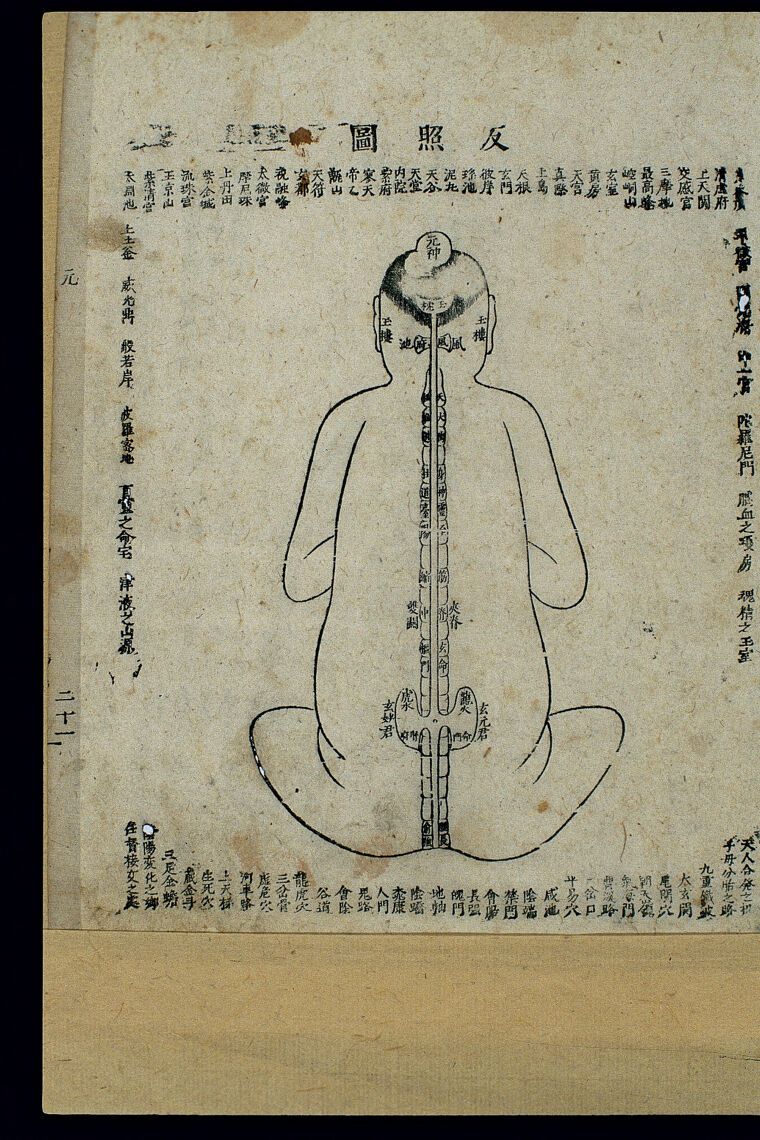
Reflected Illumination, a woodcut from Xingming guizhi, published in 1615. The artist renders an inward process as a map of the seated body.
Wellcome Collection, Chinese woodcut: Daoist internal alchemy (2). Public Domain Mark. · Image source ↗ · Public Domain
In the library
The Secret of the Golden Flower
Reading note
Read the specific account of Light of the Eye and Ear in the Wilhelm–Baynes edition.
Sources
See references (7)
- The Secret of the Golden Flower, printed p. 44, Reader page 47The Secret of the Golden Flower: A Chinese Book of Life. Chinese text translated and explained by Richard Wilhelm, English translation by Cary F. Baynes, with separate commentary by C. G. Jung. London, Kegan Paul, Trench, Trubner & Co. Lumitheca Library edition IMJ-0596-E001.Read this page in The Secret of the Golden Flower ↗
- The Secret of the Golden Flower, printed p. 45, Reader page 48The Secret of the Golden Flower: A Chinese Book of Life. Chinese text translated and explained by Richard Wilhelm, English translation by Cary F. Baynes, with separate commentary by C. G. Jung. London, Kegan Paul, Trench, Trubner & Co. Lumitheca Library edition IMJ-0596-E001.Read this page in The Secret of the Golden Flower ↗
- The Secret of the Golden Flower, printed p. 46, Reader page 49The Secret of the Golden Flower: A Chinese Book of Life. Chinese text translated and explained by Richard Wilhelm, English translation by Cary F. Baynes, with separate commentary by C. G. Jung. London, Kegan Paul, Trench, Trubner & Co. Lumitheca Library edition IMJ-0596-E001.Read this page in The Secret of the Golden Flower ↗
- The Secret of the Golden Flower, printed p. 48, Reader page 51The Secret of the Golden Flower: A Chinese Book of Life. Chinese text translated and explained by Richard Wilhelm, English translation by Cary F. Baynes, with separate commentary by C. G. Jung. London, Kegan Paul, Trench, Trubner & Co. Lumitheca Library edition IMJ-0596-E001.Read this page in The Secret of the Golden Flower ↗
- The Secret of the Golden Flower, printed p. 49, Reader page 52The Secret of the Golden Flower: A Chinese Book of Life. Chinese text translated and explained by Richard Wilhelm, English translation by Cary F. Baynes, with separate commentary by C. G. Jung. London, Kegan Paul, Trench, Trubner & Co. Lumitheca Library edition IMJ-0596-E001.Read this page in The Secret of the Golden Flower ↗
- Symbolic Transfigurations of Jinhua in The Secret of the Golden Flower, section 4.1 ↗Danke Zhang, Religions 17(1), 113 (2026).
- Reflected Illumination ↗Wellcome Collection, Chinese woodcut: Daoist internal alchemy (2). Public Domain Mark.