Laukapalili and the bowl of knowledge
Laukapalili is the vessel of knowledge consulted by Lāʻieikawai. Compare how the 1888 retelling and Haleʻole describe its form and powers.
In this article
How does Laukapalili reveal what is hidden?
Laukapalili is a vessel that reveals distant events in the story of Lāʻieikawai. She consults it to discover what her husband, Kaʻōnohiokalā, is doing while he is away on earth. [3][1]
Martha Warren Beckwith translates its name as “Trembling Leaf.” The vessel has a keeper. Lāʻieikawai can only use it when the keeper is asleep and has to make her request quietly. [1][3]
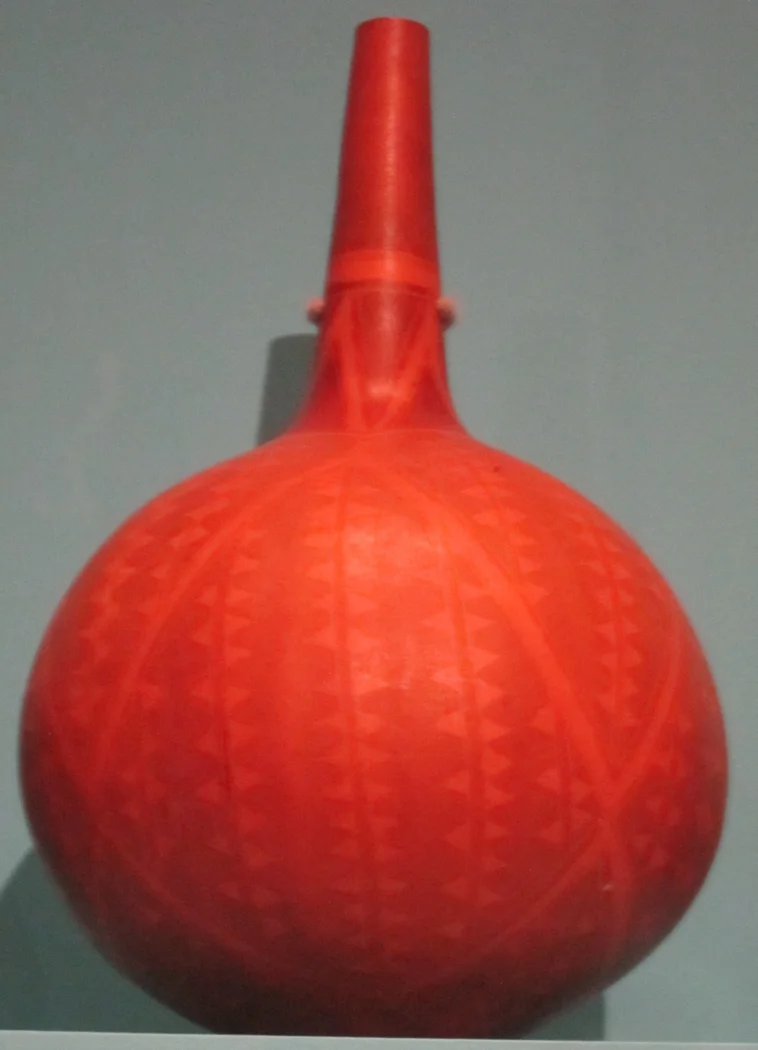
A nineteenth-century Hawaiian gourd container, Honolulu Museum of Art 331.1. The form gives material context for Haleʻole’s reference to an ipu.
Honolulu Museum of Art, accession 331.1. Photograph by Hiart, Wikimedia Commons. · Image source ↗ · CC0
Laukapalili in The Hawaiian Romance of Laieikawai by S. N. Haleʻole
In The Hawaiian Romance of Laieikawai by S. N. Haleʻole, translated by Martha Warren Beckwith, Lāʻieikawai lifts the cover of the gourd, places her head at its mouth and speaks its name. The instructions warn her against waking Laukieleula, who watches over it. [1]
The Legends and Myths of Hawaii by David Kalākaua
In David Kalākaua’s condensation of Haleʻole’s story, Laukapalili is a wooden bowl with wicker, feathers and carved birds. Lāʻieikawai calls to it while Laukieleula sleeps. After she sees her husband’s conduct, his parents consult it too. [4][3]
The discovery leads to a judgement. A rainbow gives the family a way down to confront Kaʻōnohiokalā, and Lāʻieikawai asks to return to earth and live with her sister. [3][5]
A gourd in Haleʻole and a bowl in Kalākaua
Haleʻole calls it an ipu, translated by Beckwith as a gourd, and gives detailed instructions for approaching it without waking the keeper. The 1888 retelling puts more detail into the bowl’s decoration and moves quickly to what Lāʻieikawai sees. [3][1]
Read further in the library
The Legends and Myths of Hawaii
Reading note
The separately titled account draws on exact passages in the consulted Library edition.
Sources
See references (5)
- The Hawaiian Romance of Laieikawai, printed pp. 325–327 ↗S. N. Haleʻole, The Hawaiian Romance of Laieikawai, translated by Martha Warren Beckwith, Government Printing Office, 1918, Laukapalili and the keeper of the gourd.Return to text ↑
- Nineteenth-century Hawaiian gourd container, HMA 331.1 ↗Honolulu Museum of Art, accession 331.1. Photograph by Hiart, Wikimedia Commons.
- The Legends and Myths of Hawaii, Reader page 483David Kalākaua, The Legends and Myths of Hawaii, edited with an introduction by Rollin Mallory Daggett, Charles L. Webster & Company, 1888. Exact Library edition IMJ-0646-E001. When the introduction or a signed editorial passage is used, its author is identified in the article.Read this page in The Legends and Myths of Hawaii ↗Return to text ↑
- The Legends and Myths of Hawaii, Reader page 459David Kalākaua, The Legends and Myths of Hawaii, edited with an introduction by Rollin Mallory Daggett, Charles L. Webster & Company, 1888. Exact Library edition IMJ-0646-E001. When the introduction or a signed editorial passage is used, its author is identified in the article.Read this page in The Legends and Myths of Hawaii ↗Return to text ↑
- The Legends and Myths of Hawaii, Reader page 484David Kalākaua, The Legends and Myths of Hawaii, edited with an introduction by Rollin Mallory Daggett, Charles L. Webster & Company, 1888. Exact Library edition IMJ-0646-E001. When the introduction or a signed editorial passage is used, its author is identified in the article.Read this page in The Legends and Myths of Hawaii ↗Return to text ↑