Kurukullā: The Buddhist Goddess with the Flower Bow
Kurukullā is a Buddhist tantric deity associated with magnetizing, the activity of drawing beings or favourable conditions toward a purpose. She is often depicted in red, drawing a bow with a flower-tipped arrow.
In this article
What does Kurukullā’s bow represent?
Kurukullā is a Vajrayāna Buddhist goddess associated with magnetizing, the ritual activity of attraction. Artists often show her as a red figure drawing a bow and arrow made of flowers. Her practice manual in the Tibetan Kangyur names her as a form of Tārā. [4][5][1]
In Alice Getty’s The Gods of Northern Buddhism
Alice Getty draws on a description translated by Alfred Foucher. Two of Kurukullā’s four hands hold a bow and arrow, a third carries a lotus, and the fourth offers reassurance. Getty also describes dancing figures and a peaceful, seated eight-armed form in a lotus mandala. [1][2]
Getty lists bows among the attributes of several Buddhist figures. Kurukullā’s floral weapon, red colour and dancing pose are most useful when seen together. Some of her seated forms arrange the same attributes differently. [1][3][5]
Magnetizing in the Tibetan Kangyur
Getty associates Kurukullā with love and wealth. In Thomas Doctor’s translation of the Kangyur manual, the practitioner looks on a suffering world with compassion. The verses picture wealth being given away and people in need receiving clothes and homes. Attraction serves generosity in this part of the text. [1][4]
A painting from Ngor
In the painting from Ngor, the central figure dances within a ring of flames while drawing her bow. Yellow and black forms of Jambhala flank the offering table below. The Asian Art Museum connects the bow and arrow with transforming passion into wisdom. [5][1]
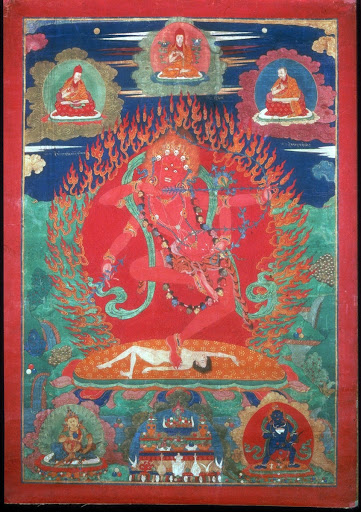
Kurukullā dances with her bow and arrow in an 18th-century painting from Ngor, Tibet. The two figures below are forms of Jambhala.
Asian Art Museum, Transfer from the Fine Arts Museums of San Francisco, Gift of Katherine Ball, B72D60. Public domain. · Image source ↗ · Public Domain
In the library
The Gods of Northern Buddhism
Reading note
Read Alice Getty’s illustrated discussion of Kurukullā.
Sources
See references (5)
- The Gods of Northern Buddhism, printed p. 126, Reader page 174Alice Getty, The Gods of Northern Buddhism, 1928 revised second edition, Munshiram Manoharlal reprint. Lumitheca Library edition IMJ-0597-E001.Read this page in The Gods of Northern Buddhism ↗
- The Gods of Northern Buddhism, printed p. 127, Reader page 175Alice Getty, The Gods of Northern Buddhism, 1928 revised second edition, Munshiram Manoharlal reprint. Lumitheca Library edition IMJ-0597-E001.Read this page in The Gods of Northern Buddhism ↗
- The Gods of Northern Buddhism, printed p. 186, Reader page 232Alice Getty, The Gods of Northern Buddhism, 1928 revised second edition, Munshiram Manoharlal reprint. Lumitheca Library edition IMJ-0597-E001.Read this page in The Gods of Northern Buddhism ↗
- The Practice Manual of Noble Tārā Kurukullā, Toh 437, §§1.24–1.32 and 1.35 ↗The Practice Manual of Noble Tārā Kurukullā, Toh 437, §§1.24–1.32 and 1.35. Source credit: Thomas Doctor, Dharmachakra Translation Committee, for 84000.
- The Buddhist deity Kurukulla ↗Asian Art Museum, Transfer from the Fine Arts Museums of San Francisco, Gift of Katherine Ball, B72D60. Public domain.