Khakkhara, the Buddhist Ringed Staff
What is a khakkhara or shakujō? Learn why Buddhist monks carried a staff with ringing metal loops and why Jizō is pictured with one.
In this article
What is a khakkhara?
A khakkhara is a Buddhist staff with loose metal rings that rattle as it moves. In Japan it is called a shakujō. For a monk on an alms round, the sound can announce his presence without speech. In Japanese art, it helps identify Jizō, the bodhisattva also known as Kṣitigarbha. [2][3][4][5]
The Gods of Northern Buddhism by Alice Getty
Alice Getty describes a wooden shaft with rings hanging from its metal head. The sound can call a householder to the door or warn small creatures out of a traveller’s path. Her illustrated survey also gives the rings symbolic meanings. For example, she connects six rings with the six perfections. [3]
In a banner Getty describes, Kṣitigarbha carries the staff as he approaches the gates of hell. The staff belongs to a scene of rescue. Getty also identifies the six-ring version as an attribute of the Japanese Jizō. [1][2]
The rules for an alms round
In the Sarasvatī Translation Team’s version of the Rite for Carrying the Ringing Staff, a monk at a door rattles the staff three times. If no one answers, the instructions increase the number to five, then seven. After that the monk goes to another household. The sequence gives a practical purpose to the sound Getty describes. [4][3]
The rings on a Japanese finial
The loose rings on this Edo-period finial hang from an openwork metal frame. Moving the shaft would set them rattling. The Met reads the six rings as the realms in which Jizō is active as well as the six perfections. [5][2][3]
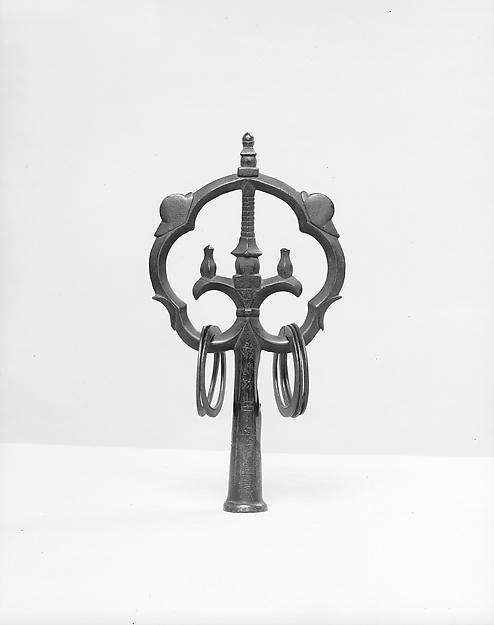
Bronze finial of a Buddhist monk’s shakujō, Japan, Edo period. The rings move independently of the openwork head.
The Metropolitan Museum of Art. Japan, Edo period. Rogers Fund, 1907. Accession 07.16. · Image source ↗ · CC0
In the library
The Gods of Northern Buddhism
Reading note
Read Alice Getty’s illustrated discussion of Khakkhara.
Sources
See references (5)
- The Gods of Northern Buddhism, printed p. 103, Reader page 152Alice Getty, The Gods of Northern Buddhism, 1928 revised second edition, Munshiram Manoharlal reprint. Lumitheca Library edition IMJ-0597-E001.Read this page in The Gods of Northern Buddhism ↗
- The Gods of Northern Buddhism, printed p. 106, Reader page 155Alice Getty, The Gods of Northern Buddhism, 1928 revised second edition, Munshiram Manoharlal reprint. Lumitheca Library edition IMJ-0597-E001.Read this page in The Gods of Northern Buddhism ↗
- The Gods of Northern Buddhism, printed p. 189, Reader page 235Alice Getty, The Gods of Northern Buddhism, 1928 revised second edition, Munshiram Manoharlal reprint. Lumitheca Library edition IMJ-0597-E001.Read this page in The Gods of Northern Buddhism ↗
- The Rite for the Protocols Associated with Carrying the Ringing Staff, Toh 336, §§ 1.3–1.5 ↗The Rite for the Protocols Associated with Carrying the Ringing Staff, Toh 336, §§ 1.3–1.5. Source credit: Sarasvatī Translation Team, 84000.
- Finial of a Buddhist Monk’s Staff (Shakujō) ↗The Metropolitan Museum of Art. Japan, Edo period. Rogers Fund, 1907. Accession 07.16.