Key of Solomon
The Key of Solomon is a family of grimoires attributed to Solomon. Compare surviving manuscript titles, diagrams and the problem of a single original text.
In this article
What is the Key of Solomon?
The Key of Solomon, or Clavicula Salomonis, is a family of European magical manuscripts attributed to the biblical king Solomon. Many versions describe ceremonies for summoning spirits and include pentacles, which are inscribed emblems, or diagrams of ritual spaces. The designs and wording can change from copy to copy. [3][4][5][6][2]
Solomon’s reputation for wisdom gave the books authority. In its record for a facsimile of a 1641 manuscript, the Bibliothèque nationale de France lists him as the attributed author. Some copies include Christian prayers and references to much later writers. [3][1]
See references (6)
- Clavicules de Salomon, catalogue record for the facsimile of the 1641 manuscript
- Clavicula Salomonis, catalogue record for a comparative edition
- Witchcraft Magic & Alchemy, printed p. 95, Reader page 87
- Witchcraft Magic & Alchemy, printed p. 102, Reader page 95
- Witchcraft Magic & Alchemy, printed p. 104, Reader page 97
- Witchcraft Magic & Alchemy, printed p. 105, Reader page 98
Witchcraft Magic & Alchemy by Grillot de Givry
Grillot de Givry reports that the Key circulated in versions that sometimes blended with the Grimoire of Pope Honorius. He points to the invocation of the Christian Trinity and the mention of Paracelsus as clues to the history of the texts that reached him. [3]
Arsenal MS 2350 combines three names in one title: the Secret of Secrets, the Key of Solomon and the True Grimoire. A marginal note by a former owner, the Marquis de Paulmy, records his difficulty identifying a Hebrew copy. A second Arsenal manuscript, MS 2348, illustrates the ritual circle with a different design. [4][5][6]
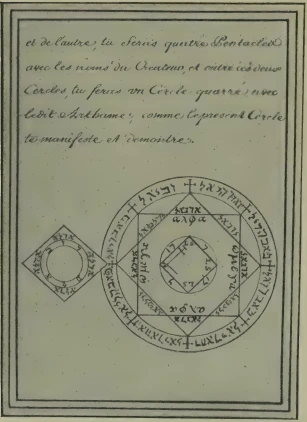
A diagram from Arsenal MS 2350, reproduced as figure 74 by De Givry. It is one of several circle designs in manuscripts transmitted as the Key of Solomon.
Bibliothèque de l’Arsenal, MS 2350, eighteenth century. Diagram reproduced by De Givry. · Image source ↗ · Public Domain
Why the manuscript matters
Arsenal MS 2350 shows how a compiler could combine titles. Arsenal MS 2348 shows how a design could change even when Solomon’s name remained. A modern comparative edition catalogued by the BnF places MS 2348 beside other manuscript copies, so readers can see where they agree and where they differ. [4][5][2][1]
In the library
Witchcraft Magic and Alchemy
Reading note
The separately titled account draws on exact passages in the consulted Library edition.
Sources
See references (6)
- Clavicules de Salomon, catalogue record for the facsimile of the 1641 manuscript ↗Bibliothèque nationale de France. The record identifies Solomon as the attributed author.
- Clavicula Salomonis, catalogue record for a comparative edition ↗Bibliothèque nationale de France. The catalogue notes that the edition draws on Arsenal MS 2348 and other witnesses.
- Witchcraft Magic & Alchemy, printed p. 95, Reader page 87Grillot de Givry, Witchcraft Magic & Alchemy, translated by J. Courtenay Locke. Boston and New York, Houghton Mifflin Company, 1931.Read this page in Witchcraft Magic and Alchemy ↗
- Witchcraft Magic & Alchemy, printed p. 102, Reader page 95Grillot de Givry, Witchcraft Magic & Alchemy, translated by J. Courtenay Locke. Boston and New York, Houghton Mifflin Company, 1931.Read this page in Witchcraft Magic and Alchemy ↗
- Witchcraft Magic & Alchemy, printed p. 104, Reader page 97Grillot de Givry, Witchcraft Magic & Alchemy, translated by J. Courtenay Locke. Boston and New York, Houghton Mifflin Company, 1931.Read this page in Witchcraft Magic and Alchemy ↗
- Witchcraft Magic & Alchemy, printed p. 105, Reader page 98Grillot de Givry, Witchcraft Magic & Alchemy, translated by J. Courtenay Locke. Boston and New York, Houghton Mifflin Company, 1931.Read this page in Witchcraft Magic and Alchemy ↗