Individuation in Jung’s Analytical Psychology
Individuation is Jung’s term for becoming more fully oneself by making room for parts of psychological life that the conscious ego has overlooked. In his Golden Flower commentary, a conflict can change when a wider interest gives both sides a place.
In this article
What is individuation?
Individuation is C. G. Jung’s term for becoming more fully oneself. It involves taking account of parts of psychological life that one’s ordinary sense of self leaves out. A person who identifies strongly with a social role, for instance, may overlook aims or feelings that are hard to reconcile with it. [8][2]
Individuation in Jung’s Golden Flower commentary
In his commentary on The Secret of the Golden Flower, Jung describes conflicts that appeared insoluble without sacrificing one side. A new interest could put the conflict in a different light. Jung compares the change to seeing a storm from a mountaintop. The storm is still there, but it occupies a smaller part of the view. [1][2][3]
The commentary connects a change in standpoint with making room for unexpected images. Jung treats a symbol as a form in which a new development in the psyche can become visible before the person has words for it. [4][5][7]
See references (6)
- The Secret of the Golden Flower, printed p. 87, Reader page 86
- The Secret of the Golden Flower, Jung’s discussion of conflict and the wider standpoint, Reader page 87
- The Secret of the Golden Flower, printed p. 89, Reader page 88
- The Secret of the Golden Flower, printed p. 90, Reader page 89
- The Secret of the Golden Flower, printed p. 96, Reader page 95
- The Secret of the Golden Flower, printed p. 106, Reader page 104
Individuation in The Relations Between the Ego and the Unconscious
In The Relations Between the Ego and the Unconscious, Jung distinguishes individuation from individualism. He describes becoming oneself in ways that can improve how one takes part in shared life. The change of standpoint therefore matters for relationships as well as for a private sense of identity. [8][2]
Jakob Böhme and the image of a centre
Jung mentions Jakob Böhme’s diagram of the soul among his examples of centred forms. The English title of Forty Questions of the Soul describes the figure as a globe or eye with a cross and heart at its centre. The portrait introduces the Christian author whose diagram Jung draws into his comparison. [10][9][6]
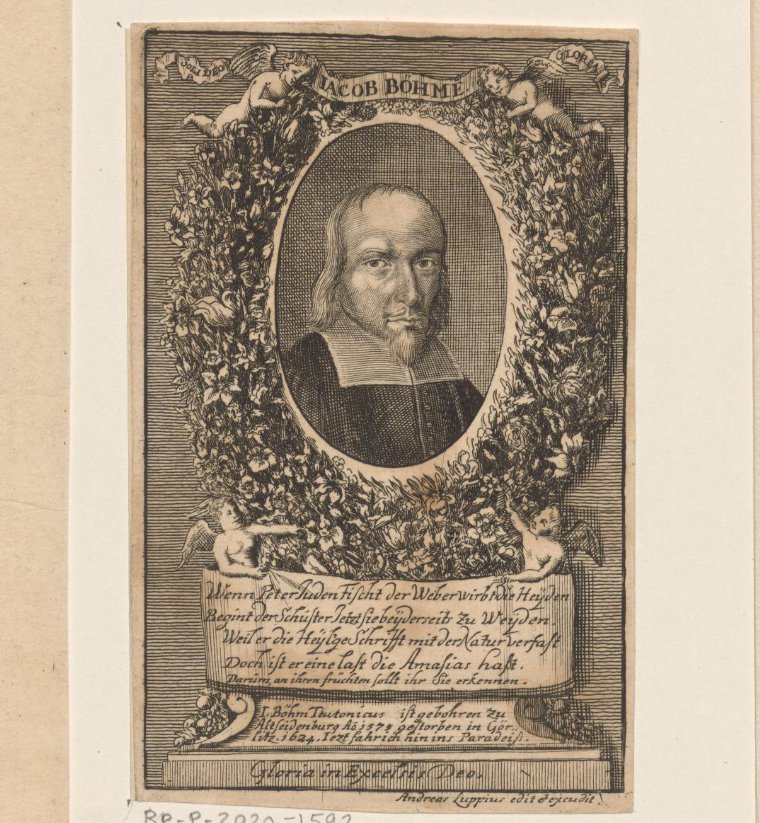
Portrait of Jakob Böhme, anonymous engraving, 1694–1703. Jung discusses Böhme’s diagram of the soul among his examples of centred symbols.
Rijksmuseum, anonymous engraving, 1694–1703. Public domain. · Image source ↗ · Public Domain
In the library
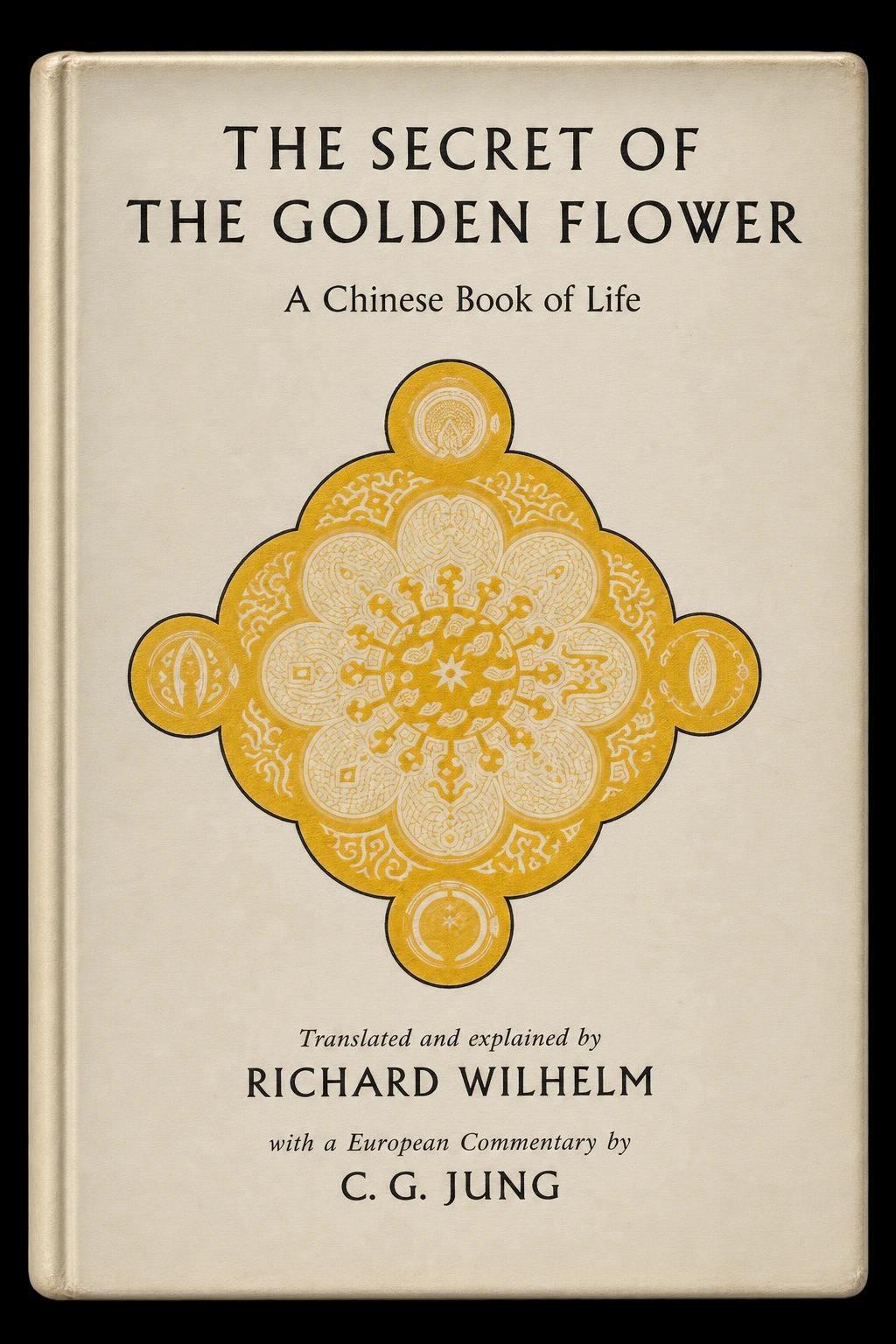
The Secret of the Golden Flower
Reading note
Read the account of Jungian Individuation in Jung’s commentary in the Wilhelm and Baynes edition.
Sources
See references (10)
- The Secret of the Golden Flower, printed p. 87, Reader page 86The Secret of the Golden Flower: A Chinese Book of Life. Chinese text translated and explained by Richard Wilhelm, English translation by Cary F. Baynes, with separate commentary by C. G. Jung. London, Kegan Paul, Trench, Trubner & Co. Lumitheca Library edition IMJ-0596-E001.Read this page in The Secret of the Golden Flower ↗
- The Secret of the Golden Flower, Jung’s discussion of conflict and the wider standpoint, Reader page 87The Secret of the Golden Flower: A Chinese Book of Life. Chinese text translated and explained by Richard Wilhelm, English translation by Cary F. Baynes, with separate commentary by C. G. Jung. London, Kegan Paul, Trench, Trubner & Co. Lumitheca Library edition IMJ-0596-E001.Read this page in The Secret of the Golden Flower ↗
- The Secret of the Golden Flower, printed p. 89, Reader page 88The Secret of the Golden Flower: A Chinese Book of Life. Chinese text translated and explained by Richard Wilhelm, English translation by Cary F. Baynes, with separate commentary by C. G. Jung. London, Kegan Paul, Trench, Trubner & Co. Lumitheca Library edition IMJ-0596-E001.Read this page in The Secret of the Golden Flower ↗
- The Secret of the Golden Flower, printed p. 90, Reader page 89The Secret of the Golden Flower: A Chinese Book of Life. Chinese text translated and explained by Richard Wilhelm, English translation by Cary F. Baynes, with separate commentary by C. G. Jung. London, Kegan Paul, Trench, Trubner & Co. Lumitheca Library edition IMJ-0596-E001.Read this page in The Secret of the Golden Flower ↗
- The Secret of the Golden Flower, printed p. 96, Reader page 95The Secret of the Golden Flower: A Chinese Book of Life. Chinese text translated and explained by Richard Wilhelm, English translation by Cary F. Baynes, with separate commentary by C. G. Jung. London, Kegan Paul, Trench, Trubner & Co. Lumitheca Library edition IMJ-0596-E001.Read this page in The Secret of the Golden Flower ↗
- The Secret of the Golden Flower, printed p. 97, Reader page 96The Secret of the Golden Flower: A Chinese Book of Life. Chinese text translated and explained by Richard Wilhelm, English translation by Cary F. Baynes, with separate commentary by C. G. Jung. London, Kegan Paul, Trench, Trubner & Co. Lumitheca Library edition IMJ-0596-E001.Read this page in The Secret of the Golden Flower ↗
- The Secret of the Golden Flower, printed p. 106, Reader page 104The Secret of the Golden Flower: A Chinese Book of Life. Chinese text translated and explained by Richard Wilhelm, English translation by Cary F. Baynes, with separate commentary by C. G. Jung. London, Kegan Paul, Trench, Trubner & Co. Lumitheca Library edition IMJ-0596-E001.Read this page in The Secret of the Golden Flower ↗
- The Relations Between the Ego and the Unconscious, §§ 266–269 ↗C. G. Jung, The Function of the Unconscious, in The Portable Jung, edited by Violet S. de Laszlo. Princeton University Press.
- Forty Questions of the Soul, title and description of the Philosophick Globe ↗Jakob Böhme, translated by John Sparrow. Folger Shakespeare Library catalogue record.
- Portrait of Jakob Böhme ↗Rijksmuseum, anonymous engraving, 1694–1703. Public domain.