International Devas in Theosophy
What is an international deva? Compare Challoner’s Brotherhood of Peace and Evolution with Hodson’s account of angels working across national boundaries.
In this article
Guardianship across nations
An international deva is a Theosophical guardian whose work crosses national boundaries. A national deva is said to guide a particular people. The international deva attends to what happens when the interests and lives of different peoples meet. [4][5][6]
Watchers of the Seven Spheres by H. K. Challoner
In The International Deva, a poem in H. K. Challoner’s Watchers of the Seven Spheres, the speakers call themselves the Brotherhood of Peace and Evolution. They trace their origin to the Silent Watcher. They perceive human activity as light and sound, with national devas helping them understand what happens within particular communities. [4][5][7]
Challoner pictures nations as limbs of a single body, so war injures the whole to which they belong. Art, science and music suggest ways to work across divisions. The poem also reflects the racial categories of early twentieth-century Theosophy. [7][6][8]
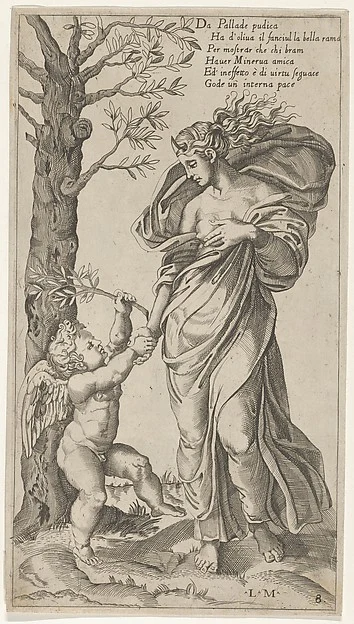
Lorenzo de Musi personifies peace in this Renaissance print. Challoner gives peace a collective agent in the Brotherhood of Peace and Evolution.
Lorenzo de Musi, Allegory of Peace. The Metropolitan Museum of Art. Gift of Katrin Bellinger Kunsthandel, 2014. · Image source ↗ · CC0
The Kingdom of the Gods by Geoffrey Hodson
In The Kingdom of the Gods, Geoffrey Hodson places an international angel above the national angels assigned to particular peoples. He describes it weaving the strands of national character, karma and duty into a larger pattern. [2][3]
Two images of cooperation
Hodson’s strands represent enduring traits, duties and consequences. Challoner hears them changing with human action. Her image of the body asks what happens to the whole when its parts work together or turn against one another. [5][6][2][3]
In the library
The Kingdom of the Gods
Reading note
Separately attributed primary Library account, cited on exact verified Reader leaves.
Watchers of the Seven Spheres
Reading note
The separately titled account draws on exact passages in the consulted Library edition.
Sources
See references (8)
- Lorenzo de Musi, Allegory of Peace ↗Lorenzo de Musi, Allegory of Peace. The Metropolitan Museum of Art. Gift of Katrin Bellinger Kunsthandel, 2014.
- The Kingdom of the Gods, Reader page 67Geoffrey Hodson, The Kingdom of the Gods, Theosophical Publishing House, first published 1952, thirteenth reprint 2007. Lumitheca Library edition IMJ-0606-E001.Read this page in The Kingdom of the Gods ↗
- The Kingdom of the Gods, Reader page 68Geoffrey Hodson, The Kingdom of the Gods, Theosophical Publishing House, first published 1952, thirteenth reprint 2007. Lumitheca Library edition IMJ-0606-E001.Read this page in The Kingdom of the Gods ↗
- Watchers of the Seven Spheres, printed p. 52, Reader page 50H. K. Challoner, Watchers of the Seven Spheres, London, George Routledge & Sons, 1933. Lumitheca Library edition IMJ-0604-E001.Read this page in Watchers of the Seven Spheres ↗
- Watchers of the Seven Spheres, Reader page 51H. K. Challoner, Watchers of the Seven Spheres, London, George Routledge & Sons, 1933. Lumitheca Library edition IMJ-0604-E001.Read this page in Watchers of the Seven Spheres ↗
- Watchers of the Seven Spheres, printed p. 55, Reader page 53H. K. Challoner, Watchers of the Seven Spheres, London, George Routledge & Sons, 1933. Lumitheca Library edition IMJ-0604-E001.Read this page in Watchers of the Seven Spheres ↗
- Watchers of the Seven Spheres, printed p. 54, Reader page 52H. K. Challoner, Watchers of the Seven Spheres, London, George Routledge & Sons, 1933. Lumitheca Library edition IMJ-0604-E001.Read this page in Watchers of the Seven Spheres ↗
- Watchers of the Seven Spheres, Reader page 54H. K. Challoner, Watchers of the Seven Spheres, London, George Routledge & Sons, 1933. Lumitheca Library edition IMJ-0604-E001.Read this page in Watchers of the Seven Spheres ↗