The Innocence of Wisdom
The innocence of wisdom is Swedenborg’s idea of a mature openness to good. It combines the capacity to judge with a willingness to be taught.
In this article
Understanding the concept
The innocence of wisdom is a mature openness to receiving and doing good. In Emanuel Swedenborg’s theology it belongs to people with a developed will and understanding who attribute the good they receive to the Lord. [1][2][3][4]
A child can be open to learning before developing independent judgment. The mature form keeps that openness and uses it to decide how to act. [1][5][2][4]
See references (5)
- Heaven and Its Wonders and Hell, printed p. 213, Reader page 220
- Heaven and Its Wonders and Hell, printed p. 215, Reader page 222
- Heaven and Its Wonders and Hell, printed p. 216, Reader page 223
- Heaven and Its Wonders and Hell, printed p. 217, Reader page 224
- Heaven and Its Wonders and Hell, printed p. 214, Reader page 221
Heaven and Its Wonders and Hell by Emanuel Swedenborg
In Heaven and Its Wonders and Hell, Swedenborg begins with children who are willing to receive care and instruction. Their openness gives him a starting point for the later state, when a person understands more about what they receive. [1][5]
In §278 he calls the innocence of wisdom genuine because it belongs to the mind. Its members attribute received good to the Lord and wish to be led by him. They delight in truth and good and act sincerely towards companions, rather than using cleverness to conceal a harmful end. [2][3]
An angel may appear simple and still act with care and judgment. The good received takes shape in the angel’s choices. Swedenborg gives sincerity a place in wisdom alongside knowledge. [3]
Section 279 connects it with regeneration. Knowledge develops towards intelligence and wisdom while receptivity accompanies the process. The phrase wise child expresses the conjunction of maturity and innocence rather than a literal return to an infant’s capacities. [4]
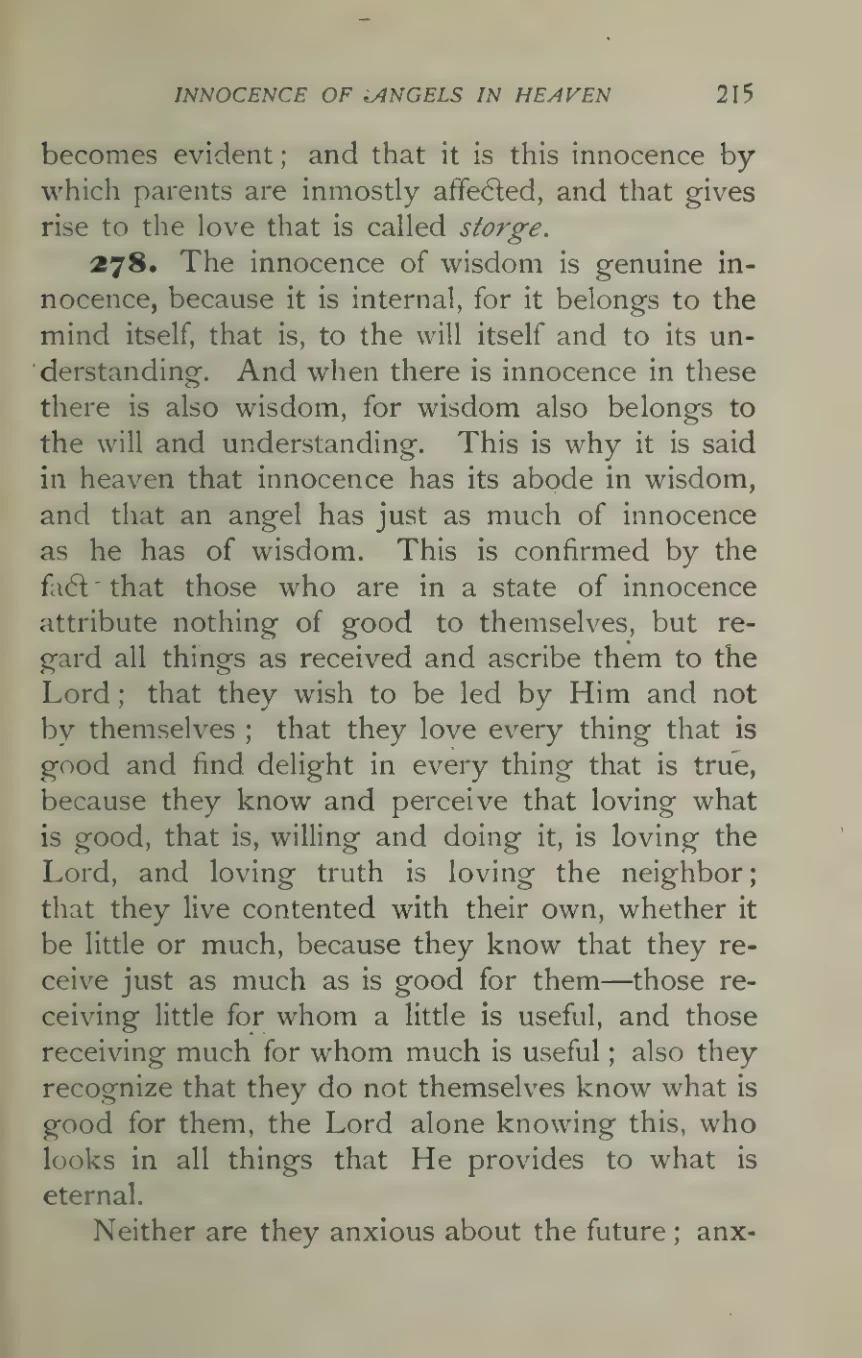
Heaven and Its Wonders and Hell (1916), printed p. 215, Library Reader page 222. Section 278 locates mature innocence in the will and understanding.
Emanuel Swedenborg, Heaven and Its Wonders and Hell, J. C. Ager translation, New York, 1916. Public-domain historical page from the checksum-verified Library PDF. · Image source ↗ · Public Domain
See references (5)
- Heaven and Its Wonders and Hell, printed p. 213, Reader page 220
- Heaven and Its Wonders and Hell, printed p. 215, Reader page 222
- Heaven and Its Wonders and Hell, printed p. 216, Reader page 223
- Heaven and Its Wonders and Hell, printed p. 217, Reader page 224
- Heaven and Its Wonders and Hell, printed p. 214, Reader page 221
Evolution of Immortality by Rosicruciæ, catalogued as F. B. Dowd
Freeman Benjamin Dowd, publishing as Rosicruciæ, interprets the serpent’s question as a stimulus to developing mind. The enclosed garden gives way to wider possibilities; desire for knowledge brings investigation and discrimination. The same chapter also distinguishes directed desire from destructive passion. [6][7][8][9]
What innocence can become
Swedenborg describes being led by the Lord while retaining the understanding needed for mature judgment. The qualities come together when a person takes what they receive into their will and conduct. [2][3][4][1]
Dowd’s retelling of Eden makes a forbidden question the start of a search for knowledge. Swedenborg asks what openness looks like once understanding has already developed. One passage follows the beginning of inquiry, and the other follows what receptivity can become in an experienced person. [6][7][8][9][1][2][3][4]
See references (8)
- Heaven and Its Wonders and Hell, printed p. 213, Reader page 220
- Heaven and Its Wonders and Hell, printed p. 215, Reader page 222
- Heaven and Its Wonders and Hell, printed p. 216, Reader page 223
- Heaven and Its Wonders and Hell, printed p. 217, Reader page 224
- Evolution of Immortality, printed p. 112, Reader page 110
- Evolution of Immortality, printed p. 113, Reader page 112
- Evolution of Immortality, printed p. 119, Reader page 118
- Evolution of Immortality, printed p. 120, Reader page 119
Read further in the library

Heaven and Its Wonders and Hell
Reading note
The separately titled account draws on exact passages in the consulted Library edition.
Evolution of Immortality
Reading note
Separately attributed comparison with exact previously researched Library passages.
Sources
See references (9)
- Heaven and Its Wonders and Hell, printed p. 213, Reader page 220Emanuel Swedenborg, Heaven and Its Wonders and Hell, From Things Heard and Seen, translated by J. C. Ager. American Swedenborg Printing and Publishing Society, New York, 1916. Latin original first published in 1758. Numbered sections and exact pages refer to this consulted edition. Claims of spiritual experience remain attributed.Read this page in Heaven and Its Wonders and Hell ↗Return to text ↑
- Heaven and Its Wonders and Hell, printed p. 215, Reader page 222Emanuel Swedenborg, Heaven and Its Wonders and Hell, From Things Heard and Seen, translated by J. C. Ager. American Swedenborg Printing and Publishing Society, New York, 1916. Latin original first published in 1758. Numbered sections and exact pages refer to this consulted edition. Claims of spiritual experience remain attributed.Read this page in Heaven and Its Wonders and Hell ↗Return to text ↑
- Heaven and Its Wonders and Hell, printed p. 216, Reader page 223Emanuel Swedenborg, Heaven and Its Wonders and Hell, From Things Heard and Seen, translated by J. C. Ager. American Swedenborg Printing and Publishing Society, New York, 1916. Latin original first published in 1758. Numbered sections and exact pages refer to this consulted edition. Claims of spiritual experience remain attributed.Read this page in Heaven and Its Wonders and Hell ↗Return to text ↑
- Heaven and Its Wonders and Hell, printed p. 217, Reader page 224Emanuel Swedenborg, Heaven and Its Wonders and Hell, From Things Heard and Seen, translated by J. C. Ager. American Swedenborg Printing and Publishing Society, New York, 1916. Latin original first published in 1758. Numbered sections and exact pages refer to this consulted edition. Claims of spiritual experience remain attributed.Read this page in Heaven and Its Wonders and Hell ↗Return to text ↑
- Heaven and Its Wonders and Hell, printed p. 214, Reader page 221Emanuel Swedenborg, Heaven and Its Wonders and Hell, From Things Heard and Seen, translated by J. C. Ager. American Swedenborg Printing and Publishing Society, New York, 1916. Latin original first published in 1758. Numbered sections and exact pages refer to this consulted edition. Claims of spiritual experience remain attributed.Read this page in Heaven and Its Wonders and Hell ↗Return to text ↑
- Evolution of Immortality, printed p. 112, Reader page 110Rosicruciæ, catalogued as Freeman Benjamin Dowd, Evolution of Immortality. Eulian Publishing Company, Salem, Mass., copyright 1900; title page undated. The book’s metaphysical and scientific assertions remain attributed. The separately reproduced Higher Thought of Sex address has no speaker named in this edition.Read this page in Evolution of Immortality ↗Return to text ↑
- Evolution of Immortality, printed p. 113, Reader page 112Rosicruciæ, catalogued as Freeman Benjamin Dowd, Evolution of Immortality. Eulian Publishing Company, Salem, Mass., copyright 1900; title page undated. The book’s metaphysical and scientific assertions remain attributed. The separately reproduced Higher Thought of Sex address has no speaker named in this edition.Read this page in Evolution of Immortality ↗Return to text ↑
- Evolution of Immortality, printed p. 119, Reader page 118Rosicruciæ, catalogued as Freeman Benjamin Dowd, Evolution of Immortality. Eulian Publishing Company, Salem, Mass., copyright 1900; title page undated. The book’s metaphysical and scientific assertions remain attributed. The separately reproduced Higher Thought of Sex address has no speaker named in this edition.Read this page in Evolution of Immortality ↗Return to text ↑
- Evolution of Immortality, printed p. 120, Reader page 119Rosicruciæ, catalogued as Freeman Benjamin Dowd, Evolution of Immortality. Eulian Publishing Company, Salem, Mass., copyright 1900; title page undated. The book’s metaphysical and scientific assertions remain attributed. The separately reproduced Higher Thought of Sex address has no speaker named in this edition.Read this page in Evolution of Immortality ↗Return to text ↑