Impermanence
Impermanence, or anicca, is the Buddhist teaching that conditioned things change. Read Dhammapada 277 and Hearn’s images of incense and departing lanterns.
In this article
What is impermanence?
Impermanence, called anicca in Pāli, is the Buddhist teaching that things that come about through causes and conditions are subject to change. A body ages, a feeling passes, and a favourable situation can turn. Seeing how changeable these things are can loosen the urge to hold on to them. [1][3][4][5][6][7][8]
Impermanence in Dhammapada 277
Verse 277 of the Dhammapada links seeing the changeability of conditioned things with disenchantment with suffering and the path to purification. Thanissaro Bhikkhu’s translation calls these conditioned things fabrications. The following two verses turn to suffering and not-self. [1]
In Ghostly Japan by Lafcadio Hearn
In Incense, Lafcadio Hearn relates an explanation from the Shin Buddhist priest Myōden. Burning incense gives off smoke until only ash is left. Myōden compares it to a body that breathes while it lives and eventually becomes funeral ashes. [9][6]
Hearn’s Japanese Buddhist Proverbs compares life to a lamp in the wind. The full moon begins to wane when it reaches fullness. Clouds obscure the moon and wind scatters flowers. Each image makes change visible at the point when something seems most secure or beautiful. [3][4][5]
In At Yaidzu, Hearn swims out beside farewell lanterns drifting away from the shore. He thinks about lives drawing apart across an immense sea. The visible motion of the lights gives his thought about separation a physical shape. [7][8][10][6][3][4][5]
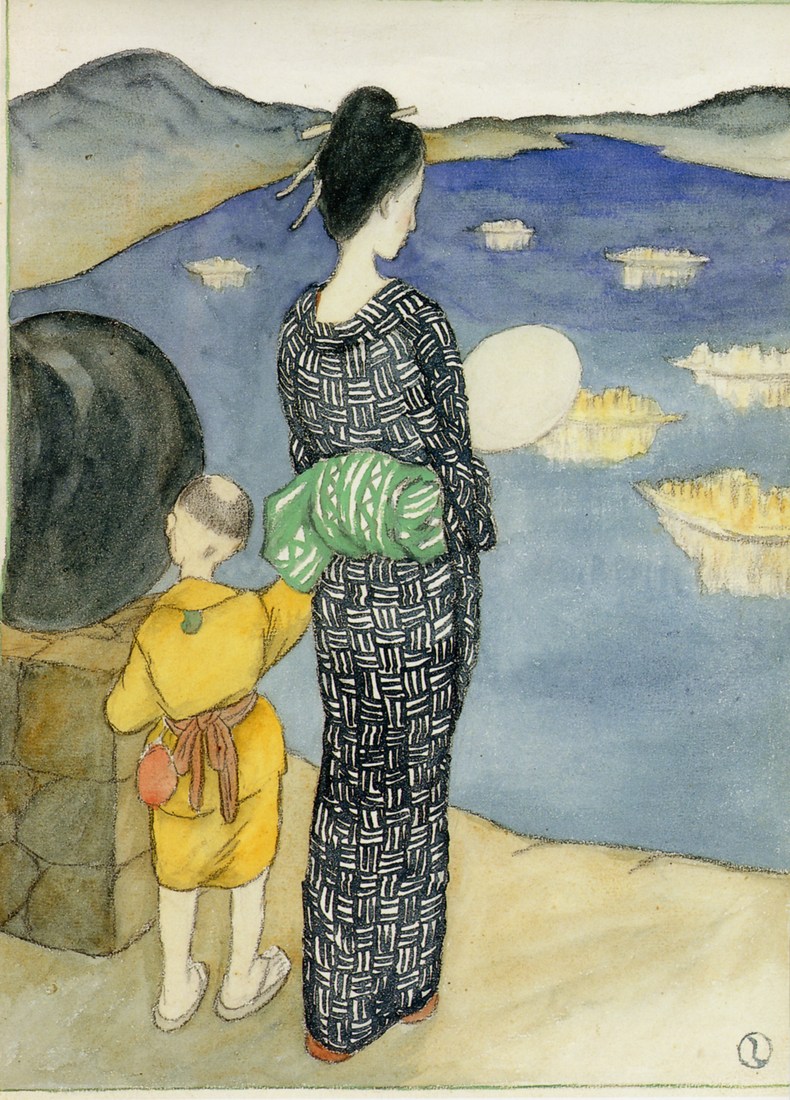
In Tōrō-nagashi (1920), Takehisa Yumeji depicts floating lanterns at Nagasaki. Hearn’s essay describes a farewell at Yaizu.
Takehisa Yumeji. Public domain; image via Wikimedia Commons. · Image source ↗ · Public Domain
Smoke, moonlight and a passing life
The Dhammapada asks what changes in us when we recognise impermanence. Hearn gives readers things they can picture changing: a burning stick of incense, a full moon, lanterns pulling away from one another. [1][7][8][6][4][5]
Read further in the library
In Ghostly Japan
Reading note
The separately titled account draws on exact passages in the consulted Library edition.
Sources
See references (10)
- Dhammapada, The Path, verses 277–279; translated by Thanissaro Bhikkhu ↗Primary verses directly read. Only the identified passage is used; this is not a claim of reading the whole Dhammapada. Canonical verse numbers identify the passage without invented Library pagination.Return to text ↑
- Takehisa Yumeji, Tōrō-nagashi, from Twelve Scenes at Nagasaki, 1920 ↗Takehisa Yumeji. Public domain; image via Wikimedia Commons.
- In Ghostly Japan, Reader page 169Lafcadio Hearn, In Ghostly Japan, Little, Brown, and Company, Boston, 1899. Exact consulted Library edition IMJ-0654-E001, with title page visually checked. Persistent PageIDs and current Reader positions are verified from the supplied edition. Embedded stories, translations and quotations are attributed to Hearn’s presentation unless an original source has separately been consulted.Read this page in In Ghostly Japan ↗Return to text ↑
- In Ghostly Japan, Reader page 178Lafcadio Hearn, In Ghostly Japan, Little, Brown, and Company, Boston, 1899. Exact consulted Library edition IMJ-0654-E001, with title page visually checked. Persistent PageIDs and current Reader positions are verified from the supplied edition. Embedded stories, translations and quotations are attributed to Hearn’s presentation unless an original source has separately been consulted.Read this page in In Ghostly Japan ↗Return to text ↑
- In Ghostly Japan, Reader page 186Lafcadio Hearn, In Ghostly Japan, Little, Brown, and Company, Boston, 1899. Exact consulted Library edition IMJ-0654-E001, with title page visually checked. Persistent PageIDs and current Reader positions are verified from the supplied edition. Embedded stories, translations and quotations are attributed to Hearn’s presentation unless an original source has separately been consulted.Read this page in In Ghostly Japan ↗Return to text ↑
- In Ghostly Japan, Reader page 31Lafcadio Hearn, In Ghostly Japan, Little, Brown, and Company, Boston, 1899. Exact consulted Library edition IMJ-0654-E001, with title page visually checked. Persistent PageIDs and current Reader positions are verified from the supplied edition. Embedded stories, translations and quotations are attributed to Hearn’s presentation unless an original source has separately been consulted.Read this page in In Ghostly Japan ↗Return to text ↑
- In Ghostly Japan, Reader page 218Lafcadio Hearn, In Ghostly Japan, Little, Brown, and Company, Boston, 1899. Exact consulted Library edition IMJ-0654-E001, with title page visually checked. Persistent PageIDs and current Reader positions are verified from the supplied edition. Embedded stories, translations and quotations are attributed to Hearn’s presentation unless an original source has separately been consulted.Read this page in In Ghostly Japan ↗Return to text ↑
- In Ghostly Japan, Reader page 219Lafcadio Hearn, In Ghostly Japan, Little, Brown, and Company, Boston, 1899. Exact consulted Library edition IMJ-0654-E001, with title page visually checked. Persistent PageIDs and current Reader positions are verified from the supplied edition. Embedded stories, translations and quotations are attributed to Hearn’s presentation unless an original source has separately been consulted.Read this page in In Ghostly Japan ↗Return to text ↑
- In Ghostly Japan, Reader page 30Lafcadio Hearn, In Ghostly Japan, Little, Brown, and Company, Boston, 1899. Exact consulted Library edition IMJ-0654-E001, with title page visually checked. Persistent PageIDs and current Reader positions are verified from the supplied edition. Embedded stories, translations and quotations are attributed to Hearn’s presentation unless an original source has separately been consulted.Read this page in In Ghostly Japan ↗Return to text ↑
- In Ghostly Japan, Reader page 220Lafcadio Hearn, In Ghostly Japan, Little, Brown, and Company, Boston, 1899. Exact consulted Library edition IMJ-0654-E001, with title page visually checked. Persistent PageIDs and current Reader positions are verified from the supplied edition. Embedded stories, translations and quotations are attributed to Hearn’s presentation unless an original source has separately been consulted.Read this page in In Ghostly Japan ↗Return to text ↑