Ihai
An ihai is a Japanese Buddhist memorial tablet. See how tablets are inscribed, placed in a household altar and used to remember the dead.
In this article
What is an ihai?
An ihai is a Japanese Buddhist tablet inscribed in memory of a person who has died. It often bears their Buddhist name. At a household altar, it gives the family a place to direct offerings and prayers for that person. [4][5][2][1][6]
Ihai and butsudan
The butsudan is the household Buddhist altar. The ihai is the tablet for an individual or group of ancestors that can be kept there. Smith’s characters open or light the altar and direct their acts of remembrance towards the people named on the tablets. [9][10][11][12][13][7][4][8][14]
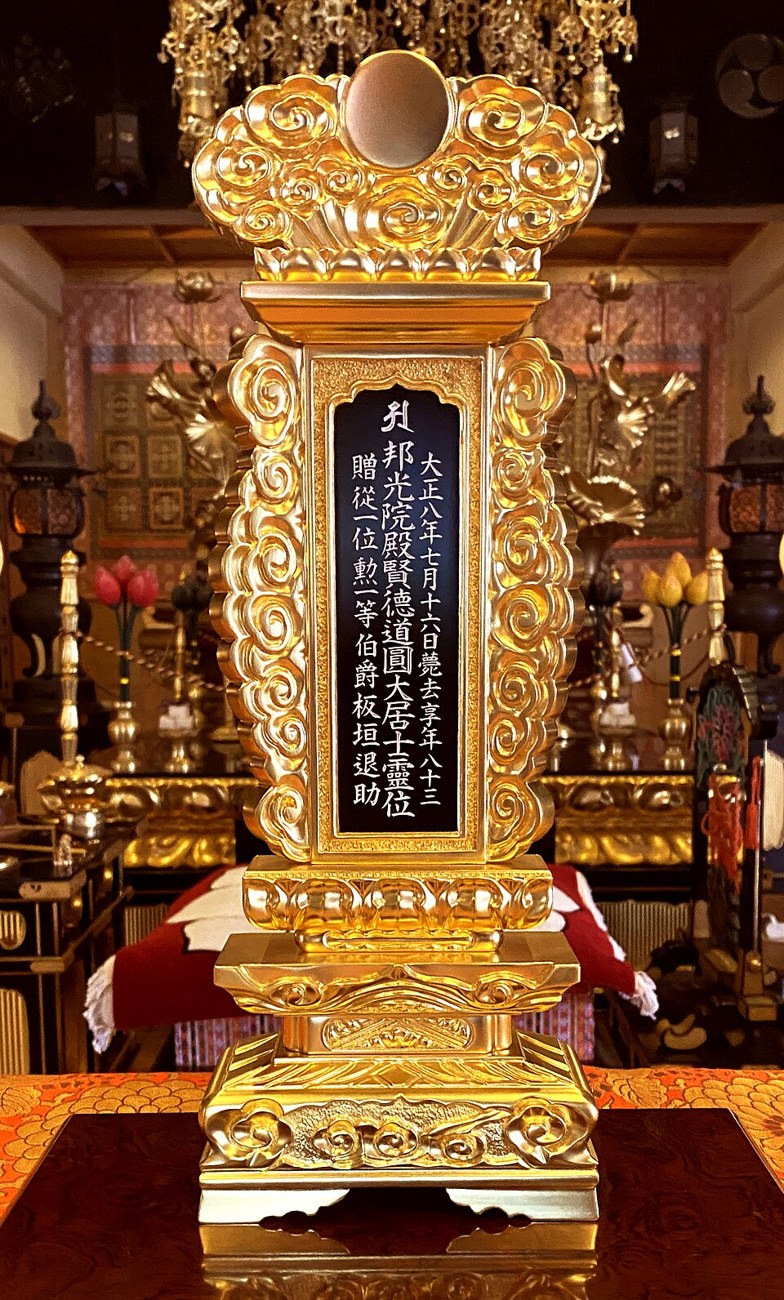
On this gilded ihai for Itagaki Taisuke, the Buddhist name occupies the centre of the inscription. Other details appear to either side.
Photo memories 1868 / Wikimedia Commons, CC BY-SA 4.0. Resized. Tablet by the Itagaki Taisuke Memorial Association. · Image source ↗ · CC BY-SA 4.0
See references (9)
- In Ghostly Japan, Reader page 79
- In Ghostly Japan, Reader page 78
- In Ghostly Japan, Reader page 83
- Ancient Tales and Folklore of Japan, Reader page 20
- Ancient Tales and Folklore of Japan, Reader page 427
- Ancient Tales and Folklore of Japan, Reader page 428
- Ancient Tales and Folklore of Japan, Reader page 456
- Ancient Tales and Folklore of Japan, Reader page 457
- Front of Itagaki Taisuke’s Buddhist memorial tablet at Kōyaji, photographed in 2024
The tablet at a Sōtō Zen family altar
Sōtō Zen guidance places memorial tablets to either side of the main Buddha image. The altar also holds offerings such as flowers, incense, light, water and food. If there are too many tablets to fit, several names can be gathered on one combined tablet, a gōdōhai. [1]
A temporary tablet in the Horniman collection
The Horniman Museum holds a shiraki-ihai, a temporary tablet of plain wood used until the forty-ninth day after death. The Buddhist name on its front includes a Jōdo-shū epithet. The date of death is inscribed on the reverse. [2]
In Ghostly Japan by Lafcadio Hearn
In A Passional Karma, Lafcadio Hearn tells how Shinzaburō sets up a tablet for O-Tsuyu, makes offerings and recites the nembutsu. When she and her attendant appear and deny that they have died, he shows them the tablet he has been tending. [7][4][8][6]
In Ingwa-banashi a wandering nun, Yukiko, carries the tablet of her former mistress. She performs services for the deceased and asks for pardon and repose. The tablet gives her remembrance a focus wherever she goes. [5][4][6]
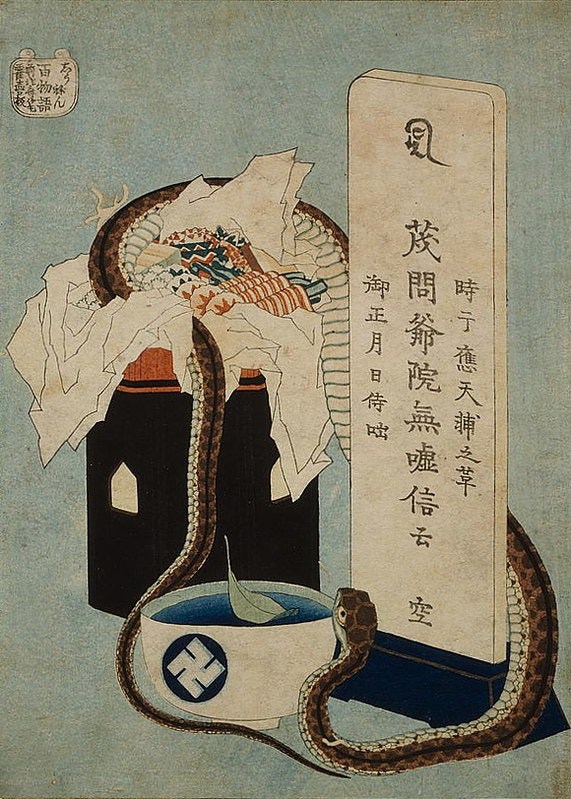
Hokusai’s Shūnen (Obsession), around 1831–1832, places an inscribed memorial tablet inside a ghost scene.
Katsushika Hokusai. Public domain; image via Wikimedia Commons. · Image source ↗ · Public Domain
In Ancient Tales and Folk-lore of Japan
In Ancient Tales and Folklore of Japan, Richard Gordon Smith has Konojo light incense before O Ko’s tablet when he learns she has died. In The Snow Ghost, Oyasu asks her host to light the altar so she can pay her respects to the ancestors. [9][10][11]
In The Precious Sword, Matsue takes a family heirloom kept at the altar. Smith’s description distinguishes the place where it was kept from the wooden tablet that bears a deceased person’s Buddhist name. [12][13]
Plain wood, gilding and portable tablets
A tablet may be a plain temporary object, an ornate one set up at an altar, or a smaller one that someone carries. In Hearn’s tales, the lasting element is the written name and the care someone continues to give it. [4][6][5][1][2]
Read further in the library
In Ghostly Japan
Reading note
The separately titled account draws on exact passages in the consulted Library edition.
Ancient Tales and Folk-lore of Japan
Reading note
Read Richard Gordon Smith’s separately attributed tale in its Library edition.
Sources
See references (14)
- Soto Zen: The Butsudan, a Family Buddha Altar ↗Sotoshu’s own description of the family altar and memorial tablets, directly consulted. The described arrangement belongs to this institutional account.Return to text ↑
- Horniman Museum: wooden ancestral tablet, museum number 6.12.65/426 ↗Museum’s own object catalogue, directly consulted, distinguishes the temporary unvarnished tablet, inscriptions and naming elements in this particular Jodoshu-associated example. Its object-specific explanation is not imposed on every Buddhist school.Return to text ↑
- Katsushika Hokusai, Shūnen (Obsession), c.1831–1832 ↗Historical image and reuse status checked against the retained source record. Katsushika Hokusai. Public domain; image via Wikimedia Commons.
- In Ghostly Japan, Reader page 79Lafcadio Hearn, In Ghostly Japan, Little, Brown, and Company, Boston, 1899. Exact consulted Library edition IMJ-0654-E001, with title page visually checked. Persistent PageIDs and current Reader positions are verified from the supplied edition. Embedded stories, translations and quotations are attributed to Hearn’s presentation unless an original source has separately been consulted.Read this page in In Ghostly Japan ↗Return to text ↑
- In Ghostly Japan, Reader page 202Lafcadio Hearn, In Ghostly Japan, Little, Brown, and Company, Boston, 1899. Exact consulted Library edition IMJ-0654-E001, with title page visually checked. Persistent PageIDs and current Reader positions are verified from the supplied edition. Embedded stories, translations and quotations are attributed to Hearn’s presentation unless an original source has separately been consulted.Read this page in In Ghostly Japan ↗Return to text ↑
- In Ghostly Japan, Reader page 84Lafcadio Hearn, In Ghostly Japan, Little, Brown, and Company, Boston, 1899. Exact consulted Library edition IMJ-0654-E001, with title page visually checked. Persistent PageIDs and current Reader positions are verified from the supplied edition. Embedded stories, translations and quotations are attributed to Hearn’s presentation unless an original source has separately been consulted.Read this page in In Ghostly Japan ↗Return to text ↑
- In Ghostly Japan, Reader page 78Lafcadio Hearn, In Ghostly Japan, Little, Brown, and Company, Boston, 1899. Exact consulted Library edition IMJ-0654-E001, with title page visually checked. Persistent PageIDs and current Reader positions are verified from the supplied edition. Embedded stories, translations and quotations are attributed to Hearn’s presentation unless an original source has separately been consulted.Read this page in In Ghostly Japan ↗Return to text ↑
- In Ghostly Japan, Reader page 83Lafcadio Hearn, In Ghostly Japan, Little, Brown, and Company, Boston, 1899. Exact consulted Library edition IMJ-0654-E001, with title page visually checked. Persistent PageIDs and current Reader positions are verified from the supplied edition. Embedded stories, translations and quotations are attributed to Hearn’s presentation unless an original source has separately been consulted.Read this page in In Ghostly Japan ↗Return to text ↑
- Ancient Tales and Folklore of Japan, Reader page 20Richard Gordon Smith, Ancient Tales and Folklore of Japan. A. & C. Black, London, 1908. Lumitheca Library edition IMJ-0588-E001.Read this page in Ancient Tales and Folk-lore of Japan ↗Return to text ↑
- Ancient Tales and Folklore of Japan, Reader page 427Richard Gordon Smith, Ancient Tales and Folklore of Japan. A. & C. Black, London, 1908. Lumitheca Library edition IMJ-0588-E001.Read this page in Ancient Tales and Folk-lore of Japan ↗Return to text ↑
- Ancient Tales and Folklore of Japan, Reader page 428Richard Gordon Smith, Ancient Tales and Folklore of Japan. A. & C. Black, London, 1908. Lumitheca Library edition IMJ-0588-E001.Read this page in Ancient Tales and Folk-lore of Japan ↗Return to text ↑
- Ancient Tales and Folklore of Japan, Reader page 456Richard Gordon Smith, Ancient Tales and Folklore of Japan. A. & C. Black, London, 1908. Lumitheca Library edition IMJ-0588-E001.Read this page in Ancient Tales and Folk-lore of Japan ↗Return to text ↑
- Ancient Tales and Folklore of Japan, Reader page 457Richard Gordon Smith, Ancient Tales and Folklore of Japan. A. & C. Black, London, 1908. Lumitheca Library edition IMJ-0588-E001.Read this page in Ancient Tales and Folk-lore of Japan ↗Return to text ↑
- Front of Itagaki Taisuke’s Buddhist memorial tablet at Kōyaji, photographed in 2024 ↗Photo memories 1868 / Wikimedia Commons, CC BY-SA 4.0. Resized. Tablet by the Itagaki Taisuke Memorial Association.Return to text ↑