The Ideal Garden
The Ideal Garden is an astral home in J. S. M. Ward’s A Subaltern in Spirit Land. Explore the original plan, its seasonal plots and the people who tend them.
In this article
Understanding the ideal garden in a subaltern in spirit land
The Ideal Garden is an astral home in J. S. M. Ward’s A Subaltern in Spirit Land. Its owner spent her earthly life imagining a house and gardens she could never afford. The place Ward describes makes that private design visible to her visitors. [1][2][3]
The plan and the plants have different origins in the story. The layout comes from the owner’s wishes. The plants are said to come from Earth after dying there, and keeping the plots in order still gives the gardeners work to do. [4][3][5]
See references (5)
A Subaltern in Spirit Land by J. S. M. Ward
In A Subaltern in Spirit Land, J. S. M. Ward visits with Rex and H. J. L. A drive leads towards the square fountain pool and the house. The published plan lets a reader follow the approach: rose and lily plots flank the drive, and the garden paths run on past the house to two terraces and an orchard. [1][4][2]
A gardener explains that the owner had been poor and spent her earthly life imagining the home she would have if her means allowed it. Her gardeners also follow chosen interests: three had worked in gardens before death, while another had been a clerk who longed to garden. Their activity is described as willing companionship rather than compulsory employment. [2][3]
The plants have a different origin from the layout. They are said to be astral forms of plants that died on earth. A failing rose becomes thin, disperses and is replaced from newly appearing stock. The garden therefore needs care even though its workers no longer face the same drudgery. [3]
Separate gardens display different earthly seasons at once. The winter garden remains because its owner always wanted one, despite the absence of winter there. Later, Rex describes terraces, a lake and birds and butterflies drawn to the owner through affection rather than held in cages. [5][6][7]
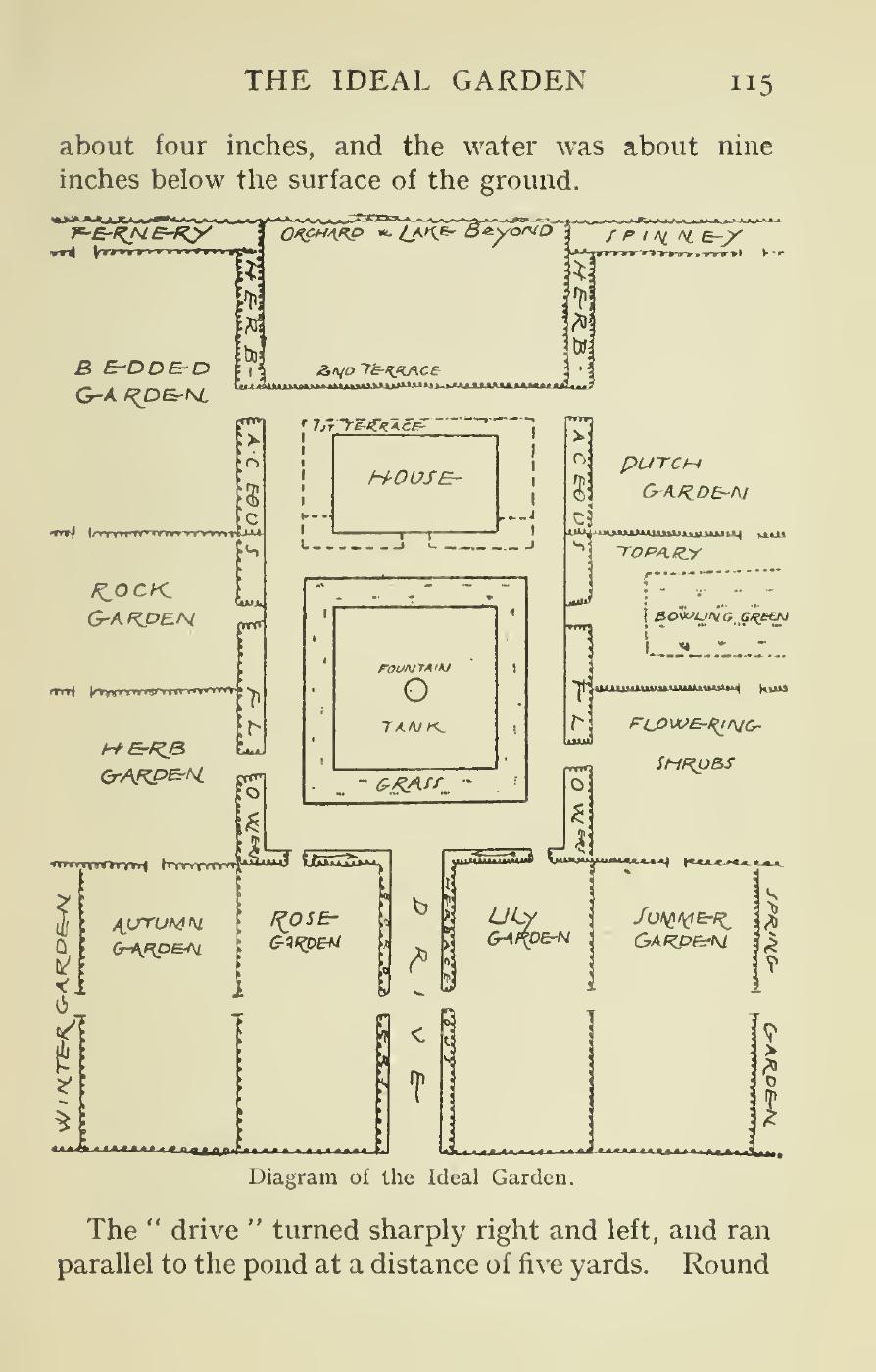
Ward’s Diagram of the Ideal Garden, printed p. 115, Library Reader page 130. Follow the drive between the seasonal gardens to the fountain, house and terraces.
J. S. M. Ward, A Subaltern in Spirit Land. William Rider & Son, 1920. Public-domain historical text and page image, extracted from the checksum-verified retained Library scan. · Image source ↗ · Public Domain
See references (7)
- A Subaltern in Spirit Land, printed p. 114, Reader page 129
- A Subaltern in Spirit Land, printed p. 116, Reader page 131
- A Subaltern in Spirit Land, printed p. 117, Reader page 132
- A Subaltern in Spirit Land, printed p. 115, Reader page 130
- A Subaltern in Spirit Land, printed p. 118, Reader page 133
- A Subaltern in Spirit Land, printed p. 121, Reader page 136
- A Subaltern in Spirit Land, printed p. 122, Reader page 137
Gone West by J. S. M. Ward
In Gone West, Ward’s Officer describes factories and shops caught in repetition. Goods return after sale, warehouses refill and a shopkeeper cannot imagine a life without selling. The scene turns the continuation of earthly occupation into a problem of purpose and attachment. [8][9]
A design, a living garden and a reason to work
The owner provides a design. Plants that have died on Earth are said to furnish it. The crops and roses can change even while the garden keeps the shape she pictured. [2][3][5]
Gardening and shopkeeping are both continuations of earthly interests in Ward’s books. The gardeners choose work they like and help maintain a place others enjoy. The shopkeeper repeats an activity he feels unable to give up. Their different purposes shape what it means to continue the work. [3][6][7][8][9]
See references (7)
- A Subaltern in Spirit Land, printed p. 116, Reader page 131
- A Subaltern in Spirit Land, printed p. 117, Reader page 132
- A Subaltern in Spirit Land, printed p. 118, Reader page 133
- A Subaltern in Spirit Land, printed p. 121, Reader page 136
- A Subaltern in Spirit Land, printed p. 122, Reader page 137
- Gone West, printed p. 153, Reader page 166
- Gone West, printed p. 154, Reader page 167
Read further in the library
A Subaltern in Spirit Land: A Sequel to Gone West
Reading note
The separately titled account draws on exact passages in the consulted Library edition.
Gone West
Reading note
Separately attributed comparison with exact previously researched Library passages.
Sources
See references (9)
- A Subaltern in Spirit Land, printed p. 114, Reader page 129J. S. M. Ward, A Subaltern in Spirit Land: A Sequel to Gone West. William Rider & Son, London, 1920. Narrated experiences and explanations are attributed to Ward and his reported spirit contributors, especially his brother Rex (R. L. W.) and H. J. L.Read this page in A Subaltern in Spirit Land: A Sequel to Gone West ↗Return to text ↑
- A Subaltern in Spirit Land, printed p. 116, Reader page 131J. S. M. Ward, A Subaltern in Spirit Land: A Sequel to Gone West. William Rider & Son, London, 1920. Narrated experiences and explanations are attributed to Ward and his reported spirit contributors, especially his brother Rex (R. L. W.) and H. J. L.Read this page in A Subaltern in Spirit Land: A Sequel to Gone West ↗Return to text ↑
- A Subaltern in Spirit Land, printed p. 117, Reader page 132J. S. M. Ward, A Subaltern in Spirit Land: A Sequel to Gone West. William Rider & Son, London, 1920. Narrated experiences and explanations are attributed to Ward and his reported spirit contributors, especially his brother Rex (R. L. W.) and H. J. L.Read this page in A Subaltern in Spirit Land: A Sequel to Gone West ↗Return to text ↑
- A Subaltern in Spirit Land, printed p. 115, Reader page 130J. S. M. Ward, A Subaltern in Spirit Land: A Sequel to Gone West. William Rider & Son, London, 1920. Narrated experiences and explanations are attributed to Ward and his reported spirit contributors, especially his brother Rex (R. L. W.) and H. J. L.Read this page in A Subaltern in Spirit Land: A Sequel to Gone West ↗Return to text ↑
- A Subaltern in Spirit Land, printed p. 118, Reader page 133J. S. M. Ward, A Subaltern in Spirit Land: A Sequel to Gone West. William Rider & Son, London, 1920. Narrated experiences and explanations are attributed to Ward and his reported spirit contributors, especially his brother Rex (R. L. W.) and H. J. L.Read this page in A Subaltern in Spirit Land: A Sequel to Gone West ↗Return to text ↑
- A Subaltern in Spirit Land, printed p. 121, Reader page 136J. S. M. Ward, A Subaltern in Spirit Land: A Sequel to Gone West. William Rider & Son, London, 1920. Narrated experiences and explanations are attributed to Ward and his reported spirit contributors, especially his brother Rex (R. L. W.) and H. J. L.Read this page in A Subaltern in Spirit Land: A Sequel to Gone West ↗Return to text ↑
- A Subaltern in Spirit Land, printed p. 122, Reader page 137J. S. M. Ward, A Subaltern in Spirit Land: A Sequel to Gone West. William Rider & Son, London, 1920. Narrated experiences and explanations are attributed to Ward and his reported spirit contributors, especially his brother Rex (R. L. W.) and H. J. L.Read this page in A Subaltern in Spirit Land: A Sequel to Gone West ↗Return to text ↑
- Gone West, printed p. 153, Reader page 166J. S. M. Ward, Gone West: Three Narratives of After-Death Experiences, third impression, William Rider & Son, London, 1920, as reproduced in Geoff Cutler’s December 2009 digital transcription. Ward’s introduction is distinct from the supplied 1974 foreword.Read this page in Gone West ↗Return to text ↑
- Gone West, printed p. 154, Reader page 167J. S. M. Ward, Gone West: Three Narratives of After-Death Experiences, third impression, William Rider & Son, London, 1920, as reproduced in Geoff Cutler’s December 2009 digital transcription. Ward’s introduction is distinct from the supplied 1974 foreword.Read this page in Gone West ↗Return to text ↑