The 64 I Ching Hexagrams: Chart, Names and Lookup
Look up any I Ching hexagram by its six lines or two trigrams. Browse all 64 figures in King Wen order and read each passage in James Legge’s 1882 edition.
In this article
Look up a hexagram
Build a figure from its six lines, find it by its two trigrams, or browse the received sequence.
Build a hexagram
Toggle any line between solid yang and broken yin. Line 1 is at the bottom.
泰 Tài
Peace
- Upper
- Kūn · Earth
- Lower
- Qián · Heaven
The upper and lower trigram chart
Find the lower trigram on the left and the upper trigram across the top. Each cell leads to that figure in the list below.
All 64 hexagrams in King Wen order
Each figure has its Chinese name, pinyin and a short English gloss. Open it to read the full passage in James Legge’s 1882 translation.
- 1. 乾 QiánHeaven
- 2. 坤 KūnEarth
- 3. 屯 ZhūnDifficulty at the Beginning
- 4. 蒙 MéngYouthful Folly
- 5. 需 XūWaiting
- 6. 訟 SòngConflict
- 7. 師 ShīThe Army
- 8. 比 BǐUnion
- 9. 小畜 Xiǎo ChùSmall Restraint
- 10. 履 LǚTreading
- 11. 泰 TàiPeace
- 12. 否 PǐStandstill
- 13. 同人 Tóng RénFellowship
- 14. 大有 Dà YǒuGreat Possession
- 15. 謙 QiānModesty
- 16. 豫 YùEnthusiasm
- 17. 隨 SuíFollowing
- 18. 蠱 GǔRepairing Decay
- 19. 臨 LínApproach
- 20. 觀 GuānContemplation
- 21. 噬嗑 Shì KèBiting Through
- 22. 賁 BìGrace
- 23. 剝 BōSplitting Apart
- 24. 復 FùReturn
- 25. 無妄 Wú WàngInnocence
- 26. 大畜 Dà ChùGreat Restraint
- 27. 頤 YíNourishment
- 28. 大過 Dà GuòGreat Excess
- 29. 坎 KǎnRepeated Danger
- 30. 離 LíFire
- 31. 咸 XiánInfluence
- 32. 恆 HéngDuration
- 33. 遯 DùnRetreat
- 34. 大壯 Dà ZhuàngGreat Power
- 35. 晉 JìnProgress
- 36. 明夷 Míng YíDarkening of the Light
- 37. 家人 Jiā RénThe Family
- 38. 睽 KuíOpposition
- 39. 蹇 JiǎnObstruction
- 40. 解 XièRelease
- 41. 損 SǔnDecrease
- 42. 益 YìIncrease
- 43. 夬 GuàiBreakthrough
- 44. 姤 GòuEncounter
- 45. 萃 CuìGathering
- 46. 升 ShēngAscending
- 47. 困 KùnOppression
- 48. 井 JǐngThe Well
- 49. 革 GéRevolution
- 50. 鼎 DǐngThe Cauldron
- 51. 震 ZhènThunder
- 52. 艮 GènStillness
- 53. 漸 JiànGradual Progress
- 54. 歸妹 Guī MèiThe Marrying Maiden
- 55. 豐 FēngAbundance
- 56. 旅 LǚThe Wanderer
- 57. 巽 XùnGentle Penetration
- 58. 兌 DuìJoy
- 59. 渙 HuànDispersion
- 60. 節 JiéLimitation
- 61. 中孚 Zhōng FúInner Truth
- 62. 小過 Xiǎo GuòSmall Excess
- 63. 既濟 Jì JìAfter Completion
- 64. 未濟 Wèi JìBefore Completion
What are the 64 I Ching hexagrams?
A hexagram is a stack of six horizontal lines in the Chinese Book of Changes, also called the I Ching or Yijing. A line is either whole, yang, or broken, yin. Count from the bottom upward. Six positions with two choices apiece give sixty-four different figures. The text gives each figure a name, a statement for the whole figure and statements attached to particular lines. The received text opens with all solid lines and follows them with all broken lines. [4][1][7]
The list uses traditional Chinese characters and modern pinyin. The brief English glosses identify figures at a glance. Legge wrote Khien for Qián and Khwăn for Kūn, so the name on a linked page may look unfamiliar even when the number and line pattern agree. The figure’s number is its place in the received sequence, a useful way to check names across editions. [4][1][7]
How do the two trigrams identify a figure?
The bottom three lines make the lower trigram. The top three make the upper trigram. The Xici commentary describes the eight trigrams being paired with one another, including with themselves. That gives eight choices below and eight above. Appendix V gives natural images associated with the trigrams, including heaven for Qián, earth for Kūn and water for Kǎn. Keep the images attached to the three-line groups when you read the chart. [5][2]
Try the opening pattern in the builder. The lower three lines are solid, giving Qián or heaven. The upper three are broken, giving Kūn or earth. That makes 11, Tài. Put earth below and heaven above and you get 12, Pǐ. Compare the two passages. The same images form two figures because their positions are part of the figure’s identity. [1][8][9]
How to read a judgment and its line statements
Begin with the statement for the figure as a whole. Then read the line statement at the position you want to examine. Legge’s line headings use nine for a solid line and six for a broken one. The heading tells you what kind of line is at that position. In the first figure, for example, the bottom nine has a dragon still hidden, while the top nine describes a dragon that has gone too far. Both are solid. Their positions put them at different points in the sequence of images. [7][4]
Read the footnotes after the short passage if you want to see how Legge handles a difficult phrase. The notes identify decisions he made as a translator and interpretations he drew from the commentaries. The Ten Wings are a traditional set of commentarial texts. Their readings of the figures sit alongside the shorter hexagram and line statements. The lookup opens the passage in the core sequence so you can start with the same layer each time. [7][5][3]
King Wen order and the arrangement attributed to Fuxi
The numbering in this guide follows Plate I of Legge’s edition, the sequence conventionally associated with King Wen. Legge discusses the history behind that attribution in his introduction. His second plate shows a different way to arrange the same patterns, traditionally attributed to Fuxi. In the illustration, a square and a circle express that alternate ordering. The interactive matrix above uses the two trigrams as coordinates and retains the received numbers inside its cells. [1][6][3]
The final two figures make a useful comparison. In 63, Jì Jì, Kǎn or water sits above Lí or fire. In 64, Wèi Jì, Lí is above Kǎn. The statement for 64 describes a fox that comes close to crossing before its tail gets wet. Legge’s note links the final figure to renewed effort after order has been achieved. Read the two chapters together to see how the Book of Changes ends with another passage still to be made. [10][11][1]
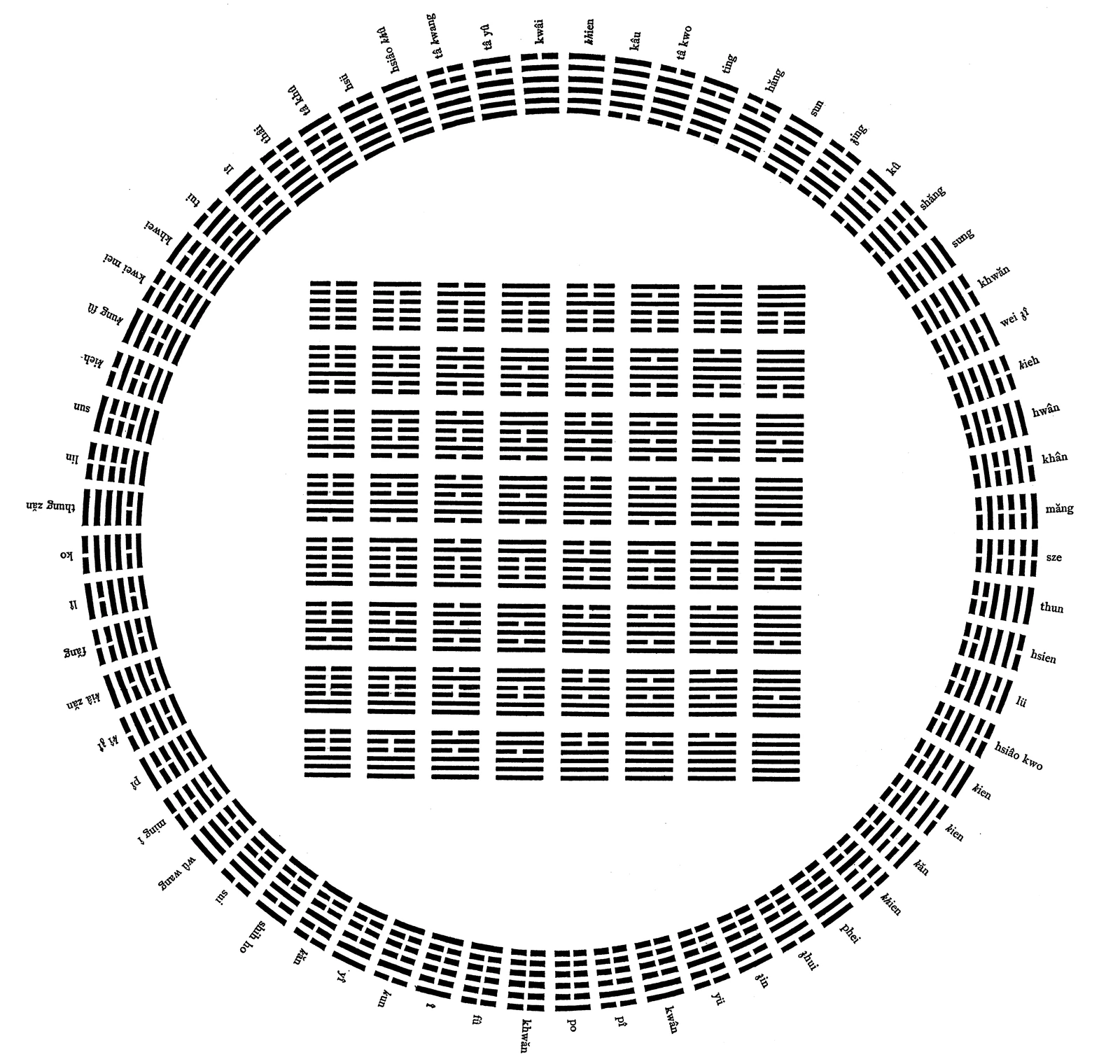
Legge’s Plate II, figure 1, presents the Fuxi arrangement twice, once as a square and once as a circle. For the King Wen numbers used in the lookup, open Plate I.
The Yî King, 1882. University of Michigan Library scan, via Wikimedia Commons. · Image source ↗ · Public Domain
Sources
See references (11)
- Plate I · The received sequence of 64 hexagrams ↗James Legge, The Yî King, Sacred Books of the East XVI. Oxford, Clarendon Press, 1882.Return to text ↑
- Appendix V · Treatise of Remarks on the Trigrams ↗James Legge, The Yî King, Sacred Books of the East XVI. Oxford, Clarendon Press, 1882.Return to text ↑
- Introduction, Chapter I · The early history and attribution of the Yî ↗James Legge, The Yî King, Sacred Books of the East XVI. Oxford, Clarendon Press, 1882.Return to text ↑
- Zhouyi 周易 · The Chinese text and received chapter titles ↗Classical Chinese text, Chinese Wikisource.Return to text ↑
- Xici I · Pairing the trigrams and forming the figures ↗Chinese Text Project, classical text with James Legge’s English translation.Return to text ↑
- Plate II, figure 1 · Square and circular arrangements attributed to Fuxi ↗University of Michigan Library scan, via Wikimedia Commons. Public Domain Mark 1.0.Return to text ↑
- Hexagram 1 · Qián · First and top line texts ↗James Legge, The Yî King, Sacred Books of the East XVI. Oxford, Clarendon Press, 1882.Return to text ↑
- Hexagram 11 · Tài · Judgment and line statements ↗James Legge, The Yî King, Sacred Books of the East XVI. Oxford, Clarendon Press, 1882.Return to text ↑
- Hexagram 12 · Pǐ · Judgment and line statements ↗James Legge, The Yî King, Sacred Books of the East XVI. Oxford, Clarendon Press, 1882.Return to text ↑
- Hexagram 63 · Jì Jì · After Completion ↗James Legge, The Yî King, Sacred Books of the East XVI. Oxford, Clarendon Press, 1882.Return to text ↑
- Hexagram 64 · Wèi Jì · Before Completion ↗James Legge, The Yî King, Sacred Books of the East XVI. Oxford, Clarendon Press, 1882.Return to text ↑