The Hour of the Ox
The Hour of the Ox follows midnight in traditional Japanese timekeeping. Learn why its length varied and how Hearn uses it in two ghost stories.
In this article
When was the Hour of the Ox?
The Hour of the Ox came after the Hour of the Rat, which marked midnight in traditional Japanese timekeeping. The same system counted hours downwards, starting at nine for the Rat and eight for the Ox. The modern clock equivalent varied with the season. [3][4][1][5][6]
Seasonal hours in the Seiko Museum’s account
The Seiko Museum Ginza describes how daylight and darkness were each divided into six units, so a summer night’s unit was shorter than a winter night’s. Some clocks accommodated these changes by varying their speed or the spacing on their dials. [1]
In Ghostly Japan by Lafcadio Hearn
In A Passional Karma, Lafcadio Hearn has a bell at Dentsū-in sound the eighth hour just before Shinzaburō hears approaching clogs. The women who have been visiting him return to find sacred writing barring the entrance. Hearn’s note identifies the hour as the Hour of the Ox and places the bell at two in the morning. [5][3]
In Ingwa-banashi, Yukiko suffers nightly from the Hour of the Ox until the Hour of the Tiger. Hearn’s footnote gives the interval from 2 to 4 a.m. In one story the bell announces a return. In the other, the interval gives a haunting a regular beginning and end. [4][6][5][3]
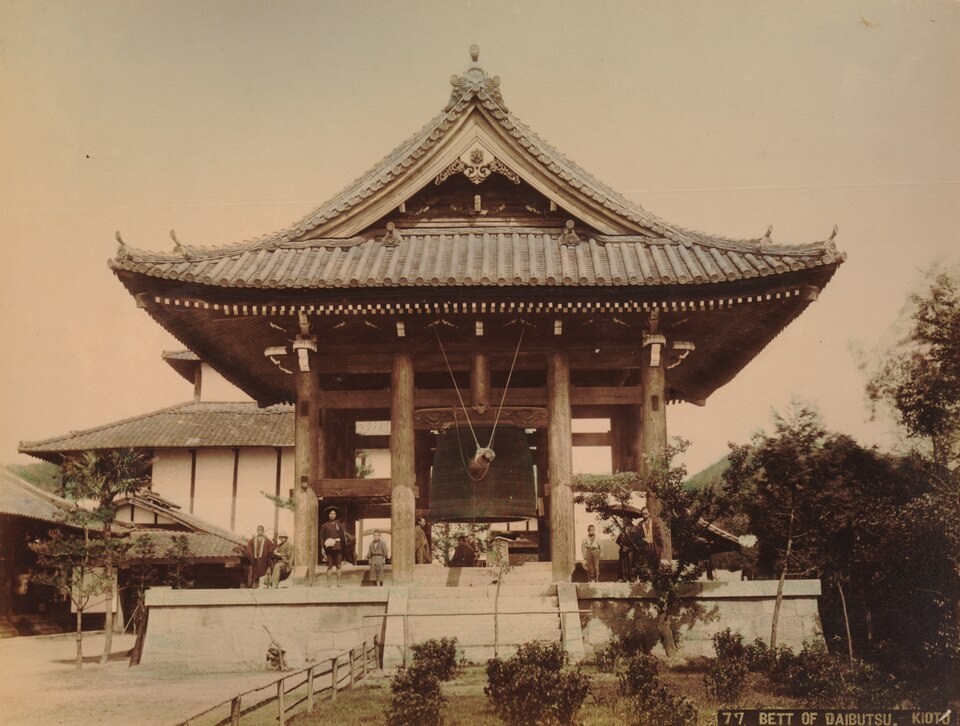
Kusakabe Kimbei photographed this temple bell in Kyoto around 1890. Hearn’s story names the bell at Dentsū-in in Tokyo.
Kusakabe Kimbei, circa 1890, KITLV 110662, via Wikimedia Commons. Public domain; resized and converted to JPEG. · Image source ↗ · Public Domain
A familiar bell makes the return uncanny
Hearn’s fixed hours help his readers follow the stories. In seasonal time, the interval could stretch or shrink. For Shinzaburō, the moment is recognisable by ear: the familiar bell is followed by the sound of approaching clogs. [5][4][1][3]
Read further in the library

In Ghostly Japan
Reading note
The separately titled account draws on exact passages in the consulted Library edition.
Sources
See references (6)
- The Seiko Museum Ginza: Seasonal Time System ↗The museum’s own account of Edo-period seasonal hours, zodiac names and counting, directly read. Its explanation is distinguished from Hearn’s fixed modern-hour glosses.Return to text ↑
- Kusakabe Kimbei, Bell of Daibutsu in Kyoto, circa 1890 ↗Kusakabe Kimbei, circa 1890, KITLV 110662, via Wikimedia Commons. Public domain; resized and converted to JPEG.
- In Ghostly Japan, Reader page 99Lafcadio Hearn, In Ghostly Japan, Little, Brown, and Company, Boston, 1899. Exact consulted Library edition IMJ-0654-E001, with title page visually checked. Persistent PageIDs and current Reader positions are verified from the supplied edition. Embedded stories, translations and quotations are attributed to Hearn’s presentation unless an original source has separately been consulted.Read this page in In Ghostly Japan ↗Return to text ↑
- In Ghostly Japan, Reader page 201Lafcadio Hearn, In Ghostly Japan, Little, Brown, and Company, Boston, 1899. Exact consulted Library edition IMJ-0654-E001, with title page visually checked. Persistent PageIDs and current Reader positions are verified from the supplied edition. Embedded stories, translations and quotations are attributed to Hearn’s presentation unless an original source has separately been consulted.Read this page in In Ghostly Japan ↗Return to text ↑
- In Ghostly Japan, Reader page 98Lafcadio Hearn, In Ghostly Japan, Little, Brown, and Company, Boston, 1899. Exact consulted Library edition IMJ-0654-E001, with title page visually checked. Persistent PageIDs and current Reader positions are verified from the supplied edition. Embedded stories, translations and quotations are attributed to Hearn’s presentation unless an original source has separately been consulted.Read this page in In Ghostly Japan ↗Return to text ↑
- In Ghostly Japan, Reader page 202Lafcadio Hearn, In Ghostly Japan, Little, Brown, and Company, Boston, 1899. Exact consulted Library edition IMJ-0654-E001, with title page visually checked. Persistent PageIDs and current Reader positions are verified from the supplied edition. Embedded stories, translations and quotations are attributed to Hearn’s presentation unless an original source has separately been consulted.Read this page in In Ghostly Japan ↗Return to text ↑