Hine-nui-te-pō and Māui
Hine-nui-te-pō is the Māori ancestress who receives the dead. Read Rawinia Higgins’s account of her descent to Rarohenga and Māui’s attempt to overcome death.
In this article
Understanding hine-nui-te-pō and māui
Hine-nui-te-pō is the Māori ancestress who receives the dead in Rarohenga. In Rawinia Higgins’s account she was known as Hine-tītama. She withdraws from the world of the living after discovering that Tāne, her husband, is also her father. [1]
Māui later tries to overcome death by reversing birth through her body. He dies in the attempt. In Higgins’s telling, the outcome makes room for Hine-nui-te-pō’s account of how people should mourn those who die. [2][3]
An ancestress who receives the dead
Higgins explains that Hine-nui-te-pō stays below to draw her descendants to her, while Tāne returns to raise them in the world of the living. Māui later becomes a mokomoko, or lizard, and enters her sleeping body. The watching tīrairaka, or fantails, laugh and wake her. She crushes him. [1]
Before the encounter, Māui asks that people be able to die and return as the moon does. Hine-nui-te-pō says human death should be permanent, with burial, greeting and mourning. Her words give the story a concern with how the living respond to the dead. [1]
The Encyclopaedia of Death and Life, Volume I, compiled by J. R. Francis
J. R. Francis reproduces Andrew Lang’s discussion of Māui as part of an argument about interpreting myths. Lang begins with an omitted ritual utterance, presents several explanations of the final undertaking and then describes the watching bird’s laughter waking Hine-nui-te-pō. Māui dies in the attempt. [2][3]
Lang’s chief disagreement is with Edward B. Tylor’s reading of the episode as a solar myth. He argues that the sun repeatedly returns, whereas Māui fails to return. Elsewhere Māui restrains the sun. For Lang these contrasts weaken the claim that the hero is simply the sun in narrative form. [2][3]
Lang brings in Greek and Christian comparisons to explain his reading. Higgins’s account preserves what those analogies can leave out: Hine-nui-te-pō already has a relationship with the people she receives below before Māui approaches her. [2][3][1]
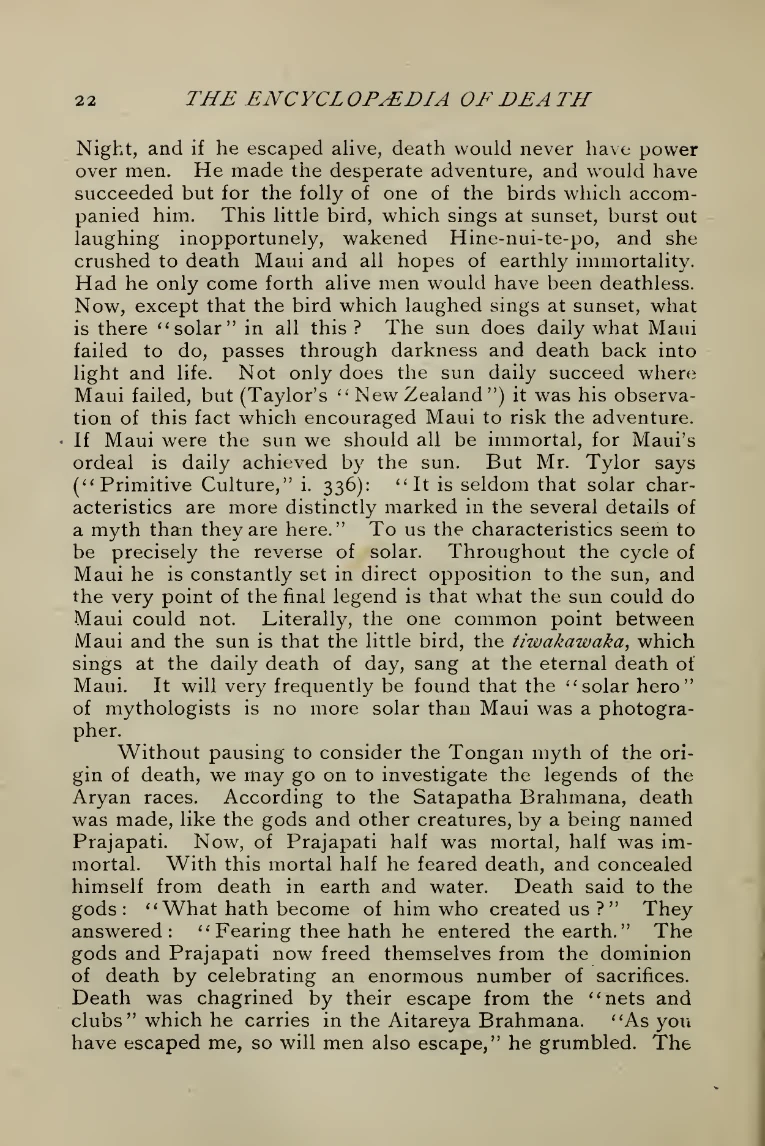
Source facsimile: The Encyclopaedia of Death and Life in the Spirit-World, Volume I (1903), printed p. 22, Reader page 21.
The Encyclopaedia of Death and Life in the Spirit-World, Volume I, fourth edition, 1903. Public-domain historical page extracted from the checksum-verified Library PDF. · Image source ↗ · Public Domain
Receiving the dead and mourning them
Lang asks whether Māui’s final attempt makes sense as a solar story. Higgins’s account puts the relationships at the centre: descendants go to an ancestress who has chosen to receive them, and the living mourn their departure. That gives Hine-nui-te-pō a role extending beyond Māui’s defeat. [2][3]
Read further in the library
The Encyclopaedia of Death and Life in the Spirit-World, Volume I
Reading note
The separately titled account draws on exact passages in the consulted Library edition.
Sources
See references (3)
- Rawinia Higgins: Tangihanga, mythological origins ↗Rawinia Higgins, Te Ara: The Encyclopedia of New Zealand, 14 May 2013, page 2. Māori cultural account. Used through concise paraphrase; photographs and extended text are not reproduced.Return to text ↑
- The Encyclopaedia of Death and Life in the Spirit-World, Volume I, printed p. 21, Reader page 20J. R. Francis (compiler), The Encyclopaedia of Death and Life in the Spirit-World, Volume I, fourth edition. The Progressive Thinker Publishing House, Chicago, 1903. Individual authors, communicators and quoted sources identified in each account.Read this page in The Encyclopaedia of Death and Life in the Spirit-World, Volume I ↗Return to text ↑
- The Encyclopaedia of Death and Life in the Spirit-World, Volume I, printed p. 22, Reader page 21J. R. Francis (compiler), The Encyclopaedia of Death and Life in the Spirit-World, Volume I, fourth edition. The Progressive Thinker Publishing House, Chicago, 1903. Individual authors, communicators and quoted sources identified in each account.Read this page in The Encyclopaedia of Death and Life in the Spirit-World, Volume I ↗Return to text ↑