Higher-Dimensional Projections
What does a projection preserve when drawing a higher-dimensional object? Compare Bragdon’s wireframe views, unfolded shapes, and intersections.
In this article
What stays visible in fewer dimensions
A projection maps an object into a space with fewer dimensions. A drawing can preserve which corners belong to an edge even when foreshortening changes the lengths and angles. Two different edges can also overlap in the image. [2][3][4][5][6]
A Primer of Higher Space by Claude Bragdon
On Plate 4 of A Primer of Higher Space, Claude Bragdon shows a cube as a net of six squares and as a projection. The net keeps the faces square and opens some joins. In the projection, the faces fit into one connected drawing and some squares appear as slanted quadrilaterals. He applies the same comparison to the cubical cells of the tesseract. [7][3]
A nested-cube projection makes one cube look smaller and sit inside the other. Bragdon explains that the position is a feature of the drawing. In the four-dimensional construction, the two cubes are separated along a fourth direction. [4][6]
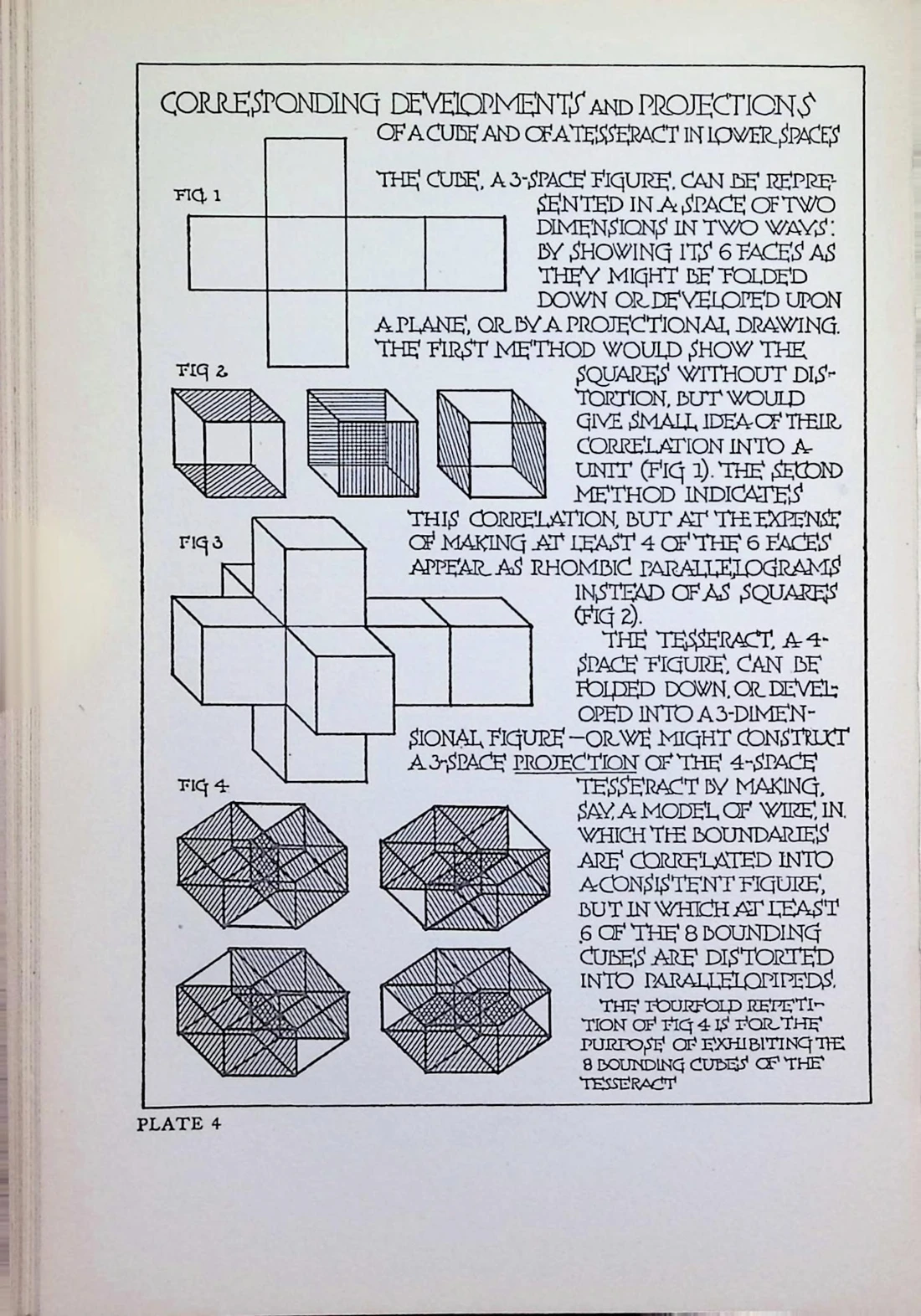
Plate 4 places unfolded shapes beside projected views. The unfolded faces keep their shapes, and the projected drawings show the joins.
Claude Bragdon, A Primer of Higher Space, The Manas Press, 1913. Stickley Museum scan via Internet Archive. · Image source ↗ · Public Domain
A net, a projection and a cross-section
A net opens the shape so its cells can be seen at their true size. A projection keeps their connections visible at the cost of possible distortion or overlap. A cross-section shows only the part that meets a slicing space. [7][3][4][8][9]
In the library
A Primer of Higher Space
Reading note
The separately titled account draws on exact passages in the consulted Library edition.
Sources
See references (9)
- Plate 4, unfolded boundaries and projections ↗Claude Bragdon, A Primer of Higher Space, The Manas Press, 1913. Stickley Museum scan via Internet Archive.
- A Primer of Higher Space, Plate 1, Reader page 30Claude Bragdon, A Primer of Higher Space (The Fourth Dimension), The Manas Press, Rochester, New York, 1913. Lumitheca Library edition IMJ-0599-E001.Read this page in A Primer of Higher Space ↗
- A Primer of Higher Space, Plate 4, Reader page 33Claude Bragdon, A Primer of Higher Space (The Fourth Dimension), The Manas Press, Rochester, New York, 1913. Lumitheca Library edition IMJ-0599-E001.Read this page in A Primer of Higher Space ↗
- A Primer of Higher Space, Plate 5, Reader page 34Claude Bragdon, A Primer of Higher Space (The Fourth Dimension), The Manas Press, Rochester, New York, 1913. Lumitheca Library edition IMJ-0599-E001.Read this page in A Primer of Higher Space ↗
- A Primer of Higher Space, Plate 12, Reader page 41Claude Bragdon, A Primer of Higher Space (The Fourth Dimension), The Manas Press, Rochester, New York, 1913. Lumitheca Library edition IMJ-0599-E001.Read this page in A Primer of Higher Space ↗
- A Primer of Higher Space, Plate 29, Reader page 58Claude Bragdon, A Primer of Higher Space (The Fourth Dimension), The Manas Press, Rochester, New York, 1913. Lumitheca Library edition IMJ-0599-E001.Read this page in A Primer of Higher Space ↗
- A Primer of Higher Space, Plate 3, Reader page 32Claude Bragdon, A Primer of Higher Space (The Fourth Dimension), The Manas Press, Rochester, New York, 1913. Lumitheca Library edition IMJ-0599-E001.Read this page in A Primer of Higher Space ↗
- A Primer of Higher Space, Plate 14, Reader page 43Claude Bragdon, A Primer of Higher Space (The Fourth Dimension), The Manas Press, Rochester, New York, 1913. Lumitheca Library edition IMJ-0599-E001.Read this page in A Primer of Higher Space ↗
- A Primer of Higher Space, Plate 30, Reader page 59Claude Bragdon, A Primer of Higher Space (The Fourth Dimension), The Manas Press, Rochester, New York, 1913. Lumitheca Library edition IMJ-0599-E001.Read this page in A Primer of Higher Space ↗