The High Fairies
The High Fairies are an order in J. S. M. Ward’s A Subaltern in Spirit Land. Their king describes compassion, service and a path to the spirit plane.
In this article
Understanding the high fairies
The High Fairies are a group in J. S. M. Ward’s A Subaltern in Spirit Land. Beyond ordinary Fairyland, Rex finds a city whose inhabitants are said to develop by helping human beings. [1][2]
The king explains how difficult that help was to learn. At first he wanted to relieve suffering, but did not understand the people he tried to help. The story makes understanding another kind of being part of becoming a High Fairy. [3][4][5]
See references (5)
A Subaltern in Spirit Land by J. S. M. Ward
J. S. M. Ward presents the visit through Rex and the children who guide him. A magician locates the High Fairies in the seventh astral division and says they have gained another road of development by helping humanity. Entry to their city is guarded and requires permission. [2][6][7]
Rex sees garments of changing colours and a palace whose shape stays the same as its appearance shifts. The details make the city different from the country he has already visited and give him an immediate sense that different rules apply there. [7][3]
The king says that becoming aware of suffering made his old life seem empty. In Ward’s Christian Spiritualist narrative, he witnesses the Crucifixion and discovers what it feels like to see another being in pain without being able to relieve it. [3][4]
The experience supposedly deepens his capacity for compassion. He returns to helping people, others follow, and some eventually pass to the spirit plane. The king still sees a possible need to experience death elsewhere. Ward’s narrative joins achievement with an unfinished future. [5]
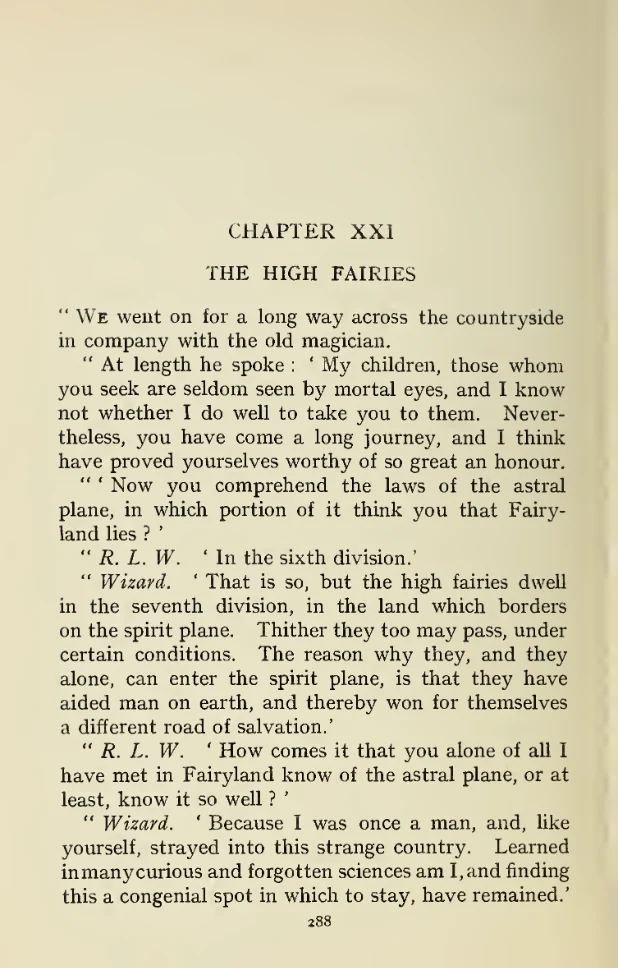
Source facsimile: A Subaltern in Spirit Land (1920), printed p. 288, Reader page 303.
J. S. M. Ward, A Subaltern in Spirit Land. William Rider & Son, 1920. Public-domain historical text and page image, extracted from the checksum-verified retained Library scan. · Image source ↗ · Public Domain
See references (6)
- A Subaltern in Spirit Land, printed p. 288, Reader page 303
- A Subaltern in Spirit Land, printed p. 291, Reader page 306
- A Subaltern in Spirit Land, printed p. 292, Reader page 307
- A Subaltern in Spirit Land, printed p. 293, Reader page 308
- A Subaltern in Spirit Land, printed p. 289, Reader page 304
- A Subaltern in Spirit Land, printed p. 290, Reader page 305
Gone West by J. S. M. Ward
Ward’s Gone West describes the monk Ambrose serving others before passing through the Wall of Fire. The passage makes assistance, companionship and further spiritual development part of one continuing history, while leaving much beyond the boundary unexplained. [9][10]
Service without an earthly human life
The king’s encounter belongs to Ward’s Christian Spiritualist story. It gives compassion a concrete beginning and offers another possibility beside Rex’s idea that fairies develop by entering earthly bodies. The court’s lights and titles show its difference to the visitor, while what the king learns explains that difference. [4][5][8][2]
In Gone West, Ambrose has already lived as a human when service brings him to the Wall of Fire. In the sequel, the king says that helping humanity lets some High Fairies reach the spirit plane by another route. Ward gives service a role in both journeys, while leaving their later stages open. [9][10][2][3][4][5]
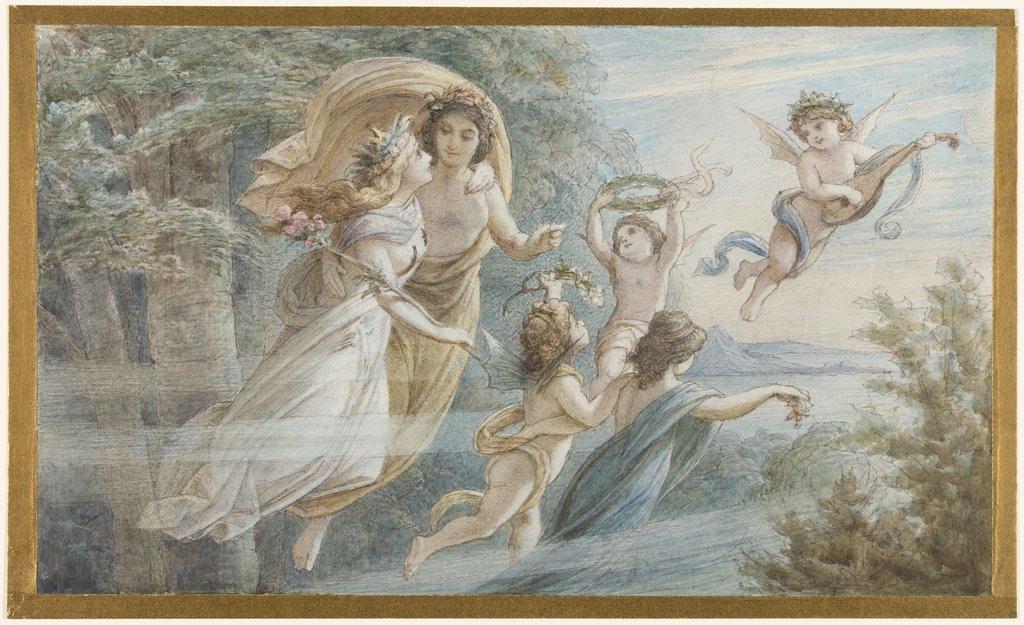
Leopold von Bode, Floating royal couple Oberon and Titania, about 1883. A Shakespearean picture of fairy royalty.
Städel Museum, Frankfurt am Main. Inventory 1834F. Public Domain. · Image source ↗ · Public Domain
See references (7)
- A Subaltern in Spirit Land, printed p. 288, Reader page 303
- A Subaltern in Spirit Land, printed p. 291, Reader page 306
- A Subaltern in Spirit Land, printed p. 292, Reader page 307
- A Subaltern in Spirit Land, printed p. 293, Reader page 308
- A Subaltern in Spirit Land, printed p. 260, Reader page 275
- Gone West, printed p. v, Reader page 9
- Gone West, printed p. vi, Reader page 10
Read further in the library
A Subaltern in Spirit Land: A Sequel to Gone West
Reading note
The separately titled account draws on exact passages in the consulted Library edition.
Gone West
Reading note
Separately attributed comparison with exact previously researched Library passages.
Sources
See references (11)
- A Subaltern in Spirit Land, printed p. 280, Reader page 295J. S. M. Ward, A Subaltern in Spirit Land: A Sequel to Gone West. William Rider & Son, London, 1920. Narrated experiences and explanations are attributed to Ward and his reported spirit contributors, especially his brother Rex (R. L. W.) and H. J. L.Read this page in A Subaltern in Spirit Land: A Sequel to Gone West ↗Return to text ↑
- A Subaltern in Spirit Land, printed p. 288, Reader page 303J. S. M. Ward, A Subaltern in Spirit Land: A Sequel to Gone West. William Rider & Son, London, 1920. Narrated experiences and explanations are attributed to Ward and his reported spirit contributors, especially his brother Rex (R. L. W.) and H. J. L.Read this page in A Subaltern in Spirit Land: A Sequel to Gone West ↗Return to text ↑
- A Subaltern in Spirit Land, printed p. 291, Reader page 306J. S. M. Ward, A Subaltern in Spirit Land: A Sequel to Gone West. William Rider & Son, London, 1920. Narrated experiences and explanations are attributed to Ward and his reported spirit contributors, especially his brother Rex (R. L. W.) and H. J. L.Read this page in A Subaltern in Spirit Land: A Sequel to Gone West ↗Return to text ↑
- A Subaltern in Spirit Land, printed p. 292, Reader page 307J. S. M. Ward, A Subaltern in Spirit Land: A Sequel to Gone West. William Rider & Son, London, 1920. Narrated experiences and explanations are attributed to Ward and his reported spirit contributors, especially his brother Rex (R. L. W.) and H. J. L.Read this page in A Subaltern in Spirit Land: A Sequel to Gone West ↗Return to text ↑
- A Subaltern in Spirit Land, printed p. 293, Reader page 308J. S. M. Ward, A Subaltern in Spirit Land: A Sequel to Gone West. William Rider & Son, London, 1920. Narrated experiences and explanations are attributed to Ward and his reported spirit contributors, especially his brother Rex (R. L. W.) and H. J. L.Read this page in A Subaltern in Spirit Land: A Sequel to Gone West ↗Return to text ↑
- A Subaltern in Spirit Land, printed p. 289, Reader page 304J. S. M. Ward, A Subaltern in Spirit Land: A Sequel to Gone West. William Rider & Son, London, 1920. Narrated experiences and explanations are attributed to Ward and his reported spirit contributors, especially his brother Rex (R. L. W.) and H. J. L.Read this page in A Subaltern in Spirit Land: A Sequel to Gone West ↗Return to text ↑
- A Subaltern in Spirit Land, printed p. 290, Reader page 305J. S. M. Ward, A Subaltern in Spirit Land: A Sequel to Gone West. William Rider & Son, London, 1920. Narrated experiences and explanations are attributed to Ward and his reported spirit contributors, especially his brother Rex (R. L. W.) and H. J. L.Read this page in A Subaltern in Spirit Land: A Sequel to Gone West ↗Return to text ↑
- A Subaltern in Spirit Land, printed p. 260, Reader page 275J. S. M. Ward, A Subaltern in Spirit Land: A Sequel to Gone West. William Rider & Son, London, 1920. Narrated experiences and explanations are attributed to Ward and his reported spirit contributors, especially his brother Rex (R. L. W.) and H. J. L.Read this page in A Subaltern in Spirit Land: A Sequel to Gone West ↗Return to text ↑
- Gone West, printed p. v, Reader page 9J. S. M. Ward, Gone West: Three Narratives of After-Death Experiences, third impression, William Rider & Son, London, 1920, as reproduced in Geoff Cutler’s December 2009 digital transcription. Ward’s introduction is distinct from the supplied 1974 foreword.Read this page in Gone West ↗Return to text ↑
- Gone West, printed p. vi, Reader page 10J. S. M. Ward, Gone West: Three Narratives of After-Death Experiences, third impression, William Rider & Son, London, 1920, as reproduced in Geoff Cutler’s December 2009 digital transcription. Ward’s introduction is distinct from the supplied 1974 foreword.Read this page in Gone West ↗Return to text ↑
- Floating royal couple Oberon and Titania, accompanied by more elves ↗Städel Museum, Frankfurt am Main. Inventory 1834F. Public Domain.