Hārītī, the Buddhist Protector of Children
Who is Hārītī? Read how the Buddha turns a child-taking yakṣiṇī into a protector of children, and see an early Gandhāran image of her nursing.
In this article
Who is Hārītī?
Hārītī is a Buddhist protector of children. In the story of her conversion, she begins as a yakṣiṇī, a female spirit who preys on children. When one of her own children disappears, she experiences the distress of the families she has harmed. [1][2][3][5]
The Gods of Northern Buddhism by Alice Getty
Alice Getty attributes her version to the Saṃyuktavastu. The Buddha hides Hārītī’s youngest son, Priyaṅkara, under his alms bowl. She searches for him and finally asks the Buddha for help. He asks her to keep his precepts and guarantee the safety of the people of Rājagṛha. [1][2]
The story then turns to food. Hārītī asks how she will feed her children after giving up her prey, and the Buddha tells the monks to share their meals with her household. Getty also describes images of her feeding a child at the breast or carrying one at her hip. [2][3]
Hārītī in The Sūtra of the Sublime Golden Light
In Peter Alan Roberts’s translation of the Sūtra of the Sublime Golden Light, Hārītī appears alongside Sarasvatī and other powerful beings. They are said to guard people who listen to the sūtra. Getty tells how Hārītī agrees to keep a city safe. The sūtra gives her a place among protectors of those who receive a teaching. [4][2]
A nursing image from Gandhāra
The Met identifies the figure in this Gandhāran rondel as Hārītī nursing a child. Its carving style is comparable to first-century finds at Sirkap, near Taxila. The rounded frame draws attention to the contact between mother and child, one of the poses Getty describes. [5][3]
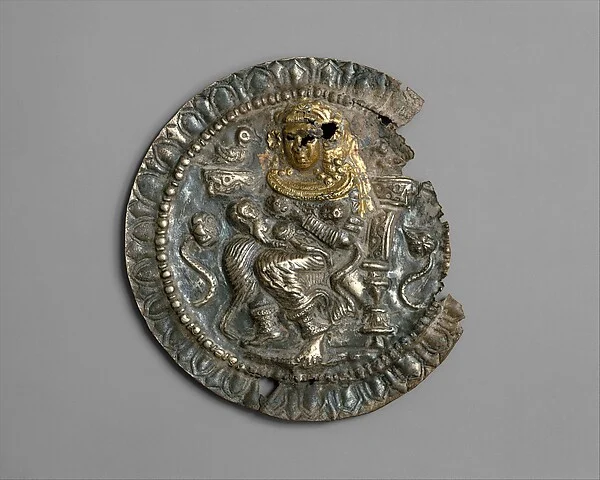
A Gandhāran silver rondel depicting Hārītī nursing a child, circa first century.
The Metropolitan Museum of Art. Gandhāra, circa first century. Gift of Steven Kossak, The Kronos Collections, 1981. Accession 1981.460.2. · Image source ↗ · CC0
In the library
The Gods of Northern Buddhism
Reading note
Read Alice Getty’s illustrated discussion of Hārītī.
Sources
See references (5)
- The Gods of Northern Buddhism, printed p. 84, Reader page 134Alice Getty, The Gods of Northern Buddhism, 1928 revised second edition, Munshiram Manoharlal reprint. Lumitheca Library edition IMJ-0597-E001.Read this page in The Gods of Northern Buddhism ↗
- The Gods of Northern Buddhism, printed p. 85, Reader page 135Alice Getty, The Gods of Northern Buddhism, 1928 revised second edition, Munshiram Manoharlal reprint. Lumitheca Library edition IMJ-0597-E001.Read this page in The Gods of Northern Buddhism ↗
- The Gods of Northern Buddhism, printed p. 86, Reader page 136Alice Getty, The Gods of Northern Buddhism, 1928 revised second edition, Munshiram Manoharlal reprint. Lumitheca Library edition IMJ-0597-E001.Read this page in The Gods of Northern Buddhism ↗
- The Sūtra of the Sublime Golden Light (1), Toh 555, §§ 1.21–1.26 ↗The Sūtra of the Sublime Golden Light (1), Toh 555, §§ 1.21–1.26. Translation credit: Peter Alan Roberts and team. Published by 84000.
- Rondel with the Goddess Hariti ↗The Metropolitan Museum of Art. Gandhāra, circa first century. Gift of Steven Kossak, The Kronos Collections, 1981. Accession 1981.460.2.