Hakuja no Myōjin
Hakuja no Myōjin is the white serpent associated with the recovery of a stolen gold Kannon image in a tale recorded by Richard Gordon Smith.
In this article
Who is Hakuja no Myōjin?
Hakuja no Myōjin means White Serpent God in a Japanese tale recorded by Richard Gordon Smith. A white snake curls around a vase containing a stolen sacred image. When the image is recovered, the serpent comes to be honoured at a shrine. [2][3][4]
In Ancient Tales and Folk-lore of Japan
In The White Serpent God, Smith follows a gold image of Kannon after a theft and killing. The snake is found around the vase. When the vase breaks, the sacred image falls out and is eventually returned. The tale ends at a shrine to the dead snake near Mount Kodayama. [2][3][4][5]
What does the white snake protect?
Another story in Smith’s collection recovers a stolen Kannon when a diver looks for a lost pipe. The White Serpent God makes the snake central to the discovery. Iwakuni’s white-snake tradition gives the animal another protective role, linking it to rice storehouses and to Benzaiten. [2][3][4][5][6][7][8][1]
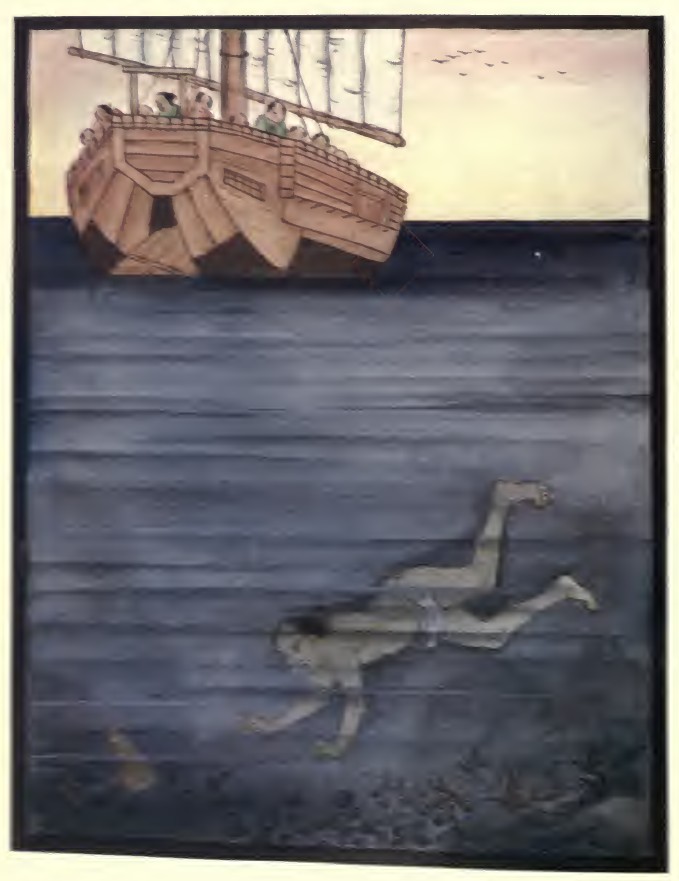
Mo-No-Yuki illustrates the rescue of a different Kannon figure in Smith’s collection. Iganosuke finds it underwater while looking for a pipe.
Mo-No-Yuki, after a sketch by Richard Gordon Smith, Iganosuke dives for the pipe and finds the idol, 1908. California Digital Library scan via Internet Archive. Public domain. · Image source ↗ · Public Domain
See references (8)
- Shirohebi Shrine (White Snake Shrine)
- Ancient Tales and Folklore of Japan, printed p. 336, Reader page 460
- Ancient Tales and Folklore of Japan, printed p. 338, Reader page 464
- Ancient Tales and Folklore of Japan, printed p. 339, Reader page 465
- Ancient Tales and Folklore of Japan, printed p. 340, Reader page 466
- Ancient Tales and Folklore of Japan, printed p. 144, Reader page 210
- Ancient Tales and Folklore of Japan, printed p. 148, Reader page 214
- Ancient Tales and Folklore of Japan, printed p. 149, Reader page 215
In the library
Ancient Tales and Folk-lore of Japan
Reading note
Read Richard Gordon Smith’s account in the verified 1908 Library edition.
Sources
See references (9)
- Shirohebi Shrine (White Snake Shrine) ↗Iwakuni tourism authority
- Ancient Tales and Folklore of Japan, printed p. 336, Reader page 460Richard Gordon Smith, Ancient Tales and Folklore of Japan. A. & C. Black, London, 1908. Lumitheca Library edition IMJ-0588-E001.Read this page in Ancient Tales and Folk-lore of Japan ↗
- Ancient Tales and Folklore of Japan, printed p. 338, Reader page 464Richard Gordon Smith, Ancient Tales and Folklore of Japan. A. & C. Black, London, 1908. Lumitheca Library edition IMJ-0588-E001.Read this page in Ancient Tales and Folk-lore of Japan ↗
- Ancient Tales and Folklore of Japan, printed p. 339, Reader page 465Richard Gordon Smith, Ancient Tales and Folklore of Japan. A. & C. Black, London, 1908. Lumitheca Library edition IMJ-0588-E001.Read this page in Ancient Tales and Folk-lore of Japan ↗
- Ancient Tales and Folklore of Japan, printed p. 340, Reader page 466Richard Gordon Smith, Ancient Tales and Folklore of Japan. A. & C. Black, London, 1908. Lumitheca Library edition IMJ-0588-E001.Read this page in Ancient Tales and Folk-lore of Japan ↗
- Ancient Tales and Folklore of Japan, printed p. 144, Reader page 210Richard Gordon Smith, Ancient Tales and Folklore of Japan. A. & C. Black, London, 1908. Lumitheca Library edition IMJ-0588-E001.Read this page in Ancient Tales and Folk-lore of Japan ↗
- Ancient Tales and Folklore of Japan, printed p. 148, Reader page 214Richard Gordon Smith, Ancient Tales and Folklore of Japan. A. & C. Black, London, 1908. Lumitheca Library edition IMJ-0588-E001.Read this page in Ancient Tales and Folk-lore of Japan ↗
- Ancient Tales and Folklore of Japan, printed p. 149, Reader page 215Richard Gordon Smith, Ancient Tales and Folklore of Japan. A. & C. Black, London, 1908. Lumitheca Library edition IMJ-0588-E001.Read this page in Ancient Tales and Folk-lore of Japan ↗
- Iganosuke dives for the pipe and finds the idol ↗Mo-No-Yuki, after a sketch by Richard Gordon Smith, Iganosuke dives for the pipe and finds the idol, 1908. California Digital Library scan via Internet Archive. Public domain.