The Three Gunas
Sattva, rajas and tamas are the three gunas, or qualities of nature. Read how the Bhagavad Gita describes each and how Vivekananda applies them to work.
In this article
Understanding the concept
The three gunas are sattva, rajas and tamas, qualities of nature in Hindu thought. They explain why understanding can become clear, desire can set action in motion and inertia can obscure what a person sees. [1][7]
The Bhagavad Gita describes the qualities taking turns predominating. Vivekananda uses their changing balance to ask why two people may both appear still when one is composed and the other unable to act. [5][7]
- Sattva
- Clarity and equilibrium. The Gita also identifies attachment to happiness and knowledge as a way it can bind.
- Rajas
- Activity and passion. The Gita relates its bondage to desire and attachment to action.
- Tamas
- Obscuration and inertia. The Gita describes negligence and sleep; Vivekananda emphasizes dullness and inactivity.
See references (6)
The Bhagavad Gita: three ways of becoming bound
In Bhagavad Gita 14.5, Krishna says the three qualities arise from prakriti, or nature. The following verses distinguish what each quality does and how it can bind a person. [1]
Verse 14.10 describes the qualities alternately prevailing. Verse 14.20 links going beyond them with release from birth, death and suffering. Together, the passages distinguish changes within nature from freedom beyond its binding qualities. [5][6]
Sattva, rajas and tamas
Karma-Yoga by Swami Vivekananda
Swami Vivekananda introduces the gunas at the beginning of the chapter “Each Is Great in His Own Place.” He attributes the account to Sankhya philosophy and describes sattva as equilibrium, rajas as activity, and tamas as inertness. Attraction and repulsion exemplify activity; dullness and inability to act exemplify tamas. [7]
Vivekananda asks why someone refrains from reacting. They may have the strength to act and choose restraint, or they may lack the capacity to respond. Similar conduct can arise from very different conditions. [7][8][9][10][11]
Later, the gunas help him distinguish silent contemplatives from public teachers. The highest sattvic figures in his account gather true thoughts without seeking a name, while more rajasic workers carry ideas into public life. This is a spiritual hierarchy within his teaching, including claims about the transmission of thought, rather than an established classification of historical influence. [12][13][14]
These passages create a useful tension with a superficial reading of the book as praise of constant busyness. Vivekananda urges most people to work, yet treats complete freedom from attachment as beyond the ordinary motives that impel work. The important distinction is therefore not the visible quantity of activity alone. [7][15][13][14][16]
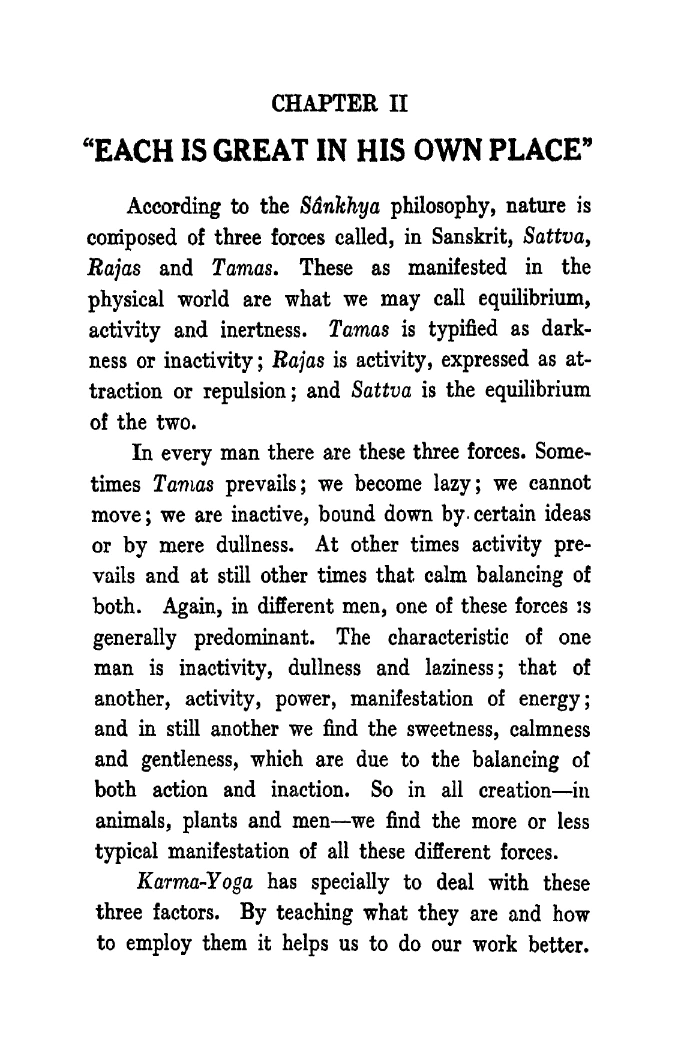
Karma-Yoga (1939), Library Reader page 16. Vivekananda introduces the gunas as equilibrium, activity and inertness.
Swami Vivekananda, Karma-Yoga, English second printing in the 1939 combined volume. Historical public-domain text, exact checksum-verified Library scan. · Image source ↗ · Public Domain
When clarity and stillness have different meanings
The Gita values clarity while allowing that a person may become attached to the happiness or knowledge it brings. Krishna’s account of liberation asks what it means to go beyond all three qualities. [2][6]
Vivekananda’s contrast turns on the reason a person seems inactive. The same outward stillness can conceal lethargy or express deliberate restraint. That is why the motive matters more in his example than the amount of visible movement. [7]
Read further in the library
Karma Yoga
Reading note
The separately titled account draws on exact passages in the consulted Library edition.
Sources
See references (16)
- Bhagavad Gita 14.5, translated by Swami Mukundananda ↗Bhagavad Gita 14.5, Sanskrit verse, word meanings and Swami Mukundananda’s separately identified English translation. The article distinguishes the verse from modern commentary.Return to text ↑
- Bhagavad Gita 14.6, translated by Swami Mukundananda ↗Bhagavad Gita 14.6, Sanskrit verse, word meanings and Swami Mukundananda’s separately identified English translation. The article distinguishes the verse from modern commentary.Return to text ↑
- Bhagavad Gita 14.7, translated by Swami Mukundananda ↗Bhagavad Gita 14.7, Sanskrit verse, word meanings and Swami Mukundananda’s separately identified English translation. The article distinguishes the verse from modern commentary.Return to text ↑
- Bhagavad Gita 14.8, translated by Swami Mukundananda ↗Bhagavad Gita 14.8, Sanskrit verse, word meanings and Swami Mukundananda’s separately identified English translation. The article distinguishes the verse from modern commentary.Return to text ↑
- Bhagavad Gita 14.10, translated by Swami Mukundananda ↗Bhagavad Gita 14.10, Sanskrit verse, word meanings and Swami Mukundananda’s separately identified English translation. The article distinguishes the verse from modern commentary.Return to text ↑
- Bhagavad Gita 14.20, translated by Swami Mukundananda ↗Bhagavad Gita 14.20, Sanskrit verse, word meanings and Swami Mukundananda’s separately identified English translation. The article distinguishes the verse from modern commentary.Return to text ↑
- Karma-Yoga, Reader page 16Swami Vivekananda, Karma-Yoga, in Karma-Yoga & Bhakti-Yoga, English second printing, Ramakrishna-Vivekananda Center of New York, Inc., 1939. Exact Library edition IMJ-0097-E002. Only the Karma-Yoga part is used in this crawl; the old Work slug mentioning Hindi does not identify this edition’s language.Read this page in Karma Yoga ↗Return to text ↑
- Karma-Yoga, Reader page 18Swami Vivekananda, Karma-Yoga, in Karma-Yoga & Bhakti-Yoga, English second printing, Ramakrishna-Vivekananda Center of New York, Inc., 1939. Exact Library edition IMJ-0097-E002. Only the Karma-Yoga part is used in this crawl; the old Work slug mentioning Hindi does not identify this edition’s language.Read this page in Karma Yoga ↗Return to text ↑
- Karma-Yoga, Reader page 19Swami Vivekananda, Karma-Yoga, in Karma-Yoga & Bhakti-Yoga, English second printing, Ramakrishna-Vivekananda Center of New York, Inc., 1939. Exact Library edition IMJ-0097-E002. Only the Karma-Yoga part is used in this crawl; the old Work slug mentioning Hindi does not identify this edition’s language.Read this page in Karma Yoga ↗Return to text ↑
- Karma-Yoga, Reader page 20Swami Vivekananda, Karma-Yoga, in Karma-Yoga & Bhakti-Yoga, English second printing, Ramakrishna-Vivekananda Center of New York, Inc., 1939. Exact Library edition IMJ-0097-E002. Only the Karma-Yoga part is used in this crawl; the old Work slug mentioning Hindi does not identify this edition’s language.Read this page in Karma Yoga ↗Return to text ↑
- Karma-Yoga, Reader page 21Swami Vivekananda, Karma-Yoga, in Karma-Yoga & Bhakti-Yoga, English second printing, Ramakrishna-Vivekananda Center of New York, Inc., 1939. Exact Library edition IMJ-0097-E002. Only the Karma-Yoga part is used in this crawl; the old Work slug mentioning Hindi does not identify this edition’s language.Read this page in Karma Yoga ↗Return to text ↑
- Karma-Yoga, Reader page 107Swami Vivekananda, Karma-Yoga, in Karma-Yoga & Bhakti-Yoga, English second printing, Ramakrishna-Vivekananda Center of New York, Inc., 1939. Exact Library edition IMJ-0097-E002. Only the Karma-Yoga part is used in this crawl; the old Work slug mentioning Hindi does not identify this edition’s language.Read this page in Karma Yoga ↗Return to text ↑
- Karma-Yoga, Reader page 108Swami Vivekananda, Karma-Yoga, in Karma-Yoga & Bhakti-Yoga, English second printing, Ramakrishna-Vivekananda Center of New York, Inc., 1939. Exact Library edition IMJ-0097-E002. Only the Karma-Yoga part is used in this crawl; the old Work slug mentioning Hindi does not identify this edition’s language.Read this page in Karma Yoga ↗Return to text ↑
- Karma-Yoga, Reader page 109Swami Vivekananda, Karma-Yoga, in Karma-Yoga & Bhakti-Yoga, English second printing, Ramakrishna-Vivekananda Center of New York, Inc., 1939. Exact Library edition IMJ-0097-E002. Only the Karma-Yoga part is used in this crawl; the old Work slug mentioning Hindi does not identify this edition’s language.Read this page in Karma Yoga ↗Return to text ↑
- Karma-Yoga, Reader page 99Swami Vivekananda, Karma-Yoga, in Karma-Yoga & Bhakti-Yoga, English second printing, Ramakrishna-Vivekananda Center of New York, Inc., 1939. Exact Library edition IMJ-0097-E002. Only the Karma-Yoga part is used in this crawl; the old Work slug mentioning Hindi does not identify this edition’s language.Read this page in Karma Yoga ↗Return to text ↑
- Karma-Yoga, Reader page 110Swami Vivekananda, Karma-Yoga, in Karma-Yoga & Bhakti-Yoga, English second printing, Ramakrishna-Vivekananda Center of New York, Inc., 1939. Exact Library edition IMJ-0097-E002. Only the Karma-Yoga part is used in this crawl; the old Work slug mentioning Hindi does not identify this edition’s language.Read this page in Karma Yoga ↗Return to text ↑