Alchemical Symbols Chart
Alchemical symbols are shorthand for substances, processes, apparatus and ideas found in historical chemical and alchemical writing. The seven planetary metals are a practical starting point. Gold is linked with the Sun, silver with the Moon, iron with Mars, copper with Venus, tin with Jupiter, lead with Saturn and quicksilver with Mercury.
Find a symbol by name or shape
The signs are typed reference forms. Compare them with the historical plate below.
25 results
The seven planetary metals
- GoldSun · Sol
- A circle with a central dot. In a list of metals, read it as gold.
- SilverMoon · Luna
- A crescent. Historical forms can open to either side.
- MercuryQuicksilver · Mercurius · Argentum vivum
- A crescent above a circle and cross. In a table of metals, the mark refers to quicksilver.
- CopperVenus
- A circle above a cross. Look for it among metal names or preparations of copper.
- IronMars
- A circle with an outward arrow. The direction and execution can vary.
- TinJupiter · Jove
- A curved form crossed by a stroke, often resembling a stylised numeral four.
- LeadSaturn
- A cross above a hooked or curved lower stroke.
Elements and principles
- FireIgnis
- An upward-pointing triangle.
- AirAer
- An upward-pointing triangle with a horizontal bar.
- WaterAqua
- A downward-pointing triangle.
- EarthTerra
- A downward-pointing triangle with a horizontal bar.
- SulfurSulphur · brimstone
- A triangle on a cross. Check whether the account describes a material or an alchemical principle.
- MercuryMercurius
- In a Paracelsian context this can name a principle as well as quicksilver in material descriptions.
- SaltSal
- A horizontally divided circle. Read in context, since salts and preparations can have separate signs.
Selected materials, operations and tools
- CinnabarCinnabaris
- A historical name for the red mercury sulfide mineral or its prepared equivalent.
- VitriolVitriolum
- A family of substances historically associated with various sulfate salts.
- NitreSal petrae
- Saltpetre. The spelling nitre appears in English texts.
- AmalgamAmalgama
- A combination involving mercury and another metal.
- DistillDistillare
- A process sign. Some sources use this form for sublimation as well.
- SublimationSublimare
- Compare the text with any vessel diagram and look for a deposit above the heated material.
- DissolveDissolvere
- A process sign referring to dissolution. Historical tables offer alternative shapes.
- PutrefactionPutrefactio
- A sign for a stage described as decay or decomposition.
- CrucibleTigillum
- A vessel sign. This chart shows one of several forms.
- AlembicDistilling head
- The head associated with distillation. Historical diagrams can clarify how it fits the vessel.
- RetortRetorta
- A vessel identified by its bent neck. The apparatus is distinct from the process sign for distilling.
What the Sun and Moon tell you about a passage
The dot in a circle can name gold in a list of metals, while a crescent can name silver. The same forms can signify the celestial bodies in an astronomical passage or describe a relationship between heaven and the materials of the laboratory. The sentence and its neighbouring signs are often a better guide than the sign on its own.
On a table that places the names Sol and Luna beside a run of metal names, the metallic reading is well supported. In a printed allegory, a crowned Sun or Moon can bring in associations that the metal list leaves aside. In a recipe, look for quantities, verbs and the other ingredients before deciding whether a symbol names a material or marks something about time.
Consider Venus and Mars. When those signs stand alongside lead, tin or quicksilver, copper and iron are the likely readings. The same sign on a calendar can keep its astronomical meaning. When citing your reading, record the author, page and words around the mark. This gives someone else a way to test that decision.
The four elements and the three principles
Fire and air point upwards. Water and earth point downwards. A crossbar distinguishes air from fire and earth from water in the familiar triangular set. These are four elements in a classical account of matter. The symbols for sulfur, mercury and salt can also refer to the Three Principles associated with Paracelsian writing.
That second group needs careful reading. A text can use the word sulfur for brimstone, speak of a philosopher’s sulfur or invoke sulfur as a principle in an account of bodies. The chart therefore puts ordinary substance names and the word principle in different contexts. It also keeps the glyph for elemental copper separate from the modern letters Cu.
When you find ☿ in a historical text, start by checking for a weight or a list of metals. Both support a reading as quicksilver. If the passage discusses how bodies are composed and names sulfur and salt beside mercury, a principle may be the better reading. Transcribe the glyph first and record your interpretation separately so another reader can compare the original.
Some names have broader meanings than their modern equivalents. Vitriol can refer to several historical preparations and classes of sulfate salts. If a manuscript specifies a colour, location, raw material or method, keep that qualifier with the transcription. It may carry more evidence than the general name.
Read the plate before assigning a meaning
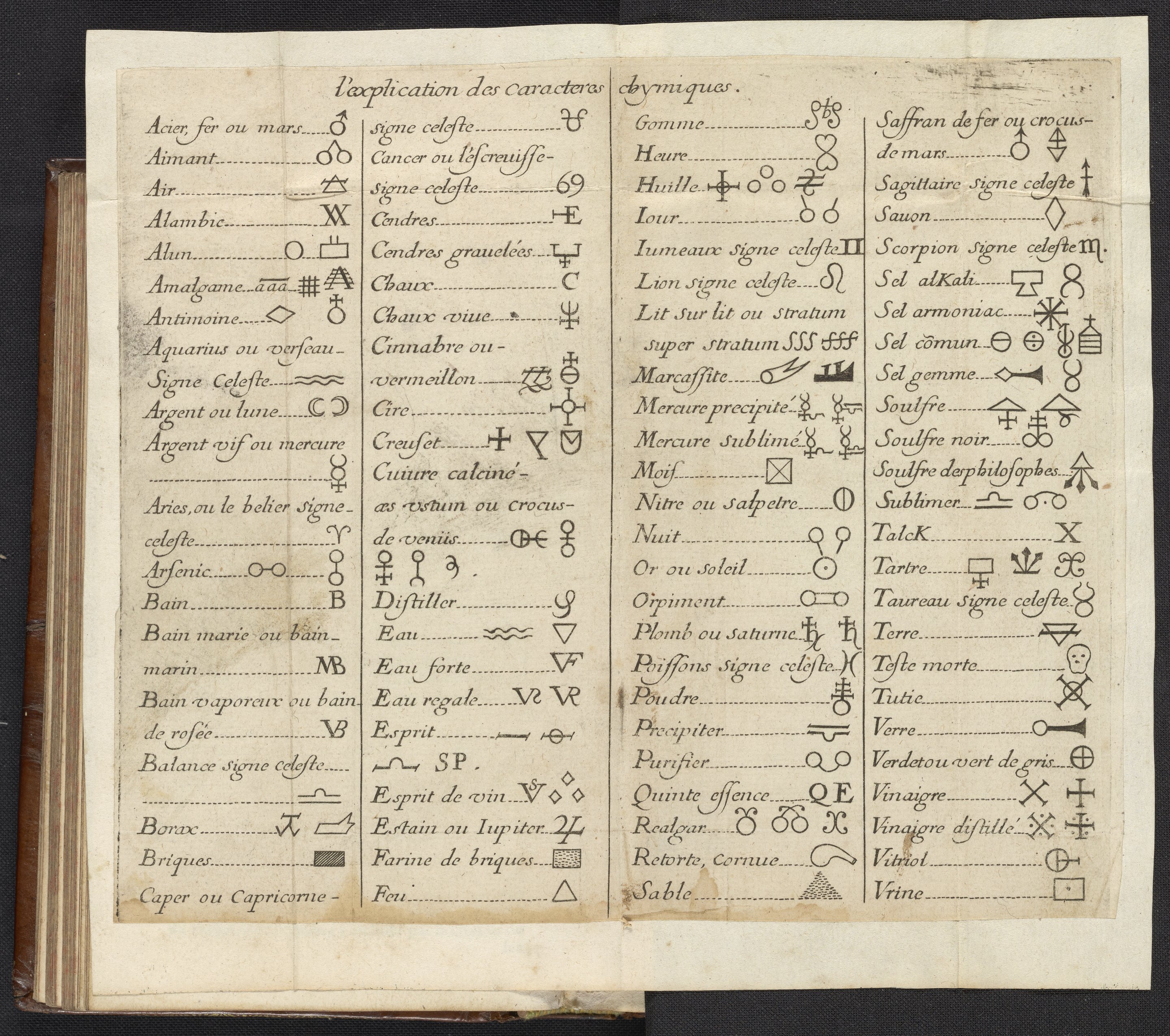
Nicaise Le Fèvre’s 1669 Traité de la Chymie places names beside crowded groups of signs. Those alternatives are a visible reminder that more than one mark could stand for the same substance. Conversely, the authors of the historical Unicode proposal document cases in which very similar forms were attached to different names across sources.
Start with the nearest printed label and check that it belongs to the mark you are reading. In a manuscript, look at repeated examples on nearby pages. Then ask whether the context expects a material such as cinnabar, an operation such as distillation or an object such as a crucible. That distinction can narrow the match even before the exact shape is clear.
Use the chart to copy a representative character into notes. Record a description of the actual stroke or attach the facsimile when it differs. Unicode enables readers to exchange a character reliably, but a font’s drawing cannot preserve every handwritten variation. The historical plate remains the reference when the variation itself matters.