Guan Yu
Guan Yu was a late Han warrior who became the god Guan Di. The Peach Garden oath tells of his loyalty, while a Qing painting shows him guarding a ritual gate.
In this article
Who is Guan Yu?
Guan Yu was a late Han warrior who died in 219 CE. Later generations worshipped him as Guan Di, or Emperor Guan. The Wanli emperor granted him that rank in the Ming period, and Qing rulers built shrines in his honour. [1][2][3]
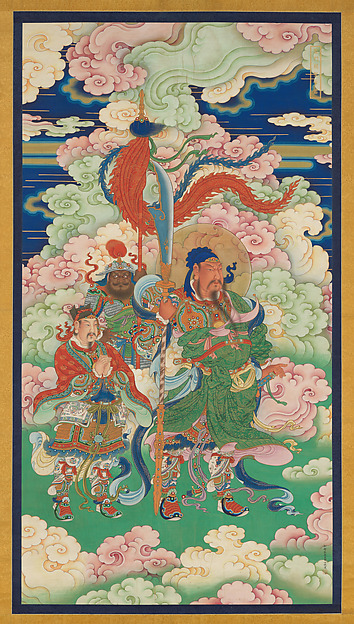
A Qing hanging scroll presents Emperor Guan as a gate guardian in a set of images for water-and-land rites.
Unidentified artist. Guan Yu. ca. 1700. The Metropolitan Museum of Art. Purchase, The B. Y. Lam Fund and Friends of Asian Art Gifts, in honor of Douglas Dillon, 2001. Public Domain. · Image source ↗ · Public Domain
In The Chinese Fairy Book
Richard Wilhelm’s The Chinese Fairy Book, translated by Frederick H. Martens, begins with a legendary oath. Guan Yu, Liu Bei and Zhang Fei meet in a peach orchard and swear loyalty as brothers. The tale gives Guan Yu a red face, a long beard and a horse named Red Hare. Its portrait of loyalty continues even after he is taken prisoner. [2][4]
After his death, Guan Yu appears to a monk and asks for his head back. The monk asks to whom the people Guan Yu killed should appeal for their lives. Guan Yu bows and disappears. The tale goes on to describe the titles and protective powers he acquires as a god. [4][3]
In another tale, his red halo harms the person who secretly watches his visit to the Celestial Master. Guan Yu himself makes way for Confucius. The episode imagines sacred authority as something a witness can see, with rank expressed through radiance. [5]
From oath brother to ritual guardian
In the Qing painting, Guan Yu descends with two attendants. Gold writing identifies him as the overseer of a gate. The painting belonged to a set used in water-and-land rites, giving the warrior a specific duty within a ritual setting. [1][2][3]
In the library
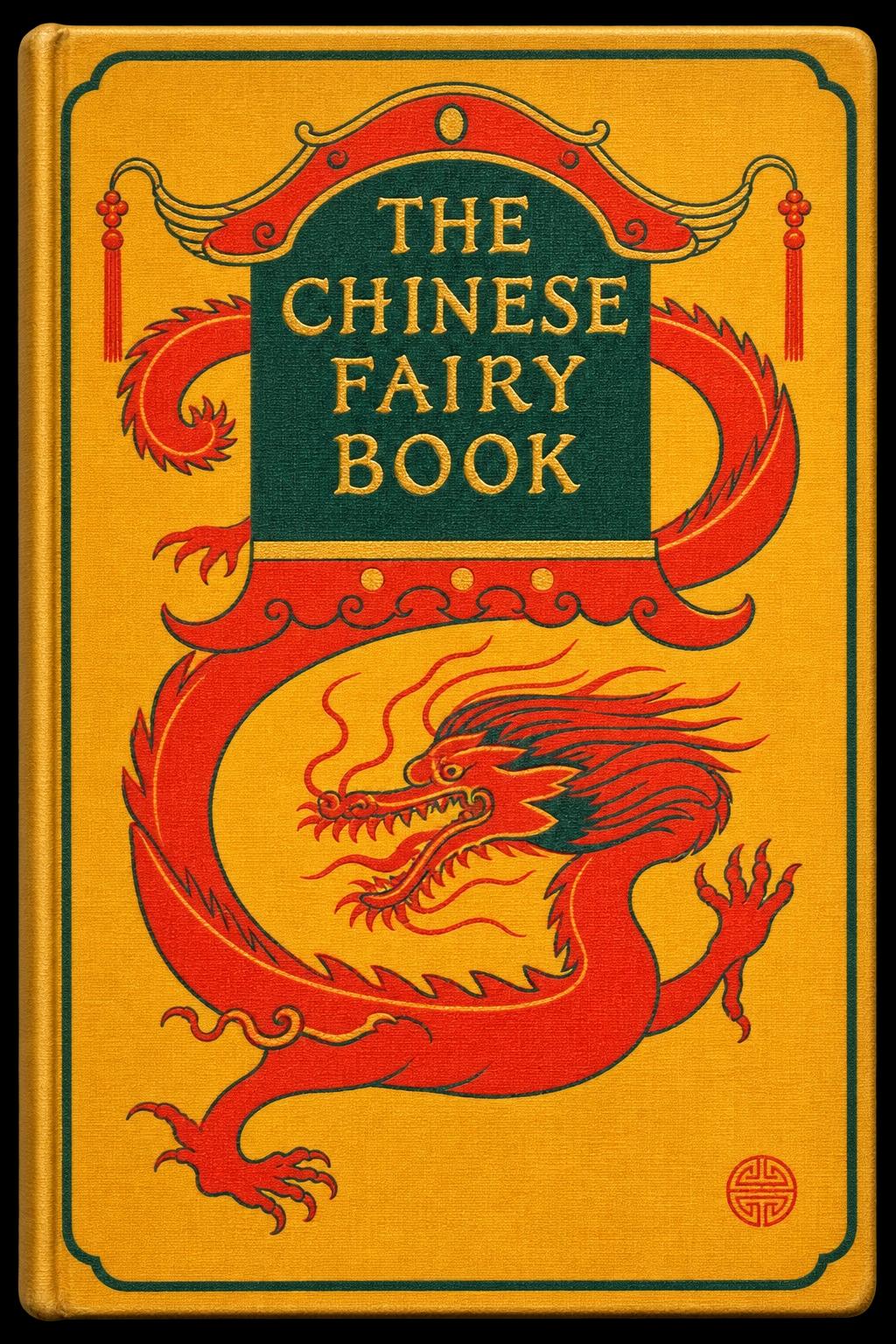
The Chinese Fairy Book
Reading note
Read the oath in the peach orchard and the monk’s encounter with Guan Yu after his death.
Sources
See references (5)
- Guan Yu ↗Unidentified artist. Guan Yu. ca. 1700. The Metropolitan Museum of Art. Purchase, The B. Y. Lam Fund and Friends of Asian Art Gifts, in honor of Douglas Dillon, 2001. Public Domain.
- The Chinese Fairy Book, Library Reader page 80Richard Wilhelm, editor. Frederick H. Martens, translator. The Chinese Fairy Book. Frederick A. Stokes Company, New York, 1921. Lumitheca Library edition IMJ-0478-E002.Read this page in The Chinese Fairy Book ↗
- The Chinese Fairy Book, Library Reader page 82Richard Wilhelm, editor. Frederick H. Martens, translator. The Chinese Fairy Book. Frederick A. Stokes Company, New York, 1921. Lumitheca Library edition IMJ-0478-E002.Read this page in The Chinese Fairy Book ↗
- The Chinese Fairy Book, Library Reader page 81Richard Wilhelm, editor. Frederick H. Martens, translator. The Chinese Fairy Book. Frederick A. Stokes Company, New York, 1921. Lumitheca Library edition IMJ-0478-E002.Read this page in The Chinese Fairy Book ↗
- The Chinese Fairy Book, Library Reader page 85Richard Wilhelm, editor. Frederick H. Martens, translator. The Chinese Fairy Book. Frederick A. Stokes Company, New York, 1921. Lumitheca Library edition IMJ-0478-E002.Read this page in The Chinese Fairy Book ↗