Contemplating growth and decay
Steiner’s growth and decay exercise pairs observation of flourishing and withering life. See how it differs from his later contemplation of a plant and its seed.
In this article
Understanding the concept
Growth and decay contemplation asks a person to look closely at life coming into flower or beginning to wither, then attend to the feelings each process evokes. Rudolf Steiner places the exercise in esoteric probation, the preparatory part of his spiritual training. [2][3][4][5]
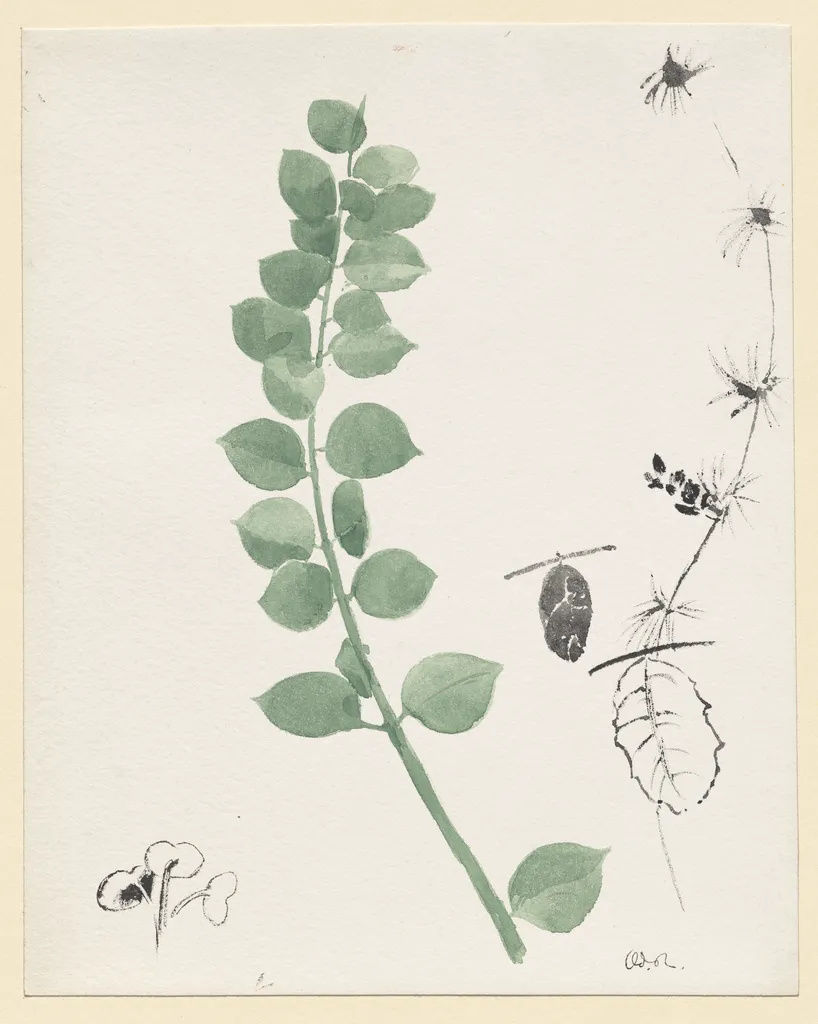
Odilon Redon, Study of Plants, ca. 1910. Fine ink marks and washes of green pick out details in the leaves and stem. Städel Museum.
Städel Museum, Frankfurt am Main, inventory 16328 Z. Public Domain. · Image source ↗ · Public Domain
Knowledge of the Higher Worlds by Rudolf Steiner
Rudolf Steiner begins with a familiar scene. Life is budding and withering all around the student, who usually passes from one impression to the next. He asks for careful sensory observation first, then for a quiet interval in which to attend to what the scene has set in motion inwardly. [3][4][6]
He compares the feeling of growth to sunrise and the feeling of decay to the rising moon. The two images convey the difference in feeling he thinks the student can learn to recognize. [4][5]
Steiner believes that sustained attention to those feelings can develop a capacity to perceive spiritual lines and figures. He imagines them taking different forms in a flower, an animal and a tree, with comparable forms perceived by similarly trained observers. He also treats artistic attention and reflection as preparation for this work. [4][5][6]
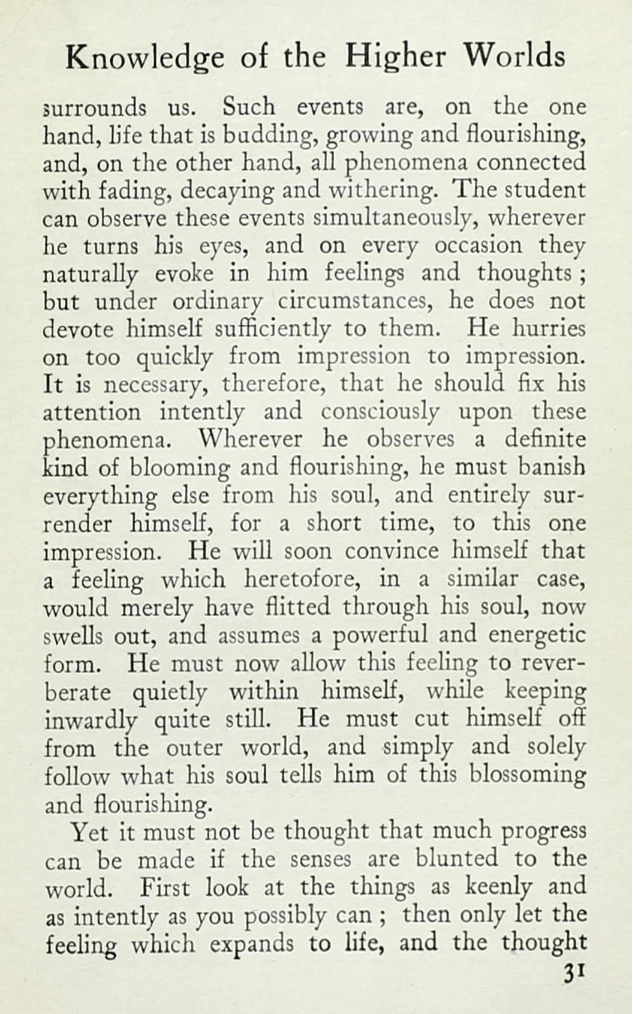
The instruction begins with budding and withering life in the student’s surroundings. Knowledge of the Higher Worlds, Library reader p. 35.
Rudolf Steiner, G. Metaxa translation, edited by Harry Collison. Historical public-domain source facsimile from the exact checksum-verified Library edition. Repository date 1932; the inspected title page is undated. · Image source ↗ · Public Domain
Watching a plant wither and thinking about its seed
The later seed exercise begins with a mature plant. The student imagines the plant gone and considers the future plant that can come from its seed. The earlier exercise attends to the feelings of growth and decline as they occur. The later one asks where the possibility of fresh growth lies when the existing plant disappears. Steiner reads both through his belief in a spiritual dimension of natural change. [3][4][7][8]
Read further in the library

Knowledge of the Higher Worlds and Its Attainment
Reading note
The separately titled account draws on exact passages in the consulted Library edition.
Sources
See references (8)
- Odilon Redon, Study of Plants, ca. 1910 ↗Städel Museum, Frankfurt am Main, inventory 16328 Z. Watercolour and black ink on wove paper, ca. 1910. Museum record identifies the picture as Public Domain.
- Knowledge of the Higher Worlds and Its Attainment, Reader page 34Rudolf Steiner, Knowledge of the Higher Worlds and Its Attainment, authorized English translation by G. Metaxa, edited by Harry Collison, Anthroposophic Press, New York City. Exact Library edition IMJ-0513-E001. No publication year is visible on the inspected title page; the repository assigns 1932. Claims of supersensible perception remain attributed to Steiner.Read this page in Knowledge of the Higher Worlds and Its Attainment ↗Return to text ↑
- Knowledge of the Higher Worlds and Its Attainment, Reader page 35Rudolf Steiner, Knowledge of the Higher Worlds and Its Attainment, authorized English translation by G. Metaxa, edited by Harry Collison, Anthroposophic Press, New York City. Exact Library edition IMJ-0513-E001. No publication year is visible on the inspected title page; the repository assigns 1932. Claims of supersensible perception remain attributed to Steiner.Read this page in Knowledge of the Higher Worlds and Its Attainment ↗Return to text ↑
- Knowledge of the Higher Worlds and Its Attainment, Reader page 36Rudolf Steiner, Knowledge of the Higher Worlds and Its Attainment, authorized English translation by G. Metaxa, edited by Harry Collison, Anthroposophic Press, New York City. Exact Library edition IMJ-0513-E001. No publication year is visible on the inspected title page; the repository assigns 1932. Claims of supersensible perception remain attributed to Steiner.Read this page in Knowledge of the Higher Worlds and Its Attainment ↗Return to text ↑
- Knowledge of the Higher Worlds and Its Attainment, Reader page 37Rudolf Steiner, Knowledge of the Higher Worlds and Its Attainment, authorized English translation by G. Metaxa, edited by Harry Collison, Anthroposophic Press, New York City. Exact Library edition IMJ-0513-E001. No publication year is visible on the inspected title page; the repository assigns 1932. Claims of supersensible perception remain attributed to Steiner.Read this page in Knowledge of the Higher Worlds and Its Attainment ↗Return to text ↑
- Knowledge of the Higher Worlds and Its Attainment, Reader page 38Rudolf Steiner, Knowledge of the Higher Worlds and Its Attainment, authorized English translation by G. Metaxa, edited by Harry Collison, Anthroposophic Press, New York City. Exact Library edition IMJ-0513-E001. No publication year is visible on the inspected title page; the repository assigns 1932. Claims of supersensible perception remain attributed to Steiner.Read this page in Knowledge of the Higher Worlds and Its Attainment ↗Return to text ↑
- Knowledge of the Higher Worlds and Its Attainment, Reader page 57Rudolf Steiner, Knowledge of the Higher Worlds and Its Attainment, authorized English translation by G. Metaxa, edited by Harry Collison, Anthroposophic Press, New York City. Exact Library edition IMJ-0513-E001. No publication year is visible on the inspected title page; the repository assigns 1932. Claims of supersensible perception remain attributed to Steiner.Read this page in Knowledge of the Higher Worlds and Its Attainment ↗Return to text ↑
- Knowledge of the Higher Worlds and Its Attainment, Reader page 58Rudolf Steiner, Knowledge of the Higher Worlds and Its Attainment, authorized English translation by G. Metaxa, edited by Harry Collison, Anthroposophic Press, New York City. Exact Library edition IMJ-0513-E001. No publication year is visible on the inspected title page; the repository assigns 1932. Claims of supersensible perception remain attributed to Steiner.Read this page in Knowledge of the Higher Worlds and Its Attainment ↗Return to text ↑